Balloon Sourcing Production Scalability Planning for United States Buyers
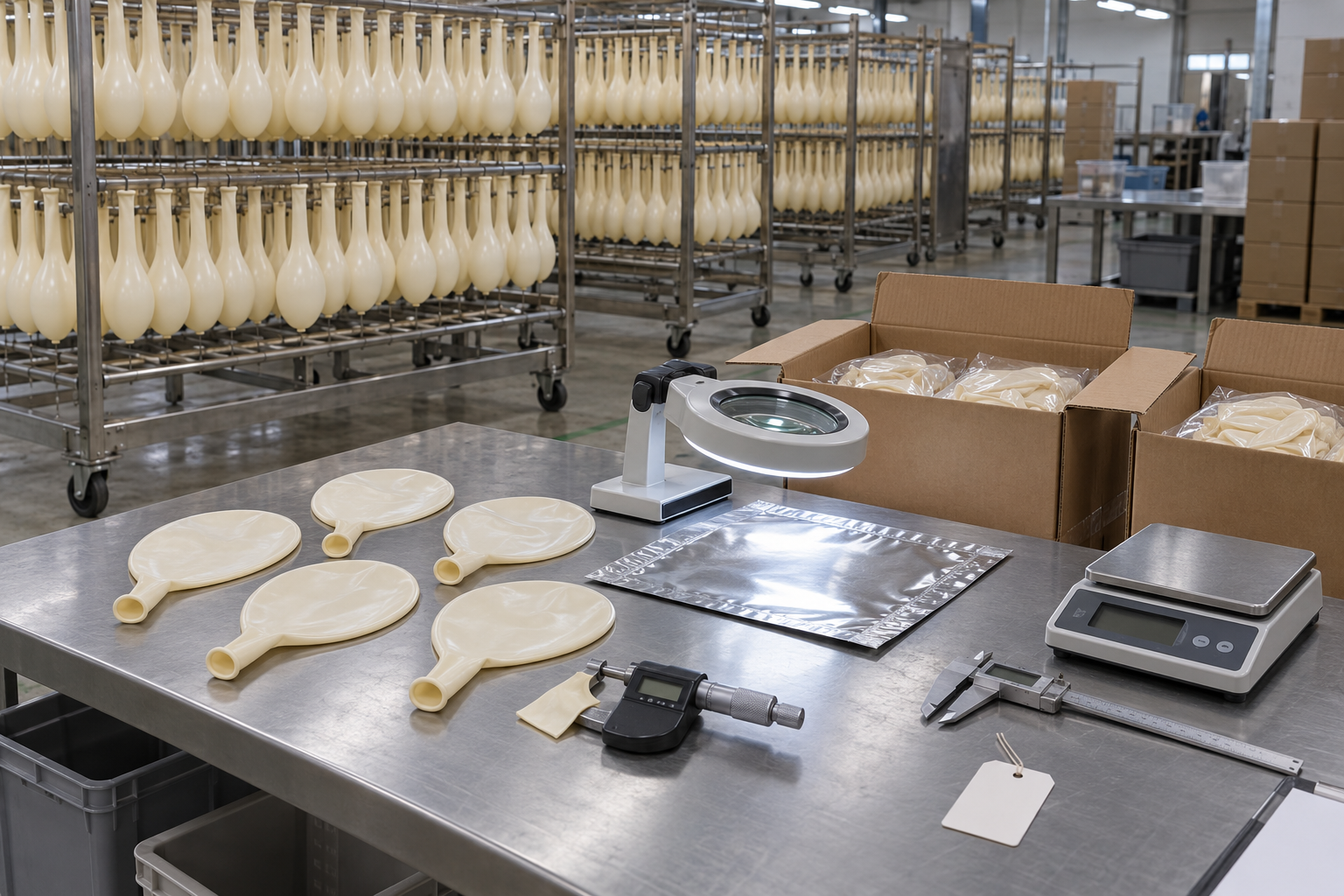
United States procurement teams should award balloon volume only after a supplier reserves SKU-level output, not after a plant publishes a large daily total. Balloon sourcing production scalability planning is the work of matching piece quantity, color or print mix, pack-out, and a United States delivery window to a rate the factory can repeat while wall thickness, seal quality, and required warnings stay inside the approved specification. The direct procurement answer is to separate the output the supplier states, the portion of that output reserved for this order, and the acceptance tests that do not loosen when quantity rises.
This page is a procurement briefing on balloons, including latex dipped balloons and foil balloons. It does not score factories, quote Joyline Party Supply prices, or claim a production trial. Figures below come from cited public pages. Each one is a benchmark to test in a request for quotation, not a Joyline measurement.
Vincent Xi, Editorial Author, prepared this briefing for Joyline Party Supply. Profile: https://joylinepartysupply.com/authors/vincent-xi/. The job title is Editorial Author. This article does not claim a factory visit, a personal production run, a client result, or a certification held by the author or by Joyline Party Supply.
How production scalability planning works for United States balloon orders
A scalable balloon order names the construction, the nominal size the United States channel will sell, the uninflated specification the factory will make, the decoration, the pieces per inner pack, the cartons in the shipment, and the week goods must be available. State the nominal inflated size in the specification. An example label, not a measured product, is a round latex balloon described in the trade as 12-inch. The supplier must restate the size on the quotation. A note that only says the factory is large does not show whether one printed color can run without stopping other work.
Latex and foil do not scale on the same step. A Bondun supply-chain article describes raw-material sourcing, latex dipping and vulcanization or foil sealing and printing, then quality control, packaging, and export. It says reliable manufacturers provide samples, consistent printing, bulk support, EN 71 and REACH documentation where those regimes apply, stable lead times, and a contingency for material prices and shipping delays (Bondun balloon supply-chain article). Those are described practices to request. They are not certificates of Joyline Party Supply, and they do not prove that a given line can absorb a surge.
A Sourcify China guide titled as a 2026 balloon-arch supplier guide tells procurement managers to decouple sourcing, require thickness at or above 260Q, require third-party tests, split MOQs written as 50k+ across suppliers, plan lead times of 30 to 45 days, and secure seasonal volume early in the fourth quarter, with ISO and EN 71 files (Sourcify China balloon-arch supplier guide). The 260Q floor, the 50k+ MOQ wording, and the 30 to 45 day lead are recommendations in that 2026-titled guide for the pattern it describes. They are not United States legal limits, not a measured port transit, and not Joyline Party Supply terms. This briefing does not convert Q into microns or mils. Confirm the MOQ unit on the quotation before reading 50k+ as pieces. The same guide places balloon making in Guangdong, including Shantou, and associates frames with Zhejiang. Frame capacity is not balloon capacity and should not be added into a balloon slot.
For a United States date, fix the in-distribution-center day first. Then require the supplier's own cycle to replace any published range. Early placement is a scheduling control, not a quality control.
Published capacity claims and what a buyer can safely calculate
Everts states on its production-capacity page that an automated facility in Melaka, Malaysia, produces over 5 million balloons daily, with latex dipping lines and in-house printing, and that it holds a 100 million piece warehouse. The same page states packing of 100,000 packs daily, EN 71-12 quality control, and full traceability for high-volume retail (Everts production-capacity page).
Treat those as page-stated claims. The excerpt used here gives no measurement date and no independent audit.
Over 5 million balloons per day is a daily piece-rate claim for that Melaka facility as Everts publishes it. The 100 million piece warehouse figure uses pieces as its unit and is the warehouse quantity Everts publishes; the page does not say whether it means storage capacity, on-hand stock, or a peak. The packing figure is 100,000 packs per day for that published operation. Pieces per pack are absent, so packs cannot be turned into balloons from the excerpt. EN 71-12 is a European toy-safety part on N-nitrosamines and N-nitrosatable substances. A sentence saying a facility uses EN 71-12 quality control is not a certificate, not a lot report, and not a United States compliance finding.
Example calculation, not a factory result, to verify and replace inside the supplier quote: assume a United States order of 1,200,000 pieces of one printed latex SKU. Using 5,000,000 balloons as a round stand-in for the published over 5 million daily claim, 1,200,000 divided by 5,000,000 equals 0.24 of one published plant-day. The order quantity, the rounded divisor, and the 0.24 result are assumptions. They do not reserve capacity. They ignore changeovers, shared lines, cure time, print setup, and output already sold. Do not multiply 100,000 packs per day by an assumed pack size. That conversion stays blocked until the quotation states pieces per pack.
A plant-wide total still helps as a scale check. It becomes an approval document only when the quotation names a reserved quantity, a line, and a week.
Specification trade-offs that appear when balloon volume increases
Thickness versus cycle time. The cited 260Q-and-above floor is a buyer recommendation from the 2026-titled Sourcify guide, not a law and not a Joyline specification. A faster latex dip can thin the wall if compound, coagulant, and dwell move. Lock a thickness unit, a method, and a sample size that applies to the production lot. Because the guide does not publish a Q-to-micron conversion, do not invent one in the purchase order.
Print and seal versus speed. Bondun separates latex dipping and vulcanization from foil sealing and printing, and it treats consistent printing as a sourcing expectation. A faster latex print can shift registration. A faster foil seal can change seal strength and valve position. Keep the sample acceptance limits as the mass-run limits. A looser grade at higher speed is a different product and needs a written concession before the United States shipment is approved.
Minimum quantity versus concentration. The Sourcify guide's 50k+ split-supplier recommendation can reduce a single-plant stoppage risk and can also multiply color drift and label versions. Compare one reserved slot with a split only when both options quote the same balloon specification, the same pack, and the same United States delivery window.
Material and freight movement versus a fixed retail date. Bondun identifies material-price and shipping-delay contingency as part of a reliable supply discussion. The purchase file should say who pays if latex or film moves, how much notice precedes a date change, and which ship mode is already priced. Do not insert ocean-day assumptions the cited pages did not measure for a United States discharge port.
Documents versus slogans. ISO, EN 71, EN 71-12, and REACH appear in the cited pages as expectations or as a plant quality-control description. None of those lines is a current certificate for Joyline Party Supply. EN 71 and REACH are European regimes. They do not replace United States labeling. Separate the standard's own requirement from a supplier sentence that says the plant complies.
Decision table for comparing scalable balloon sources
Use the table to specify, compare, verify, or approve. Evidence cells repeat cited claims; they are not Joyline test results.
| Decision | What to specify | Evidence to compare | United States approval gate |
|---|---|---|---|
| Reserved output versus plant total | Pieces per day and per week for the SKU, plus the reserved week | Everts publishes over 5 million balloons per day for its Melaka facility, with no measurement date in the excerpt used here | Approve a written reservation, not a plant slogan |
| Warehouse and pack-out | Pieces per pack, packs per carton, and whether the warehouse figure is capacity or stock | Everts publishes a 100 million piece warehouse and 100,000 packs per day, without pieces per pack | Do not convert packs into pieces until the pack quantity is quoted |
| Latex thickness at the production rate | Unit, method, and the supplier definition of Q if Q is used | The Sourcify guide recommends 260Q or above for the pattern it covers and gives no micron conversion | Reject a thinner lot unless a concession is signed |
| Foil seal and print at the same rate | Seal, valve, and registration tolerances at production speed | Bondun separates foil sealing and printing from latex dipping and expects consistent printing | Approve mass output only after a production-speed sample |
| MOQ and split sourcing | Minimum pieces per SKU and whether volume sits at one plant or several | The Sourcify guide recommends 50k+ MOQs split across suppliers; confirm the piece unit on the quote | Accept a split only if every site signs the same specification |
| Lead time against the United States window | Production days and the ship mode the date uses | That guide plans 30 to 45 days and early fourth-quarter placement; it is not a port transit study | Count backward from the United States in-DC date |
| Chemical-test file | Lab, method, report date, and lot link | Everts describes EN 71-12 quality control; Bondun cites EN 71 and REACH papers buyers should expect | File the report; do not file a web sentence as a certificate |
| Label and landed cost | Warning artwork, Incoterm, freight, and an open duty line | The cited pages do not state a United States duty rate or a carton cube | Release the order only after artwork approval and a recalculable cost sheet |
United States labeling, landed cost, and delivery controls
Capacity outside the United States does not settle the label or the landed cost.
Latex balloons packaged for consumers need the choking-hazard warning for balloons under the Federal Hazardous Substances Act rules at 16 CFR 1500.19. That warning, as published in the regulation, addresses children under 8 years and uninflated or broken balloons. Require artwork, check it against the current Code of Federal Regulations text when the order is placed, and apply it to the pack that will enter the United States. An EN 71 file does not substitute for that warning. This briefing is not legal advice.
Foil balloons are a different build. Do not assume the latex warning is automatically right or complete for foil, and do not ignore channel rules on metallic film. If the channel may treat the balloon as a children's product, the buyer should ask counsel whether children's-product tracking and third-party testing apply. The cited sources do not make that classification.
Keep landed cost additive. Ask for the unit price on a stated piece count, the Incoterm, carton size and gross weight once known, freight, any insurance, brokerage, and duty. This article states no duty rate and no Harmonized Tariff Schedule code, because the cited pages do not establish either one. A customs broker has to confirm both for the actual balloon.
Example calculation and assumption, to verify in the quotation and with the broker, not a market price: take the quoted balloon price P for whatever piece count the quote uses. If the broker confirms a duty rate R as a decimal, estimated duty for that same piece count is P multiplied by R. Add the quoted freight and brokerage afterward. If another plant can hold the same specification only by changing ship mode to meet the United States date, compare landed cost after that mode is priced.
Delivery scalability is a quantity on a date. Require the production site, the ship-from point, the piece count by SKU, and the notice period for a delay. Bondun's shipping-delay point is the question to ask. It is not a measured delay on a United States lane.
How the figures were derived, and what they do not prove
Methodology. Capacity, location, MOQ, lead-time, thickness, and process statements were taken from the Everts production-capacity page, the Bondun supply-chain article, and the Sourcify guide titled as a 2026 balloon-arch supplier guide. No figure was calculated from Joyline Party Supply production records. Any division of a plant total by an order quantity is labeled as an example. Standards are named to separate a requirement, or a claim on a cited page, from this company's practice.
Limitations. The Everts rates are self-published. In the excerpt used here they are undated, and they may mix products or describe a peak. The Sourcify guide states that China accounts for 70 to 80 percent of latex balloon production, with balloon making concentrated in Guangdong, including Shantou. That percent range is a share of latex balloon production as the guide states it, scoped to a page titled for 2026. The excerpt does not name a statistical office or an as-of month, so the range is not reproduced here as a customs fact. The guide's MOQ, Q-thickness, and 30 to 45 day points are recommendations for the pattern it discusses, including arch-related buying, and they need a fresh quote before they are applied to a different construction. EN 71-12, other EN 71 parts, ISO, and REACH are not claimed as current certifications of Joyline Party Supply. Pack rates cannot be reconciled to pieces until pieces per pack are known. United States warning text, children's-product status, tariff class, duty, and transit time must be checked at order time. If a quotation conflicts with a cited web page, the quotation and its attachments govern the purchase.
RFQ Checklist
- Ask the supplier to quote reserved pieces per day and pieces per week for each balloon SKU, separate from any plant-wide daily total.
- Require the manufacturer to name the production site, whether the line is latex dipping or foil sealing and printing, and the week the reserved quantity will run.
- Specify nominal balloon size, wall thickness unit, and test method, and require the manufacturer to define Q in writing if the quote uses a Q value.
- Ask the supplier to quote a single-source slot and a split-source option against the same specification, pack, and United States delivery window, with the minimum pieces per SKU stated.
- Require the manufacturer to attach the current third-party report for the proposed compound or film, including laboratory, method, report date, and lot link, and to label any EN 71-12 or REACH file as separate from United States labeling.
- Specify latex pack artwork that can be checked against the current balloon choking-hazard warning in 16 CFR 1500.19 before print approval for the United States shipment.
- Ask the supplier to state pieces per inner pack, packs per carton, carton dimensions, and gross weight before anyone reconciles a packs-per-day claim to pieces.
- Require the manufacturer to show unit price, Incoterm, freight, and a separate duty line so United States landed cost can be recalculated after the broker confirms the rate.
- Specify the United States in-DC or on-dock date, the ship mode that date assumes, and the delay notice period that keeps the slot acceptable.
- Verify that thickness, print, foil-seal, and visual-defect limits approved on the sample are the limits for the scaled lot, with no automatic relaxation as quantity increases.
- Ask the supplier to state who bears a latex or foil-film price move and whether any material change stops production until the buyer approves it.
Discuss Your Requirements
Review our manufacturing capabilities, then share your specifications for a supplier-fit review.