Paper Cup Wholesale Supplier Product Development Capability for Malaysia
Vincent Xi, Editorial Author, Joyline Party Supply. Profile: https://joylinepartysupply.com/authors/vincent-xi/
Malaysian packaging buyers evaluating a paper cup wholesale supplier product development capability must treat development as an itemized, auditable scope of work rather than a generic promotional claim. If no engineering dieline, internal barrier specification, or pre-press artwork exists, the RFQ must require the supplier to state explicitly whether it will engineer the base material, physical cup structure, barrier coating, and print layout. This development effort must be separated from subsequent wholesale production releases. Conversely, if a buyer already maintains production-ready vector dielines and validated barrier criteria, development reduces strictly to physical tooling verification and sign-off sampling. These two scenarios entail distinct lead times, cost structures, and commercial exposures for an import program into Malaysia.
Public manufacturer disclosures show wide operational variation across supplier development offerings. CupsPak states that its R&D team develops concepts across material, structure, coating, and artwork, supporting commercial buyers without finished artwork, with OEM and ODM programs requiring a non-disclosure agreement (NDA), pre-production sampling, and an MOQ starting from 20,000 pieces (CupsPak private-label page). The unit is individual pieces, scoped to CupsPak's private-label program; the excerpt is undated supplier marketing copy and does not represent a landed quote or delivery commitment for Malaysia.
Similarly, Van de Velde Packaging states in-house tooling capabilities, design support, material selection, and concept-to-production management, with personalized runs starting from 1,000 units using recyclable materials (Van de Velde paper cups). Sowinpak reports custom wholesale cup manufacturing across production plants in China and Vietnam, claiming 110,000 square metres of manufacturing capacity, a 35-day production lead time, compliance references to FSC, BRC, and FDA standards, and commercial supply to more than 2,000 global brands (Sowinpak paper cups). Each metric reflects an individual firm's self-reported corporate profile. None of the source excerpts carries an audit date, and none constitutes evidence of Joyline Party Supply operational practice, Malaysian statutory compliance, or port clearance protocols in Port Klang or Penang.
What product development capability covers in paper cup wholesale supply
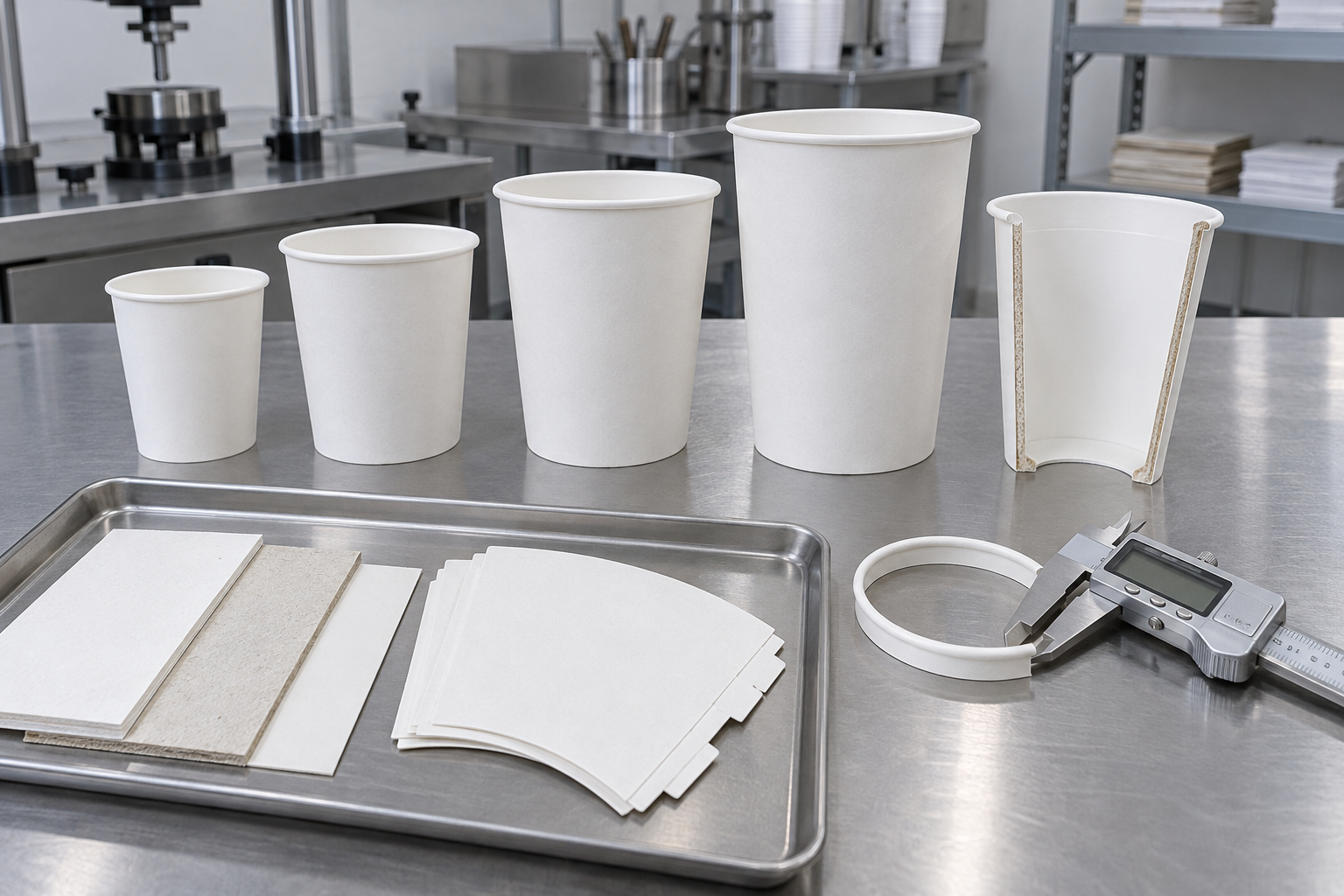
In paper cup wholesale supply, product development capability encompasses the complete series of technical parameters that must be finalized before repeat commercial production can begin at a stable unit price. A commercial buyer starting with only a beverage fill volume is procuring engineering consultation and tooling setup. A buyer supplying a verified dieline is procuring exact tool setup and visual conformance.
Development files must freeze the following technical parameters:
- Physical geometry: Target fill volume, total cup height, top rim curl diameter, wall taper angle, and bottom recess depth. Tooling must match these dimensions precisely; alterations require tool rework or new forming dies.
- Substrate and barrier coating: Base paperboard grammage (gsm) and the liquid barrier layer. CupsPak identifies coating selection as an R&D variable. The cited sources do not define a universal lining formulation suitable for ambient tropical conditions in Malaysia.
- Artwork prepress and legal ownership: Specification of which party executes mechanical dieline layout, prepress trapping, and file sign-off, alongside clear intellectual property terms. CupsPak references NDA execution as part of custom development, but buyers must verify the operative agreement.
- Sample sign-off gate: Clear definition of whether sampling involves unprinted blanks for mechanical check, fully printed mockups, or off-tool production runs, including agreed sample quantities.
- Wholesale commercial handoff: The minimum order threshold, carton packaging architecture, and physical acceptance criteria that govern production release after sample approval.
While CupsPak and Van de Velde both document comprehensive support from concept through finished goods, their published order thresholds differ by an order of magnitude: 20,000 pieces on CupsPak's platform versus 1,000 units on Van de Velde's page. Such divergence highlights why Malaysian procurement teams must require transparent line-item quotes rather than assuming an unverified industry benchmark.
Technical specifications must also designate the printing process (flexographic or offset), ink formulation, Pantone standards, and visual tolerance limits. Blending liquid containment testing with color-density evaluation on an undefined sample makes commercial recourse difficult. Procurement contracts should identify defects that justify lot rejection: side-seam delamination, rim deformation, bottom plate rock, trace chemical odor, or print misregistration.
What buyers in Malaysia should freeze in the development file
RFQ documentation for a Malaysian delivery should name the corporate entity, delivery address (such as warehouse facilities in the Klang Valley or Johor), and the requested Incoterm (e.g., FOB origin port, CIF Port Klang, or DDP destination). Sowinpak's reference to manufacturing facilities in China and Vietnam describes its corporate asset footprint; it does not indicate transit duration to Malaysian container terminals, nor does it establish compliance with Malaysian food-contact requirements or warehouse humidity tolerance.
Operational performance criteria must be documented as contractual buyer requirements rather than presumed supplier capabilities. Procurement specifications should state the beverage profile (hot coffee above 85°C, iced beverage with surface condensation, or dry food), local warehouse storage conditions, and required transit packaging. If a manufacturer asserts compliance with tropical moisture standards or food-contact safety, require submission of an accredited third-party test report showing the testing standard, laboratory accreditation, issue date, and exact cup lot tested.
Development scoping should focus on the paper cup itself. Associated accessories, such as matching thermoformed lids or corrugated sleeves, should be negotiated as distinct line items to avoid masking cup unit economics. Factory accreditations require identical diligence: FSC, BRC, and FDA designations on Sowinpak's marketing materials are corporate claims specific to Sowinpak. They do not apply to Joyline Party Supply, nor do they confer formal legal clearance under Malaysian health regulations. Buyers requiring hygiene or chain-of-custody documentation must obtain current PDF certificates for the actual manufacturing site, confirming legal entity identity, facility address, certified product scope, and active validity dates.
Logistical documentation must specify the designated importer of record, palletization standards, sleeve bagging thickness, carton burst strength, and case pack quantities. Because none of the reference sources states master carton dimensions or cubic volume, freight calculations must be derived directly from verified supplier packing manifests.
Decision table: specify, compare, and approve development scope
The figures listed below reflect published claims by external manufacturers and serve as operational benchmarks during supplier audits. They do not constitute Joyline Party Supply quotes or capabilities.
| Procurement Decision | Technical Specification to Freeze | Published Reference Point and Context | Buyer Approval Requirement |
|---|---|---|---|
| Custom design scope | Board grade, geometry, barrier type, prepress art, and NDA execution | CupsPak states R&D across material, structure, coating, and artwork for clients lacking designs, plus an NDA (undated source) | Require formal contract confirmation whether creative dieline preparation is included or customer-provided |
| Minimum piece run | Sample pieces versus production MOQ (in pieces) for a single size | CupsPak states MOQ from 20,000 pieces; Van de Velde states personalization from 1,000 units (both undated sources) | Reject quotes that combine multiple sizes, coatings, or prints into a single unspecified minimum threshold |
| Production schedule | Calendar days from prepress approval to designated port handover | Sowinpak reports a 35-day manufacturing lead time without milestone start dates or geographic destination (undated source) | Unbundle tooling lead time, sample dispatch, production schedule, and ocean transit days into separate contractual timelines |
| Factory capacity | Designated manufacturing facility and dedicated line allocation | Sowinpak claims 110,000 square metres across China and Vietnam plants (undated source) | Recognize that aggregate factory floor area does not guarantee line availability for a buyer's production schedule |
| Documented compliance | Standard name, certificate holder, production facility, and validity | Sowinpak references FSC, BRC, and FDA compliance for its manufacturing operations (undated source) | Require an authentic, unexpired certificate PDF listing the exact manufacturing site prior to quote sign-off |
| Manufacturing track record | Verifiable commercial client references in commercial supply | Sowinpak claims service to over 2,000 global corporate brands (undated source) | Disregard unverifiable brand totals and evaluate audited supply performance directly |
Example Calculation (labeled scenario assumption, not a supplier quote or market average): Based strictly on CupsPak's published threshold of 20,000 pieces, a buyer attempting to develop three structural cup profiles concurrently under independent production runs would commit to 3 × 20,000 = 60,000 pieces before volume selection. If the supplier allows multi-size consolidation within one setup, this baseline calculation does not apply. Comparing CupsPak's 20,000-piece baseline against Van de Velde's 1,000-unit entry floor yields a proportional ratio of 20,000 ÷ 1,000 = 20, illustrating the wide divergence in minimum order commitments across commercial suppliers.
Sowinpak's stated 35-day lead time reflects an unverified factory cycle, not a landed delivery schedule for Malaysia. Transit days must be quoted based on carrier routing. Similarly, Sowinpak's reported 110,000 square metres represents aggregate corporate factory space, not dedicated machinery capacity for a specific cup line.
Sampling, quantity, and time trade-offs a buyer can measure
Altering product development parameters directly affects three commercial metrics: committed upfront expenditure before design validation, aggregate calendar days to physical sign-off, and unresolved technical variables at commercial launch.
A lower stated minimum order reduces capital exposure while tooling and barrier integrity remain unproven. Van de Velde's published threshold of 1,000 units illustrates low-volume digital or sheet-fed production runs, though this figure represents only that firm's specific commercial model. Larger thresholds, such as CupsPak's 20,000-piece baseline, reflect rotary flexographic setup, high-speed slitting, and automated cup-forming dynamics. Buyers should establish whether distinct graphic variations, seasonal promotions, or minor dimensional shifts trigger independent minimum order quantities.
Lead-time comparisons require standardized start and stop triggers. Approving a new water-based dispersion barrier entails different aging and leak testing timelines than issuing repeat artwork on existing tooling. For ocean deliveries into Malaysia, procurement agreements must separate factory production from container freight schedules. When a milestone duration is omitted from a supplier's proposal, log it as "unquoted" rather than assuming an estimated duration.
Development delegation determines technical control. Relying entirely on supplier-led development for board selection, structural drafting, barrier formulation, and artwork design allows buyers without in-house design capabilities to launch custom packaging, as described by CupsPak. However, this shifts proprietary dieline control to the vendor. Supplying production-ready dielines preserves buyer asset control but leaves prepress sizing and bleed responsibility with the buyer. Regardless of workflow, final sign-off controls risk: buyers should withhold wholesale production release until approved physical pre-production samples match the agreed engineering specification.
Where non-disclosure agreements are used, contract terms should stipulate validity duration, proprietary barrier formulations, and dieline ownership. Dieline reorder rights must be documented in writing to prevent supplier lock-in on subsequent repeat manufacturing runs.
Receiving personnel in Malaysia should inspect inbound containers against a formal quality control dossier: the frozen engineering specification, the finalized purchase order revision, physical counter-samples signed during development, and valid quality certificates for the supplying facility.
Board, geometry, coating, and print checks
Production-ready cup files require measurable physical parameters. Unknown items should be designated "vendor to propose, client to approve in writing" rather than omitted.
Specify target volume in millilitres, alongside target rim curl diameter, overall height, and bottom rim depth in millimetres. Note whether the cup must seal with standard off-the-shelf lids. If exact cup geometry is under development, require the vendor to submit dimensioned mechanical drawings and confirm tooling status (standard die, modified tooling, or full custom tooling), along with tooling ownership terms. Van de Velde's reference to in-house tooling applies to its internal manufacturing setup, not to other quoting suppliers.
State the required base paperboard type (virgin wood pulp or solid bleached sulfate) and the lining mechanism (polyethylene extrusion or dispersion aqueous coating) using clear technical definitions rather than marketing terms like "eco-friendly." While Sowinpak's marketing materials feature sustainable terminology, such phrasing does not define a barrier measurement. Similarly, Van de Velde refers to recyclable materials, yet local waste-stream handling and recycling acceptance in Malaysian municipalities must be validated independently by the importer. Do not authorize standard recycling emblems on cup art without verifying local regulatory compliance.
Separate structural checks from visual print approval. Plain unprinted samples allow objective testing of side-seam sealing, bottom pin-holing, and rim curl rigidity when filled with liquid at intended serving temperatures. Printed proofs verify visual alignment, ink adhesion, and color values. Written acceptance standards should evaluate:
- Liquid containment at operational beverage temperatures.
- Rim roundness and fit against agreed closure profiles.
- Base flatness and standing stability.
- Absence of residual solvent or chemical odors within sealed cases.
- Print registration tolerances relative to the dieline.
Record the cup capacity and profile on every sample delivery box. An approved sample for an 8 oz vessel does not authorize production for a 12 oz or 16 oz size, as different fill volumes utilize distinct forming dies and paperboard calipers. When a wholesale order encompasses multiple cup capacities, each profile requires separate minimum order commitments, sample approvals, and technical acceptance checks.
RFQ Checklist
- Ask the supplier to state whether product development includes material, structure, coating, and artwork, or only manufacture from buyer-supplied files.
- Require the manufacturer to quote sample quantity, wholesale MOQ, and tooling as separate lines, in pieces or "not applicable," for one named cup size.
- Specify the Malaysia destination, the Incoterm to price, and the event that starts the lead-time count.
- Ask the supplier to state how many sample rounds are included and which change in geometry, coating, or artwork starts a new charge.
- Require the manufacturer to provide current certificates only for the producing site, with holder, scope, and expiry, or to mark "no current document" for each scheme the buyer names.
- Specify fill volume, drink temperature, board, and coating as values or as "supplier to propose for approval."
- Require the quote to compare a buyer-supplied-art path with a supplier-developed path on pieces, days, file ownership, and NDA coverage before choosing.
- Specify written checks for leak, rim, base, odor, and print placement, and require that the wholesale balance waits on that approval.
- Ask the supplier to confirm tool and file ownership after payment and whether the same specification can be reordered later.
Source method, author role, and limits
Data points cited above were extracted directly from published supplier pages and were not independently remeasured or laboratory-verified. CupsPak's private-label page provided the stated 20,000-piece minimum order quantity, development scope across material, structure, coating, and artwork, design support claims, NDA mentions, and sample protocols. Van de Velde's paper-cup page served as the source for in-house tooling, design support, concept-to-production tracking, recyclable material references, and the 1,000-unit personalization baseline. Sowinpak's paper-cup page supplied references to 110,000 square metres of plant area across China and Vietnam, a 35-day stated lead time, FSC, BRC, and FDA certificate listings, and service claims covering more than 2,000 corporate brands. These figures reflect company-specific disclosures. Publication dates were not provided in the source excerpts, meaning none of these metrics can be interpreted as current Joyline Party Supply quotes or landed delivery terms for Malaysia. The 60,000-piece scenario and the 20:1 ratio represent labeled arithmetic examples for quote comparison, not empirical observations. No search engine demand, keyword traffic, ranking, or CPC data was utilized.
Vincent Xi is the Editorial Author (https://joylinepartysupply.com/authors/vincent-xi/), holding the title Editorial Author at Joyline Party Supply. This byline does not claim factory inspection visits, specific client packaging projects, empirical laboratory testing, or first-hand production authority. No personal production experience forms part of the verified editorial basis for this publication.
Procurement limits are substantial. Undated vendor materials are subject to revision, and minimum order commitments can adjust once specific cup dimensions, paperboard calipers, and color separations are finalized. Certificate listings on third-party marketing pages do not demonstrate certified operational compliance by Joyline Party Supply. Standards cited by external manufacturers reflect those firms' representations and do not replace formal audit documentation. Malaysian statutory food-contact compliance and municipal waste-processing rules should be confirmed through accredited advisory specialists and authenticated supplier documents. Buyers must review commercial quotes against physical counter-samples, verified engineering dielines, and unexpired compliance certificates before authorizing commercial production balances.
Discuss Your Requirements
Review our manufacturing capabilities, then share your specifications for a supplier-fit review.