Paper Cup Wholesale Supplier Production Scalability Planning for United States Buyers
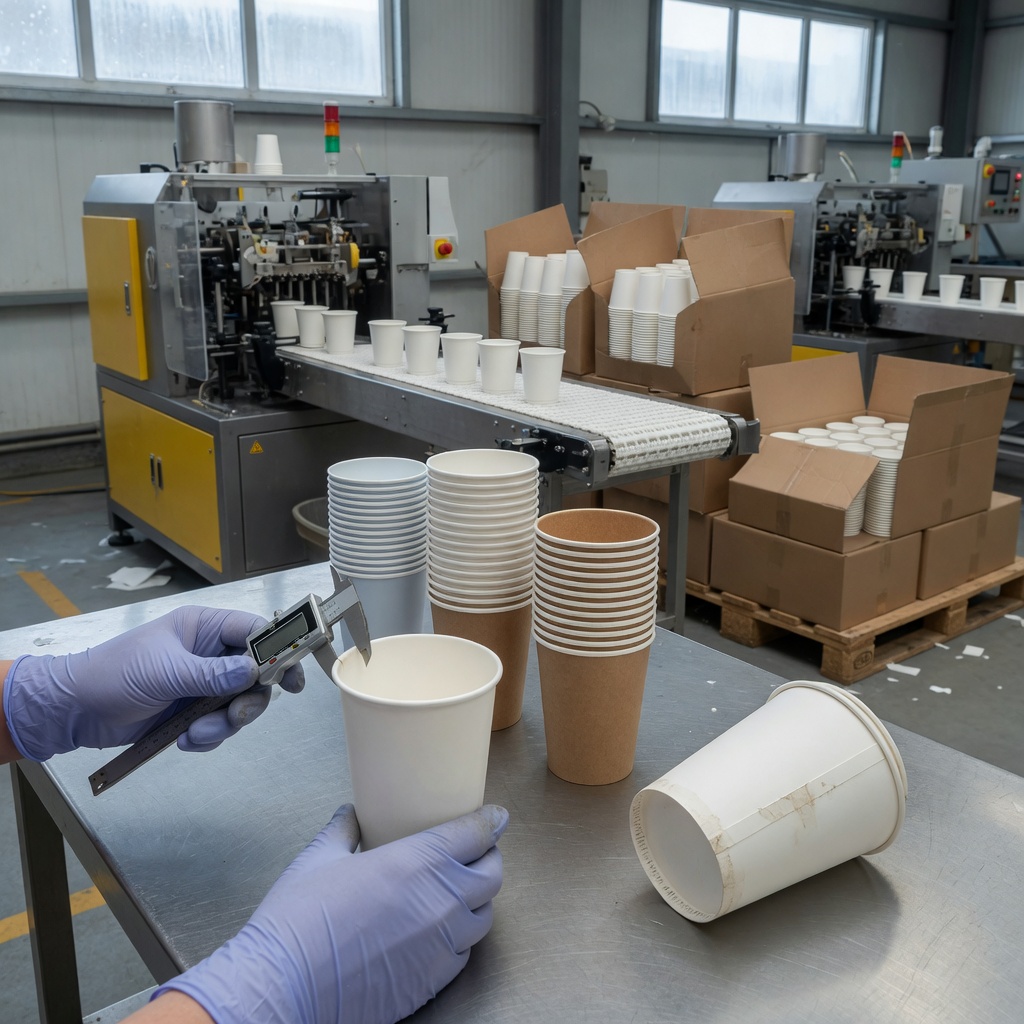
By Vincent Xi, Editorial Author
United States B2B buyers should treat paper cup wholesale supplier production scalability planning as a size-specific capacity contract, not a catalog contest or a unit-price shootout. Award annual volume only after four items are written into the RFQ and returned on a dated quote: claimed output for each cup size and print version; the scheduled-hour base and overall equipment effectiveness (OEE) assumption behind that claim; a utilization cap so wholesale supply is not booked at 100% of nameplate; and a modular expansion path if growth would otherwise force a full forming-line replacement.
A United States distributor, commissary, or multi-unit foodservice operator needs that paper trail before raising monthly cups. Ask for size-level cups per day, a pack-out a United States DC can receive, and food-contact files for the exact board and coating. Capacity does not, by itself, prove labeling, seam integrity, or on-time putaway.
The figures below are restated from published equipment-capacity and bulk-sourcing pages as language a United States buyer can verify on a supplier quote. This page does not state, imply, estimate, relabel, or calculate search volume, CPC, difficulty, traffic, or ranking for the topic.
Why United States buyers lock capacity before they lock print
Do not award a paper cup program on artwork or a plant-wide cups-per-day slogan. Specify the SKU mix first, then require hours that can actually be allocated to that mix.
United States wholesale programs combine sizes, seasonal prints, and case-pack rules, and each changeover consumes time the slogan number usually ignores. A supplier that quotes one plant-wide “cups per day” figure, with no size, coating, or print-station constraint, is quoting marketing output rather than allocatable wholesale supply.
Landed cost in the United States also couples capacity to pack-out. Papacko’s bulk sourcing guide states that a 40-foot container holds about 1.8 million to 2.5 million 8 oz cups (unit count; 8 oz size only; 40 ft container; packing-dependent; publication date not stated on the page used here) (Papacko bulk paper cups guide). A 12 oz or 16 oz SKU ships fewer selling units per sailing and occupies a United States warehouse differently. Capacity that cannot match the buyer’s carton, pallet, and DC receiving rules does not scale.
Keep food-contact documentation separate from output claims. Ask for current food-contact declarations for the exact board, PE or PLA coating, and inks intended for United States use. Treat ISO 9001 or FSC mentions as files to date, scope, and match to the producing legal entity—not as proof of reserved cups. Papacko lists ISO 9001 and FSC among common document checks; those frameworks are not a substitute for size-level output evidence, and this article does not assert that any named plant holds a current certificate (Papacko bulk paper cups guide).
Production scalability planning: hours, OEE, and modular lines
Convert a scale-up slogan into a dated hours-and-OEE model plus a named add-on path. If either artifact is missing, treat the claim as unverified.
Newdebao’s equipment-selection note frames production scalability planning as matching forming-line capacity to volume, footprint, and growth instead of buying the largest machine first. It publishes a planning construct of (annual cups × 1.2) ÷ (hours × 0.75), using a 20% growth factor and a 75% OEE assumption. The same undated page positions compact lines for about 200,000 to 1,000,000 cups per year and argues that modular high-capacity setups can add output without replacing the original equipment, which avoids stranded overcapacity (Newdebao capacity vs. size guidance). Treat that math as manufacturer-published planning, not as a measured rating of a Joyline Party Supply line or of any other unnamed plant.
Example calculation (assumption to verify on the supplier quote, not a factory rating):
- Target volume: 1,000,000 cups per year of one size (annual units; single-SKU example).
- Growth-adjusted volume: 1,000,000 × 1.2 = 1,200,000 cups.
- Scheduled hours example: 2,000 hours per year (250 days × 8 hours; confirm actual shifts).
- Effective hours at 75% OEE: 2,000 × 0.75 = 1,500 hours.
- Implied average output: 1,200,000 ÷ 1,500 = 800 cups per hour, or about 13 cups per minute if converted to a per-minute rate.
Ask whether the factory’s speed figure is cups per minute, cups per hour, or cups per shift. The Newdebao note labels the construct a CPM formula; if “hours” in the denominator are annual operating hours, the raw result is cups per hour. A United States buyer who treats 800 as cups per minute would overstate wholesale supply by a factor of 60.
The 20% growth factor and 75% OEE look conservative on a spreadsheet, but size changes, print changes, PE versus PLA forming windows, and QC holds can push realized OEE lower. If the plan uses 75% and the cell runs near 55% during a branded campaign, the gap shows up as late United States warehouse receipts. Neither 75% nor 55% is a measured rating of a named Joyline Party Supply cell; 55% is a buyer stress-test assumption to check against shift reports.
A compact cell in the published 200,000–1,000,000 cups/year class can be the right first module for a regional United States program, while modular add-ons are the control for multi-year growth. An oversized line bought too early still does not reserve hours for the contracted SKUs if the factory sells idle time to other customers.
Size-specific daily output versus nameplate capacity
Write only size-level, buffer-adjusted cups into the United States promotion calendar. Nameplate at 100% is not wholesale supply.
Papacko’s wholesale sourcing guidance tells buyers to audit production by asking for daily output for specific cup sizes and to verify figures with tours or reports. It also advises committing only to 60–70% of claimed capacity (percentage of stated output; wholesale planning heuristic; publication date not stated) (Papacko bulk paper cups guide). That band is not a legal cap and is not a Joyline Party Supply allocation policy.
Worked buffer (example to verify): if a supplier claims 100,000 cups per day for a designated 8 oz single-wall SKU, a 60–70% commitment implies planning 60,000 to 70,000 cups per day as allocatable wholesale volume. The remaining 30–40% is the buffer for downtime, other customers, reprints, and quality holds. Writing the full 100,000 into a United States promotion calendar is how stockouts get scheduled. The 100,000 cups/day starting point is an example input, not a published plant rating.
Lokyo’s wholesale guide, also undated on the page used here, tells long-term buyers to evaluate production capacity, quality consistency, and supply scalability rather than unit price alone, so growth from one cafe to multi-location chains does not create disruptions (Lokyo paper cups wholesale guide). That is the same procurement task: reserved converting hours plus stable quality beat a low first-container price.
MOQ bands in the two wholesale guides do not agree, which is a planning signal rather than a price. Lokyo cites stock MOQs of 1,000–5,000 units and custom-printed MOQs of 30,000–50,000 units, with 15–30 day lead times (units and calendar days; stock vs custom print; date not stated). Papacko cites typical MOQs of 50,000–500,000 units. Do not average the blogs. Lock size, wall, coating, print colors, case pack, and whether quantity is per SKU. None of those bands is a Joyline Party Supply MOQ.
Container math, United States delivery, and cash tied in inventory
Forming-line output is not wholesale supply until it ships in a pack-out a United States DC can receive, at an inventory duration the buyer will fund.
- 8 oz benchmark load: 1.8 million to 2.5 million 8 oz cups per 40-foot container, per Papacko (undated; 8 oz; 40 ft; nesting, wall, lids, and pallet height change the count) (Papacko bulk paper cups guide).
- Other sizes: require cups per carton, cartons per pallet, pallets per 40 ft, and net cups per container for each SKU. Larger brim sizes and double-wall board reduce units per container. Do not reuse the 8 oz range for 12 oz or 16 oz SKUs.
- United States inbound controls: destination type (port, transload, or buyer DC), named Incoterm, inner-pack counts that match pick faces, pallet footprint and maximum height the receiving DC will accept, and whether lids ship in the same container. A plant can “have capacity” and still miss a United States in-stock date if cartons fail receiving rules.
Filling a 40 ft container toward the 1.8–2.5 million 8 oz example lowers ocean cost per thousand cups but raises United States warehouse occupancy and cash conversion days. Production scalability planning should state both cups per hour and the maximum inventory days the United States buyer will fund.
Lokyo’s 15–30 day wholesale band is usable only after the clock start is defined (artwork freeze, board allocation, or forming start). Custom print plus a capacity ramp can exceed 30 days even if stock cups move faster. Treat 15–30 days as a source-stated planning band to confirm, not as a United States door-to-door SLA (Lokyo paper cups wholesale guide).
United States specifications, labeling, and factory evidence when volume increases
Scale only the SKU that is specified, labeled, and released at production speed. Missing files mean missing volume, even if the former is fast.
Convert a scale-up slogan into artifacts:
- Daily and weekly output by cup size, coating, and print version—not a blended plant total.
- Verification method: shift reports, a dated capacity study, or an on-site view of the cell that will run the United States SKUs. Papacko recommends tours or reports; require the file, not the slogan (Papacko bulk paper cups guide).
- Staffing of the forming, printing, and packing cells assigned to the order (shifts per day and who runs changeovers). Headcount is not published in the three source pages; do not accept “enough people.”
- Buffer policy: whether the supplier will reserve no more than 60–70% of the quoted cell, or some other stated percentage, for the buyer’s forecast.
- Modular expansion: which unit operations can be added (second former, extra print station, extra pack line) without replacing the first machine, consistent with Newdebao’s modular-scaling argument (Newdebao capacity vs. size guidance).
- Upgrade calendar: time to install, commission, and release extra cups per hour, including board and ink lead time—not only machine installation.
- Specification lock: named size (fl oz), wall, board gsm, coating, lid fit, and print colors for each United States SKU.
- Labeling lock: inner-pack and carton marks the United States DC will receive (SKU, size, pack count, lot/batch, PO) plus a current food-contact declaration that matches the shipped lot’s board, coating, and inks. Do not infer labeling fitness from capacity.
Quality at rate is part of scalability. A cell that forms quickly but fails rim-roll or leak tests does not create wholesale supply ready for United States distribution. Specify leak, seam, rim diameter, height, and print-registration checks as release gates on production-speed cups, not on hand-made samples. Do not treat unnamed “industry standard” dimensions as a substitute for the buyer’s written limits.
If ISO 9001, FSC, or another certificate is offered, record legal entity, site address, standard edition, and expiry, and match them to the producing plant. No current document means the claim is unverified. A management-system certificate is not a reserved-capacity clause and is not a United States food-contact label. This article does not assert that Joyline Party Supply, or any plant named in the source pages, holds a current certificate.
Buyer decision table: scalability controls for paper cup wholesale supply
Each row is a specify, compare, verify, approve, or order gate for United States volume.
| Decision control | Weak signal (do not award volume on this alone) | Stronger United States wholesale control | Attach to RFQ / PO |
|---|---|---|---|
| Output claim | One plant-wide cups-per-day number | Cups per day and per hour by size, wall, coating, and print | Size-level capacity sheet with hour base and date |
| Growth math | An unquantified growth slogan | Documented method using annual cups × 1.2 at a stated OEE, plus a modular add-on path | Worked model using the buyer’s 12-month forecast |
| Utilization | 100% of nameplate sold to one buyer | Contracted allocation, e.g. 60–70% of claimed cell output as a planning cap | Written reserved-capacity percentage |
| Equipment path | Oversized idle line | Compact cell now (source example: ~200,000–1,000,000 cups/year class) with named add-on modules | Line list: current formers/printers vs future units |
| MOQ | Unspecified “wholesale MOQ” | MOQ per SKU; published guides disagree (1,000–5,000 / 30,000–50,000 vs 50,000–500,000) | MOQ, price break, and make-ready charge per SKU |
| Lead time | “15–30 days” with no clock start | Clock start (artwork, materials, or forming) plus United States transit and DC putaway | Calendar: production + freight + receiving |
| Logistics | Capacity quoted without pack-out | Cups/carton, cartons/pallet, pallets/40 ft; 8 oz source example 1.8–2.5 million cups/40 ft | Packing data sheet per SKU |
| Landed cost | Ocean rate only | Cost per thousand cups plus United States inventory days the buyer will fund | Container fill vs days-of-cover split |
| Labeling | Generic export carton | Carton/lot marks plus food-contact declarations for United States use on the exact SKU | Lot-level declaration of compliance and mark sample |
| Quality at rate | Lab or hand samples only | Release tests at the quoted forming speed | Leak/dimensional protocol at production rate |
| Certificates | Names or logos on a website | Current PDF matching plant legal name and site—if a claim is made | Certificate files and expiry; no certification implied if missing |
| United States market fit | Capacity with no receiving rules | Named Incoterm, destination type, and inner-pack that matches pick faces | Written inbound and putaway rules |
RFQ checklist for paper cup wholesale supply scale-up
Each item should return a number with units, a document, or a contractual clause.
- SKU map: For each United States SKU, state named size (fl oz), brim-full volume if used, wall (single/double), board gsm, coating, lid fit, and print colors.
- Forecast: 12-month cups by SKU and month, plus a labeled growth case (example: +20% from the Newdebao factor—an assumption to verify, not a demand forecast).
- Size-level capacity: Daily and weekly output for each SKU, with scheduled hours, shifts, and the OEE or utilization percentage used.
- Unit clarification: Confirm cups per minute vs per hour vs per shift; include a sample conversion so 800 cups/hour is not read as 800 cups/minute.
- Allocation cap: Maximum share of the cell that may be counted (example: 60–70% of claimed capacity, Papacko heuristic, to confirm in the quote).
- Changeover loss: Minutes to change size and print; cups lost per changeover.
- Modular expansion: Modules that can be added, extra cups per hour, and calendar time to commission.
- MOQ and make-ready: Per SKU, stock vs custom; do not paste a blended blog range onto the PO.
- Lead-time clock: Days from artwork approval, from board arrival, and from forming start; then United States port-to-DC days under a named Incoterm.
- Container and carton: Cups per carton, cartons per pallet, pallets per 40 ft; recount 12 oz and 16 oz against the 1.8–2.5 million 8 oz / 40 ft published example.
- Landed-cost split: Ocean (or other freight) cost per thousand cups versus maximum United States DC days of cover and which party owns that stock.
- Quality at speed: Leak, seam, rim diameter, height, and registration limits on production-rate cups.
- Labeling pack: Inner-pack and carton mark fields (SKU, size, count, lot, PO) plus a sample unmarked vs marked carton photo set with no implied brand approval until the buyer’s marks are applied.
- Food-contact file: Current declarations for the exact materials for United States food-contact use; a written yes/no on restricted chemistry if the buyer’s destinations require it. Do not infer this from capacity.
- Certificate files (only if claimed): ISO 9001, FSC, or others as PDFs with site scope and expiry.
- Verification artifact: Dated capacity report, cell video, or audit protocol, with the signer named.
- Over-forecast rule: If monthly orders exceed the reserved allocation: overtime, second cell, split production, or refuse-to-book language.
- Approval cups: Pre-production cups from the actual line and nested-carton pack-out that will ship to the United States.
- PO clauses: Reserved capacity, SKU-level lead time, inspection protocol, labeling marks, and container pack-out as enforceable lines.
Methodology, source context, and what to verify
Author basis. Bylined to Vincent Xi, Editorial Author, for Joyline Party Supply (author profile). Attribution is limited to that named editorial role. The article does not attribute factory visits, customer outcomes, tests, awards, or personal operating experience to Vincent Xi or to Joyline Party Supply.
Source contexts. (1) Newdebao product-news guidance on matching paper cup forming equipment to volume, footprint, and growth, including (annual cups × 1.2) ÷ (hours × 0.75), a 20% growth factor, 75% OEE, a 200,000–1,000,000 cups/year compact-line band, and modular expansion without full replacement (Newdebao capacity vs. size guidance). (2) Papacko bulk wholesale sourcing guidance on size-specific daily output, a 60–70% commitment heuristic, MOQs of 50,000–500,000 units, 40 ft loads of 1.8–2.5 million 8 oz cups, and ISO 9001/FSC document checks (Papacko bulk paper cups guide). (3) Lokyo wholesale guidance on stock vs custom MOQs (1,000–5,000 and 30,000–50,000 units), 15–30 day lead times, and preferring capacity, consistency, and scalability over unit price (Lokyo paper cups wholesale guide).
How the figures were derived. Numbers were copied with their published units and restated with scope. Extensions (converting 800 cups per hour to about 13 cups per minute; applying 60–70% to a 100,000 cups/day example; using 2,000 scheduled hours as 250 × 8) are labeled as example calculations or planning assumptions to verify on the supplier quote. Conflicting MOQ bands were not averaged. No keyword-demand, traffic, or ranking metric is stated or implied.
Limitations. Publication dates were not stated on the pages used. Equipment vendors may assume OEE a given cell will not hit after artwork changeovers. Container counts vary with cup size, wall, lids, and pallet pattern. Certificate names in a sourcing article are not a current audit. United States food-contact and destination chemistry rules must be specified in the RFQ; they are not established by the three capacity/MOQ pages. Joyline Party Supply prices, certifications, lead times, plant ratings, and reserved-capacity percentages are not claimed here and must come from a dated quotation.
Discuss Your Requirements
Review our manufacturing capabilities, then share your specifications for a supplier-fit review.