Paper Plate Wholesale Supplier Product Development Capability for Canadian B2B Buyers
By Vincent Xi, Editorial Author Author profile: https://joylinepartysupply.com/authors/vincent-xi/
The Article/BlogPosting author is a Person named Vincent Xi, jobTitle Editorial Author, URL https://joylinepartysupply.com/authors/vincent-xi/. This page does not add mill visits, laboratory work, client names, awards, certifications, or first-person production stories.
Award a Canada-bound paper plate wholesale supply contract on product development capability, not on a catalog unit price. The working test is whether the bidder can turn a written specification into a measured sample and then into a repeatable production lot, with documented fiber, coating, print, pack-out, and food-contact evidence. A stock-only list of diameters does not meet that test. A public OEM manufacturer page describes product development, specification control, and private-label packaging as the split between a specialized manufacturer and a general stock supplier (VAV Paper manufacturer overview).
Pass condition: frozen geometry and gsm; unprinted then printed samples on the production substrate and ink system; a dated finished-article evidence pack; pack-out that matches the named Canadian ship-to; and separate clocks for sample, mass production, and transit.
Fail-closed: MOQ stated only as low; a homepage eco badge instead of a current certificate; a digital sales sample standing in for flexo production; or a 35-day delivery claim with no SKU, coating, or Incoterms term.
Freeze the specification table, send one RFQ packet, then score every bidder on the decision table. Withhold the first production PO if any fail-closed cell is empty. Size, grammage, capacity, and delivery figures below are supplier-stated examples from named pages. They are not Joyline Party Supply metrics and are not certificates. Re-verify every number on the live quote with unit, SKU scope, and date.
What Product Development Capability Covers for Paper Plate Wholesale Supply
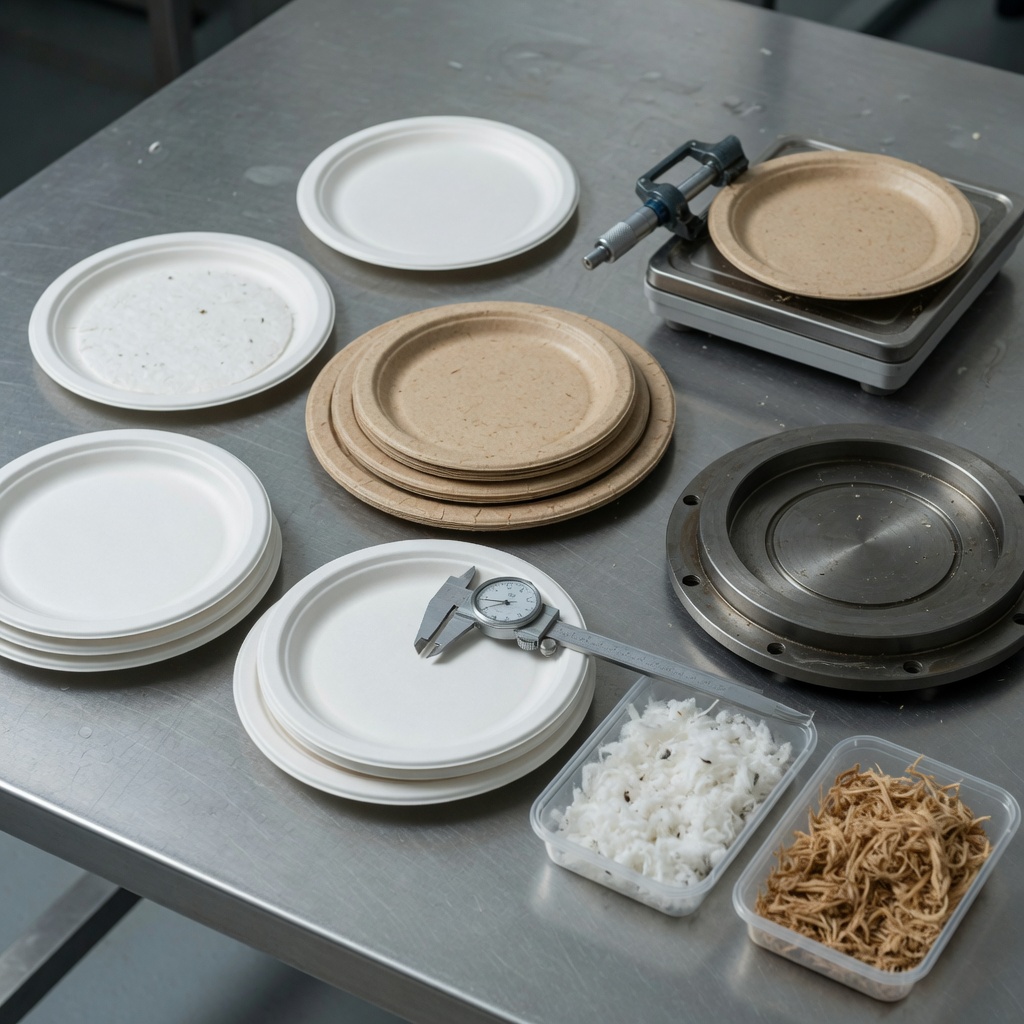
Product development for disposable plates is a sequence of locked decisions. A capable wholesale partner typically controls, or can document who controls:
- Geometry: diameter, depth, flange, nested stack height, and tolerance.
- Substrate: virgin pulp, allowed recycled content, or plant-fiber bodies such as bagasse, with gsm and caliper stated separately.
- Barrier: uncoated, PE, PLA, or aqueous coating, plus any heat or oil-use limit the brand will print or imply.
- Decoration: flexo, offset, or digital print; color standard; ink food-contact status.
- Conversion: existing cavity versus a new forming mold, plus rim and nest behavior.
- Commercial pack: sleeve count, carton, pallet pattern, and private-label film or board.
- Evidence pack: fiber origin, finished-article food-contact file, and any chain-of-custody certificate the buyer intends to print.
The VAV Paper manufacturer overview states that a specialized paper plate manufacturer supports product development, specification control, private-label packaging, export planning, and long-term B2B supply consistency, unlike general stock-only suppliers (VAV Paper manufacturer overview). A manufacturer site that presents integrated R&D, design, production, and sales lists a professional design team, low MOQ, free samples, biodegradable plant-fiber materials, and a 35-day delivery claim for wholesale B2B clients (Mingyuan manufacturer site). Those sentences are each company's published positions on the cited pages. They are a comparison template, not a universal SLA, not a dated certificate, and not a Joyline Party Supply figure. Re-open each URL before artwork freeze.
RFQ control, not a laboratory result: a new mold, a new coating chemistry, or a multi-color brand print adds sample cycles, scrap risk, and evidence burden. Reusing a proven cavity and a coating already on the supplier's food-contact file usually shortens time to first mass lot. Buyers who need a unique silhouette should ask who pays for the tool, who owns it after amortization, and how many sample rounds are included in the quote.
Specification Ranges Buyers Should Lock Before Artwork
A published B2B buyer's guide covers custom paper plate development from specification through print and QC. It describes a 7-10 inch size band and a 250-350 gsm basis-weight band, coatings, and materials named as virgin pulp or bagasse. Print methods listed include flexo, offset, and digital with PMS matching. The same page states in-house designers, FSC-certified eco materials, and a monthly capacity of 50 million plates for wholesale buyers (Artcool B2B buyer's guide).
Use those published numbers as prompts, not as the frozen spec:
| Published figure | Unit and scope | As-of / source context | How a Canadian buyer should use it |
|---|---|---|---|
| 7-10 inch | Diameter band (inches) described for custom plates on that guide; depth is not included in this figure | As published on the Artcool B2B buyer's guide; this page does not add a retrieval timestamp | Freeze exact diameter in inches and millimetres; depth, flange, and nest height are separate fields |
| 250-350 gsm | Basis-weight range (grams per square metre) on that guide; coat-weight add-on is not included | Same page, as published | Specify gsm and caliper; coating add-on weight is extra and must be quoted separately |
| 50 million plates per month | Capacity claim (plates per month) for that publisher's stated operation, not SKU-level allocation | Same page, as published; not a Joyline Party Supply figure | Ask for plates per month on your gsm, coating, and print, not plant-wide marketing capacity |
| 35-day delivery | Stated delivery (calendar days) to wholesale B2B clients; no SKU, coating, or Incoterms term attached | Mingyuan manufacturer site, as published | Split sample days, tooling days, mass-production days, and transit to the named Canadian destination |
| Founded 2009 | Company-history year on that manufacturer page | Mingyuan manufacturer site, as published | Due-diligence prompt only; not a quality score |
Specification practice to verify in the quote, not a measured result on this page: higher gsm and deeper draws are commonly used to improve rigidity and cut-through resistance but raise fiber grams per plate and can change forming moisture and scrap. A bagasse or other plant-fiber body supports a compostability claim only when coating, ink, adhesive, and the destination-market rule all match. The fiber name alone is not finished-article proof.
For Canada-bound programs, write the spec in SI and imperial and freeze the use case (hot entree, oily foods, cold salad, or dry bakery). Oil and heat are usual failure modes when coating is under-specified; treat that as a use-case lock in the RFQ, not as a test report from this page.
Sampling, Tooling, Print, and Lead-Time Trade-offs
Force every bidder to separate four clocks:
- Design: dieline, brand colors, and pack copy, including any bilingual strings the Canadian program will print if the brand requires both languages.
- Tooling: existing mold identifier versus a new-tool quote, ownership, and storage.
- Sample: unprinted forming samples first, then printed samples, then a packed shipper sample.
- Mass lot plus freight: production after sign-off, then transit to Canada under a named Incoterms term and year.
The 35-day delivery figure on the Mingyuan page has no SKU, coating, or Incoterm attached (Mingyuan manufacturer site). Unit: calendar days. Scope: wholesale B2B clients as that page states. As-of: as published on the cited page. Do not paste it into an internal SLA. Convert each bid into calendar days to unprinted sample, days to printed sample after artwork freeze, days to first mass production after sample sign-off, and days in transit to the named Canadian port, airport, or DC.
Print method is a cost and quality fork. The buyer's guide lists flexo, offset, and digital with PMS matching (Artcool B2B buyer's guide). RFQ control: if production ink will be flexo, do not approve a digital-only sales sample as the production standard unless the supplier documents a color tolerance and a production-ink drawdown on the same substrate. That rule is a fail-closed sampling control, not a laboratory comparison performed for this article.
MOQ: none of the supplied pages states a numeric minimum order. Low MOQ is not a number (Mingyuan manufacturer site). The RFQ must force units: pieces per SKU, per print design, and per coating, and whether mixed diameters share one production minimum. Treat any non-numeric MOQ as an empty fail-closed cell.
Private-label packaging is part of product development. The VAV page lists private-label packaging and export planning among the services that distinguish a specialized manufacturer (VAV Paper manufacturer overview). Specify sleeve film, carton board, barcode, case count, nested count, and whether Canada-destination marks are printed at origin or applied in a Canadian DC. This page does not quote a carton language statute.
Food-Contact, Fiber Claims, and Standards Versus Website Badges
Name standards only as documents to request. A logo on a homepage is not a current certificate. A standard's requirement is not this publisher's practice, and this page does not imply certification.
- FSC. Manufacturer pages in this set mention FSC-certified materials or FSC-certified paper plates (VAV Paper manufacturer overview; Artcool B2B buyer's guide). FSC is a forest-product chain-of-custody system. If the Canadian program will print an FSC mark, the buyer needs a current certificate, a product-group match, and the certificate holder's on-product labeling rules. This article does not verify any factory's status. Joyline Party Supply does not claim FSC certification here.
- Food-contact file. Food-contact schemes are not interchangeable. A packaging hygiene audit is not a finished-article declaration. Request finished-article declarations, relevant grease-resistance or migration reports for the coating, and ink or coating supplier letters. Do not treat the word food-safe on a website as meeting a retailer's or foodservice operator's file. This page does not quote a Canadian regulatory text.
- Biodegradable, compostable, plant-fiber. The Mingyuan page describes biodegradable plant-fiber materials (Mingyuan manufacturer site). Those words are claims on that page. Ask which finished-article standard is in scope and whether coating, ink, and adhesive are included. Fiber body alone is not proof.
Joyline Party Supply is the publisher of this editorial brief. No mill audit, laboratory result, production capacity, or certification is attributed to Joyline here.
Canada-Bound Wholesale Supply: Pack-Out and Labeling Fields to Freeze
Keep the plate decision primary. Product development capability is unfinished until destination pack-out is as controlled as diameter and gsm. For programs whose sales market is Canada, freeze the following as RFQ fields. This section is not a country import guide and does not quote duty rates, freight rates, or bilingual packaging statutes.
- Named Canadian destination (port, airport, or DC) and Incoterms term and year.
- Carton language: if the brand requires English and French, supply both strings in the artwork brief; do not leave translation to the factory. That is a brand-copy lock, not a statute citation.
- Nested count, carton outer dimensions, and pallet pattern so the buyer's freight owner can model cube; this page does not quote freight rates.
- Retailer or operator routing rules for pallet height, case labels, and GTIN, if they apply.
- Duty, brokerage, and inland freight as buyer-owned lines unless the supplier quotes DDP and can show the same term on prior comparable lots.
Canadian bilingual labeling, duty, and food-contact obligations must be confirmed with the buyer's counsel and customs broker. The procurement point is that a Canada-bound paper plate wholesale supply RFQ must freeze language blocks, carton marks, and landed-cost terms in the same packet as mold and coating.
Buyer Decision Table: Scoring Paper Plate Product Development Capability
Use this table in scorecards. Every row is a specify, compare, verify, approve, or order action.
| Decision factor | What to specify in the RFQ | Cost, time, or risk trade-off | Evidence to request | Fail-closed check before PO |
|---|---|---|---|---|
| Plate geometry | Diameter (in and mm), depth, flange, nested height, tolerance | New cavity versus reuse of a common 7-10 inch class tool (published example band from the Artcool guide, not your frozen spec) | 2D drawing plus formed unprinted sample | Sample measures within stated tolerance |
| Substrate | Fiber type, gsm, caliper, recycled % if any | 250-350 gsm is one published example range on the Artcool guide, not your spec | Mill sheet or incoming COA | Measured gsm on a retained sample |
| Coating / barrier | Uncoated, PE, PLA, or aqueous; coat weight; heat and oil use | Barrier adds cost and can block compostability claims | Coating TDS plus grease or migration report if a claim will be made | Use-case check on a retained sample (example protocol to verify with QA, not a sourced test method: hot oil, 30-60 minutes) |
| Color / print | Flexo, offset, or digital; PMS or LAB; max colors | Digital sample may not equal flexo production | Drawdown on the production substrate; stated color tolerance | Production method matches the approved sample |
| Tooling | Existing mold ID or new-tool quote, ownership, storage | Unique silhouette versus faster reuse | Tool drawing, lead time, amortization | Written tool-ownership clause |
| Food-contact file | Finished article for a Canada-bound program | Missing file delays operator or retailer onboarding | Declarations, test reports, ink letters | Documents in date and in scope for the finished plate |
| Fiber or eco mark | FSC or compostability only if the brand will print it | Scope mismatch is a claim-control error | Current certificate plus product group | Mark not printed until the certificate is checked |
| Pack-out | Count, nested height, sleeve, carton OD, pallet pattern; bilingual copy only if the brand requires it | Origin print versus Canadian DC apply; cube drives freight | Pack dieline; carton strength if claimed; packed sample | Packed sample matches the PO and cube sheet |
| MOQ | Pieces per SKU and per design; mixed-SKU rules | Low MOQ is not a number on the supplied pages | Written MOQ table in pieces | Contract MOQ matches the table |
| Time | Sample days; mass days after sign-off; transit to Canada | 35-day published example is not an SLA | Gantt with gates | Dates bind only after sample approval |
| Capacity | Plates per month for this gsm, coating, and print | 50 million plates per month is one publisher's plant-wide claim on the Artcool guide | Allocation letter for the program | No dual-booking without written allocation |
| QC | AQL, dimensional audit, print defects, moisture, odor | Tighter AQL raises cost and inspect time | QC plan and retained-sample policy | First-article report travels with the shipment |
RFQ Checklist for Custom Paper Plate Development
Send one packet. Incomplete packets produce bids that cannot be compared.
- Program identity: Canadian ship-to location (port, airport, or DC); channel (foodservice, grocery, catering, airline, or other); annual volume in plates; first PO volume; SKU mix.
- Use case: hot, wet, oily, or dry; microwave or oven only if claimed; maximum fill weight and hold time.
- Geometry: diameter, depth, flange, nested height, and tolerances in inches and millimetres; drawing or spec revision ID.
- Substrate: fiber type and source; gsm; caliper; brightness; whether recycled content is allowed.
- Coating: chemistry; coat weight; brand restricted-substance list; heat and oil limits the brand will print or imply.
- Print: production method; color standard; coverage; rule that the sample method must equal production unless a documented exception is signed.
- Tooling: existing versus new mold; who pays; who owns; storage after the program ends; amortization in pieces.
- Sample plan: unprinted quantity; printed quantity; packed carton sample; measurement photos; number of included revision rounds; whether free samples includes freight.
- Food-contact evidence: finished-article declarations and reports, not homepage wording.
- Optional marks: FSC or compostability only if the brand will use them; attach the claim rules the brand must follow.
- Packaging: sleeve and carton specs, nested count, GTIN, and English/French copy blocks if the Canadian brand requires both; origin print versus Canadian DC apply.
- MOQ and price ladder: units per SKU, per design, and per coating; currency; quote validity date.
- Lead time: design, tool, sample, and mass-plus-freight clocks to Canada; Incoterms term and year.
- Capacity: monthly plates available for this SKU after other orders, not plant-wide marketing capacity.
- QC and remedy: AQL; retained samples; odor and moisture limits; defective-lot remedy.
- Change control: written approval before mill, coating, ink, or mold changes.
- Export file: packing list, certificate of origin, and copies of any mark certificates that must travel with the Canada-bound shipment.
- Commercial: payment terms; sample fees; tool amortization schedule; artwork freeze date.
- Cube sheet: nested count, carton outer dimensions, mass per carton, cartons per pallet, so the buyer's freight owner can model landed cost; this page is not a freight-rate quote.
- Retained standard: how many signed plates and packed cartons are kept, by whom, and for how long after shipment.
How These Figures Were Derived, and What to Verify
Source contexts. Three publicly published pages were used as research-source evidence for editorial claims only.
- An OEM manufacturer overview positions specialized paper plate development, specification control, private-label packaging, export planning, and FSC-certified plates as distinct from stock-only supply (VAV Paper manufacturer overview).
- A B2B buyer's guide states a 7-10 inch size band (diameter, inches), a 250-350 gsm band (basis weight, grams per square metre), flexo/offset/digital print with PMS matching, in-house designers, FSC-certified eco materials, and 50 million plates per month (capacity, plates per month, that publisher's stated operation) (Artcool B2B buyer's guide).
- A manufacturer site states integration of R&D and design, a professional design team, low MOQ, free samples, biodegradable plant-fiber materials, a 2009 founding year, and 35-day delivery (calendar days, wholesale B2B clients as stated, no SKU or Incoterms) (Mingyuan manufacturer site).
Methodology. This article is an editorial synthesis of those pages for Canadian B2B specification work on paper plate wholesale supply product development capability. Numbers were copied with their units and attributed to the named page. No laboratory test, factory visit, certificate retrieval, or landed-cost model was performed for this article. Author credit is limited to Vincent Xi, Editorial Author (author profile). No first-person production, audit, or customer-outcome claim is made.
Limitations and what to verify. Marketing pages can omit test methods, Incoterms, certificate expiry, and SKU-level capacity. A 50-million-plate monthly capacity and a 35-day delivery figure are supplier-stated examples, not industry medians and not Joyline Party Supply metrics. The 7-10 inch and 250-350 gsm bands are one guide's ranges; many programs use other diameters and weights. FSC and compostability marks are not confirmed here. Canadian bilingual labeling, duty, and food-contact obligations are not quoted from statute in this brief and must be confirmed with the buyer's counsel and broker. Re-quote every number with a date stamp, unit, and SKU scope before approving artwork or paying for a mold.
If a bidder cannot complete the decision table and RFQ checklist with current documents, treat product development capability as unproven and do not award the first production lot.
Discuss Your Requirements
Review our manufacturing capabilities, then share your specifications for a supplier-fit review.