Paper Plate Wholesale Supplier Production Scalability Planning for New Zealand Buyers
Byline: Vincent Xi, Editorial Author. Profile: https://joylinepartysupply.com/authors/vincent-xi/. This page is an evidence-bound procurement article for New Zealand B2B buyers. It does not attach factory visits, laboratory tests, awards, named clients, or production-floor experience to the named author or to Joyline Party Supply.
Decision first. New Zealand buyers should treat paper plate wholesale supplier production scalability planning as a capacity-reservation problem, not a headline-price problem. Do not commit seasonal or contract volume until the quote states, with units and a quote date: (1) pieces per month on the named forming line for the specified diameter in millimetres and named material; (2) booked versus free hours for the weeks required; (3) changeover minutes between sizes or print SKUs; (4) pack-out and pallet data that can be checked against a New Zealand DC; and (5) a document pack that can be presented at New Zealand import entry. Price without dated free capacity is a price list, not a wholesale-supply plan.
Plant-model annual headlines in the hundreds of millions of pieces are design illustrations, not a named mill's free week and not New Zealand demand evidence. Convert any such headline into line-level hours before ordering. The source-stated range and source context sit in Data point 1 below.
Use this page as a specify → compare → verify → approve → order article for paper plate wholesale supply. The sections that follow turn production scalability planning into RFQ fields, measurable trade-offs, a decision table, and New Zealand freight and documentation gates on the same purchase order.
Evidence classes below. (A) Source-backed numbers, each with unit, scope, as-of context, and URL. (B) Example calculations and planning objects, labelled as assumptions to replace with the supplier quote and a New Zealand freight quote. (C) Buyer RFQ controls and risk gates that are not industry averages.
Production scalability planning for a New Zealand paper plate wholesale programme
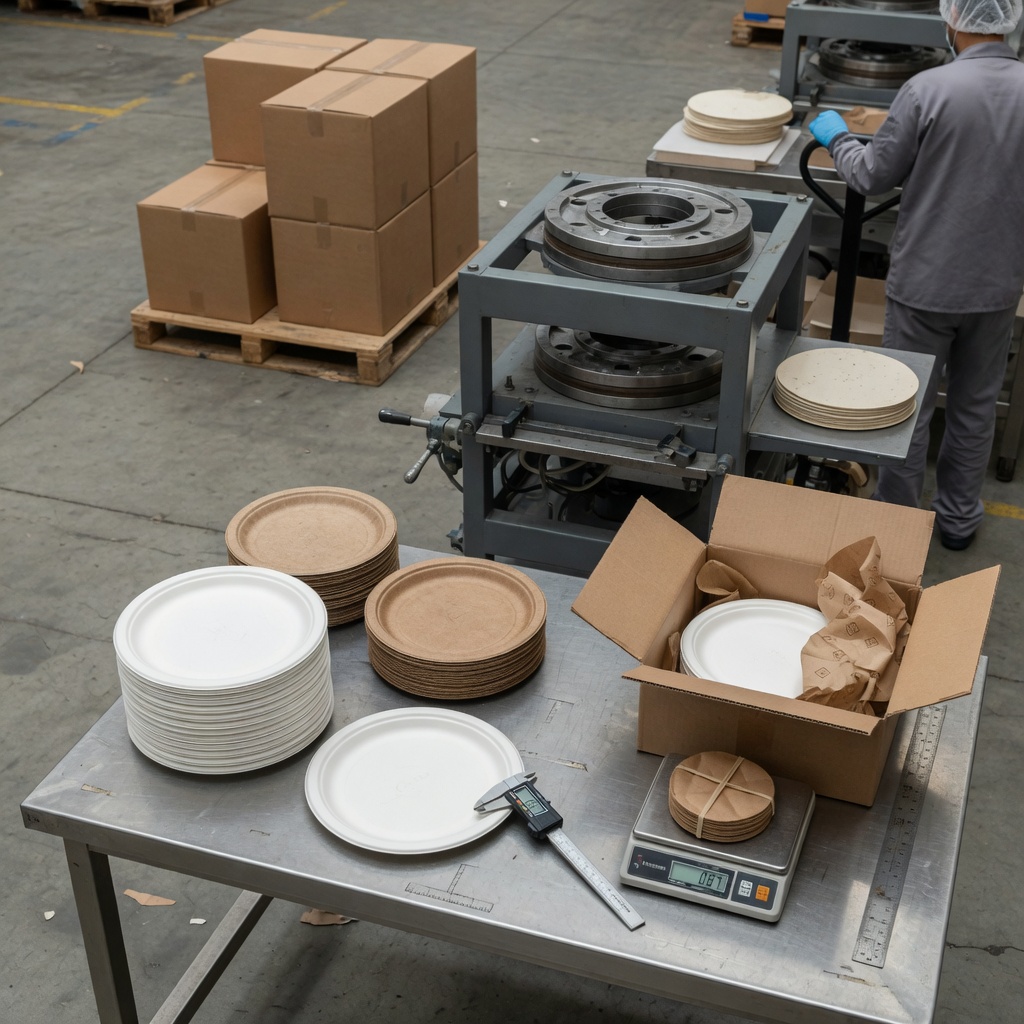
On this page, scalability means adding pieces of a named paper-plate SKU without breaking specification, pack-out, or the ship date the New Zealand warehouse actually needs. A plant-wide annual total does not prove that a given week is free. Put these constraints into the RFQ unless the quote proves they do not bind: forming hours on the named die, print or tool changeovers, carton packing rate, hold days for measurement and food-contact files, and the freight-and-document clock into New Zealand.
A manufacturer page on OEM and private-label paper plates states that production capability influences scalability, that a manufacturer should support both initial launch volumes and future growth, and that wholesale buyers prioritize supply reliability and long-term production partnerships as private-label programmes and distributor networks expand (VAV Paper). Treat that as a question list. It is not proof that spare dies, spare board, spare carton labour, or a named overflow site exist in the weeks on the purchase order.
Specify the order as:
- SKU: diameter and depth in millimetres, rim style, paperboard or molded fiber, coating, and print.
- Rate: pieces per shift on that SKU, not a plant-wide annual headline.
- Load: free hours by week after the purchase-order date, as-of the quote date.
- Surge: overtime, a second named line, or a named overflow site that uses the same die and board rules.
- Hold: days the lot stays for measurement and food-contact paperwork before release.
Example planning objects (assumptions to verify against the buyer forecast, not market averages and not source-backed typical volumes): a 20,000-piece trial and a 400,000-piece peak programme are different planning objects. If the supplier cannot show how the second object fits around the first on named dies and dated free hours, there is not a scale-up path.
Plant-model capacity versus the line that will run the SKU
Data point 1 — plant-model annual capacity. IMARC Group’s paper plates manufacturing plant project report (page title references DPR 2026) describes a proposed manufacturing facility designed with an annual production capacity ranging between 100 million and 500 million pieces (unit: pieces per year; scope: a proposed facility in that project report, not a named mill’s audited production and not a New Zealand import volume; as-of: the 2026-titled report page cited here). The same page states that production capacity can be increased to match regional or seasonal demand fluctuations (IMARC Group).
Ask the quoting supplier to convert any headline capacity into:
- named lines and dies for the specified millimetre size;
- shifts per day and days per week;
- yield after warp, trim, and print reject, as a supplier-declared percent for a comparable plate;
- last 90 calendar days of packed pieces on a comparable plate (supplier-declared; verify with carton photos or inspection; 90 calendar days is a buyer-specified verification window, not a sourced industry standard).
If the only number received is hundreds of millions of pieces per year, it is not possible to tell whether the required week is free.
Example calculation (assumption to verify in the supplier quote): 180,000 plates, 50 plates per inner, 10 inners per carton = 360 export cartons. If packing is 1,200 cartons per shift, packing is unlikely to bind. If packing is 180 cartons per shift and the line is already heavily booked, the order does not fit without overtime, a second line, or a split shipment. Replace every placeholder rate with the supplier’s figures and date them to the quote.
Lead time, seasonality, and SKU-mix trade-offs
Data point 2 — pre-peak order window. A wholesale and custom paper plates and cups tips article states that the party supply industry is seasonal, with spikes from graduation, Christmas, and summer festivals, and recommends orders 8–12 weeks before peak season (Sun Beauty). Unit: weeks. Scope: advisory recommendation on that undated page, not a contractual SLA and not a New Zealand peak calendar. As-of: the undated cited page listed in Source context B. The named events are examples on that source page. They are not a New Zealand demand study. Put the New Zealand need-by weeks in the RFQ. Add a second clock for origin cut-off, transit, and import entry; the 8–12 week figure does not include that clock.
Data point 3 — large-order size named in a quality discussion. The same article cites 50,000 units in the context of large wholesale orders and names ISO and FSC certifications as quality references (Sun Beauty). Unit: pieces (units). Scope: example large wholesale order size on that page, not a typical MOQ and not a Joyline Party Supply MOQ. As-of: the same undated cited page. ISO and FSC are third-party schemes. They are not a requirement of this article, not a Joyline Party Supply claim, and not valid without a current certificate that names the producing site and product group.
Score these trade-offs in the quote:
- Unprinted stock versus custom print: fewer plate changes versus extra days for tooling and first-article approval.
- One diameter versus an assortment: higher pieces per hour versus changeover minutes and extra dies.
- One large PO versus call-offs: better forming efficiency versus New Zealand warehouse cube and cash.
- Tight AQL versus a commercial spec: fewer complaints versus more hold days and missed ex-works dates. State the AQL in the RFQ; this page does not set an AQL.
- Reserved hours versus spot production: peak protection versus a written volume commitment.
MOQ must be by SKU. Example contrast to verify in the quote (not a stated industry rule): a printed coated ~254 mm plate does not share setup cost with a plain uncoated ~178 mm plate. Ask whether unused custom print can be cancelled; treat unused custom print as non-cancellable until the quote states a cancel window. If volume will grow, require retained samples and carton lot codes so later lots match the launch plate; treat that as a buyer RFQ control, not as proof of a named factory’s current system.
Decode any vague scale-up phrase into more shifts, a second forming press, or subcontracted overflow. Overflow without a named plant and matching specification is not a scale-up plan.
New Zealand freight, documentation, and food-contact gates
Keep the product decision primary. Use New Zealand import rules as gates on the same purchase order, not as a country guide. This page does not reprint official schedules and does not assign a clearance outcome.
Incoterms. A single lead-time number that mixes production and transit hides risk. Require production days after artwork lock, then a named Incoterm and place. Price at least one path to a New Zealand DC so door dates are visible. Replace any calendar arithmetic with the live forwarder quote.
Pack and biosecurity. Specify plates per inner, inners per carton, carton millimetres and gross kilograms, cartons per pallet, pallet height in millimetres, and pallet material. If wood pallets are used, require ISPM 15 marks that match the packing list, then confirm the current Ministry for Primary Industries import rule with the import broker. ISPM 15 is a wood-packaging standard. This page does not claim that any quoting factory, or Joyline Party Supply, currently ships ISPM 15 pallets, and it does not reprint MPI schedules.
Customs pack. Invoice, packing list, and bill of lading or air waybill must match piece counts and origins. Confirm classification, GST treatment, and any origin claim with the New Zealand Customs Service at time of entry. This page does not assign an HS code or duty rate.
Food contact. If plates will contact food, require a stated manufacturing framework plus current test reports that match the board, coating, and ink, not a brochure for a different SKU. Have a New Zealand compliance adviser confirm whether that file meets the Food Act obligations for the intended use. A website badge is not a certificate, and naming ISO or FSC is not the same as holding a current, site-matched PDF.
Example calculation (assumption to verify): 10 calendar days of production after artwork lock plus a forwarder-quoted door cycle (replace with the live lane quote) is the real calendar. Reserving only the production-side 8–12 week window from Data point 2 can still leave the New Zealand freight clock unplanned. Put both clocks in the RFQ.
Do not scale a SKU that cannot clear documents. Extra forming hours will not repair untreated wood packaging or a missing food-contact report. If any of the five reservation fields in the opening decision block is missing, do not approve the purchase order.
Decision table: compare wholesale suppliers on scalability evidence
Every row is a specify, compare, verify, approve, or order action. Weak/strong columns are evidence tests for the RFQ, not sourced industry benchmarks.
| Decision factor | Specify in the RFQ | Weak evidence | Strong evidence | New Zealand approve/order action |
|---|---|---|---|---|
| Forming capacity | Pieces/month by size, material, print | Headline annual millions | Named line, dies, last 90 days packed pieces | Reject if free pieces are below peak month plus a buyer-stated buffer |
| Booked load | Free hours by week for the next 16 weeks (buyer planning horizon to date on the quote, not a published SLA) | Undated promise to make room | Dated sold-versus-free chart | Do not approve a PO that sits only in sold weeks |
| Changeover | Minutes for size and print changes | Not stated | Timed changeover and max SKUs per day | Assortments need extra days or extra dies |
| Surge method | Overtime, second line, or named overflow | Unspecified scale-up assurance | Written SOP and overflow quality owner | Overflow lots need the same retain sample |
| MOQ | By SKU, increment, cancel window | One MOQ for all plates | SKU MOQ plus tooling ownership | Do not over-buy non-returnable print |
| Pack-out | Piece/carton, mm, kg, pallet pattern | Export carton | Dieline and recent pallet photo | Check NZ racking and wood-packaging rules with the import broker |
| Quality hold | Hold days and AQL | ISO/FSC named with no PDF | AQL plus certificate PDF only if current and site-matched | Do not treat missing files as certified |
| Food-contact | Framework plus matching reports | Generic claim | Dated lab reports for the specified coating and ink | Hold foodservice POs until the file exists |
| Dual clock | Production days plus Incoterm logistics | One combined 4 weeks (example of a hidden mix, not a sourced norm) | Two dated clocks | Add NZ entry; reject hidden freight |
| Traceability | Board, coating, print lot on carton | Carton count only | Lot-code key and retain period | Required for a NZ complaint isolation |
| Reservation | What payment actually books | Open-ended capacity talk | Named week, SKU, refund if missed | Pay a reservation only against dated hours |
| Continuity | 12-month volume band and spare dies | Cheap one-off sample | Tooling ownership and dual-source board policy | Needed if the programme repeats next season |
RFQ checklist: lock capacity, hours, and scale-up proof
Issue these as one RFQ. Each item supports specify, compare, verify, approve, or order. Planning horizons below are buyer-specified controls, not sourced industry standards.
- Lock the SKU: millimetre diameter and depth, rim, material, coating, print, pack-out, and a drawing or retain-sample photo.
- State first-PO pieces and, separately, a 6- and 12-month forecast labelled binding or non-binding.
- Give the New Zealand DC need-by date, latest ex-works date, and whether partial shipments are allowed.
- Require pieces per shift on the named line, line or die ID, shifts per day, days per week, and booked versus free hours for 16 weeks, as-of the quote date (16 weeks is a buyer planning horizon to specify, not a sourced industry standard).
- Require last-90-day packed output and reject percent on a comparable plate, plus carton photos.
- Require changeover minutes for size and for print, and the maximum SKUs in the production week.
- Require a surge plan: overtime cap, second line, or named overflow site with the same die and board rules, plus the quality owner for overflow lots.
- Require MOQ and increments by SKU, plate or cylinder charges, tooling ownership, and whether unused custom print can be cancelled.
- Split lead time: artwork days, production days after PO and artwork lock, packing days, named Incoterm, named place, and a door-date path to a New Zealand DC.
- Require packaging data: inners, carton mm and kg, pallet type and height, ISPM 15 if wood, and a load plan (any TEU count is an example the supplier must replace).
- Require food-contact reports matching coating and ink; attach any ISO, FSC, or other certificate only if the PDF names site, product group, and expiry. Do not assume any factory holds them.
- Require a New Zealand import invoice and packing-list template, plus a written wood-packaging instruction after MPI rules are confirmed with the import broker.
- Require the carton lot-code structure so a New Zealand warehouse can isolate one board lot, and state retain-sample duration.
- Require a written miss-window clause: split ship, air top-up at whose cost, or cancel.
- Require a paid or unpaid pre-production sample and a rule that bulk cannot start without written approval.
- Require what payment actually books: named week, SKU, piece band, and refund if reserved hours are missed.
Methodology, source context, and limitations
Source context A. IMARC Group’s paper plates manufacturing plant project report (2026-titled DPR page) supplies the 100–500 million pieces per year proposed-facility range and the note that capacity can be increased for regional or seasonal demand (IMARC Group).
Source context B. Sun Beauty’s wholesale and custom paper plates and cups tips page supplies the 8–12 week pre-peak recommendation, named seasonal spikes, the 50,000-unit large-order example, and the ISO/FSC mention as buyer-facing quality references, not as this site’s certification (Sun Beauty). VAV Paper supplies the qualitative scalability, launch-to-growth, and private-label consistency criteria (VAV Paper).
How the data was derived. Only numbers stated on those pages are treated as data points. Example carton maths, trial-versus-peak piece bands, millimetre-class SKU contrasts, dual-clock calendars, and the 16-week booking horizon are labelled assumptions to verify in a supplier quote and a New Zealand freight quote. Research-source pages support only the factual claims attributed to them; they are not keyword-demand evidence and not New Zealand sales-volume evidence. No search-volume, CPC, difficulty, intent-score, traffic, or ranking metric is stated or implied. No Joyline Party Supply capacity, price, certification, test result, or customer outcome is claimed.
What to verify. The IMARC range is a proposed-plant model. The 8–12 week window excludes New Zealand transit and is not a New Zealand seasonal calendar. 50,000 units is not a proven typical MOQ. Certificates count only with current site-matched documents. Confirm Customs, GST, MPI biosecurity, and Food Act duties with official New Zealand sources and a compliance adviser on the import date. Replace every example figure with quoted pieces, hours, millimetres, kilograms, and calendar dates before approval.
Editorial author: Vincent Xi, Editorial Author, https://joylinepartysupply.com/authors/vincent-xi/. No production-floor, laboratory, client, or capacity claim is attached to the author or to Joyline Party Supply.
Discuss Your Requirements
Review our manufacturing capabilities, then share your specifications for a supplier-fit review.