Party Decoration OEM Quality Control Inspection for Europe
By Vincent Xi | Editorial Author
For a Europe-bound party decoration OEM order, quality control inspection should be contracted as part of manufacturing rather than left as a general request before shipment. The RFQ should connect the purchase order to the current SKU revision, approved comparison sample, production stage, destination route, defect rules, evidence requirements, corrective action, and named release authority.
The central purchasing test is whether the supplier quote repeats the inspection lot, sample-selection method, measurable criteria, report fields, access terms, failure disposition, and shipment-hold instruction without ambiguity. Until those points are accepted, the buyer has not secured a usable inspection scope.
Every control below is a buyer-defined RFQ term. It is not a claim about Joyline Party Supply, a supplier's current process, product quality, inspection access, certification, or manufacturing capability. A proposed control becomes order-specific only when expressly accepted in the signed quote or contract.
Europe Party Decoration Quality Control Inspection: Set the Release Gate
Define who can release the shipment, then work backward to the evidence that role requires.
| Decision gate | Buyer-defined RFQ requirement | Required supplier response | Hold trigger |
|---|---|---|---|
| Specification control | Identify the SKU, revision, materials, construction, dimensions, tolerances, artwork, components, and packing method | Confirm the production records and disclose every conflict, substitution, or exception | A record is missing, obsolete, conflicting, or unapproved |
| Lot identity | Define the ordered quantity, SKU allocation, lot-formation rule, manufacturing location, and stock that must be accessible | State the quantity, location, and production scope covered by the proposed inspection | Available goods cannot be reconciled with the purchase order and inspection lot |
| Stage readiness | State the selected manufacturing checkpoint and the required production and packing status | Confirm the operation, goods, records, and personnel that will be available | Declared readiness has not been achieved |
| Inspection instruction | Define sample selection, measurable criteria, equipment, defect classes, acceptance rules, and evidence fields | Accept each parameter or state the exception, cost effect, and schedule effect | The response relies on an undefined acronym or general quality promise |
| Report completion | Require measurements, photographs, quantity reconciliation, defect records, packing findings, and document comparisons | Confirm the report format, delivery point, and responsible contact | Findings cannot be traced to the inspected SKU, revision, lot, site, and inspection date |
| Shipment release | Name the buyer-authorized role that may accept, reject, or require corrective action and reinspection | Confirm that shipment remains held until the required written decision is received | Evidence, corrective action, or buyer authorization remains incomplete |
Ask the supplier to mark every line as accepted or excepted and to state the associated price, assumption, and lead-time effect. Silence, sample approval, or a general quality statement should not be treated as acceptance of an inspection term.
The RFQ should also establish document precedence. The parties need a written rule for resolving differences among the purchase order, SKU specification, artwork, bill of materials, packaging drawing, and controlled approval sample before affected manufacturing proceeds.
Build Quality Control Inspection Into Party Decoration Manufacturing
The supplied Quality Control and Inspection Sourcing page presents in-process quality control and end-of-line or final inspection as distinct activities. That limited source context supports separate manufacturing-stage and finished-goods requirements in an RFQ. It does not provide a party decoration sampling plan, acceptance threshold, inspection frequency, or evidence that a named supplier performs either activity.
Use only the checkpoints relevant to the quoted SKU:
| Manufacturing checkpoint | RFQ scope | Evidence to request | Hold condition |
|---|---|---|---|
| Pre-production readiness | Current specification, artwork, bill of materials, approval sample, packing files, destination matrix, and inspection instruction | Revision-controlled record list and confirmation of the intended production inputs | A required record is absent, inconsistent, or awaiting approval |
| Incoming-material control | Applicable paper, tissue, film, textile, cord, adhesive, wire, ink, coating, or purchased component | Material identity, purchase-order comparison, observed condition, and specifically requested supporting records | Material identity or scope cannot be linked to the ordered SKU |
| In-process control | Buyer-selected cutting, printing, bonding, stitching, assembly, sequence, component count, or dimensional characteristic | Measurements and photographs tied to the available operation, SKU revision, and inspected quantity | The selected operation is unavailable, inaccessible, or no longer represented by the available goods |
| Pre-shipment inspection | Finished and packed lot, SKU identity, workmanship, dimensions, assembly or use check, assortment, retail pack, and carton reconciliation | Completed report tied to the accessible lot and current specification | Finished quantity, packing status, or lot identity does not meet booked readiness |
| Corrective-action verification | Affected scope, segregation, sorting or rework instruction, replacement responsibility, and reinspection rule | Closure record identifying the action completed, remaining exceptions, and verification result | Corrective action cannot be traced to the original finding and affected goods |
For each booked inspection, define the readiness declaration, notice procedure, accessible site and stock, quantity records, inspection contact, photography permission, waiting-time terms, cancellation charges, and rebooking responsibility. Keep manufacturing findings and destination-document comparisons in separate report sections. An acceptable workmanship result should not be presented as proof of legal applicability.
Turn Each Party Decoration SKU Into Inspectable Criteria
The following rows are conditional RFQ templates, not claims about a current product range. Use a row only when it matches the quoted SKU, and replace every descriptive field with the buyer-approved requirement.
| Example SKU, if quoted | Specification fields | Inspection observations and records |
|---|---|---|
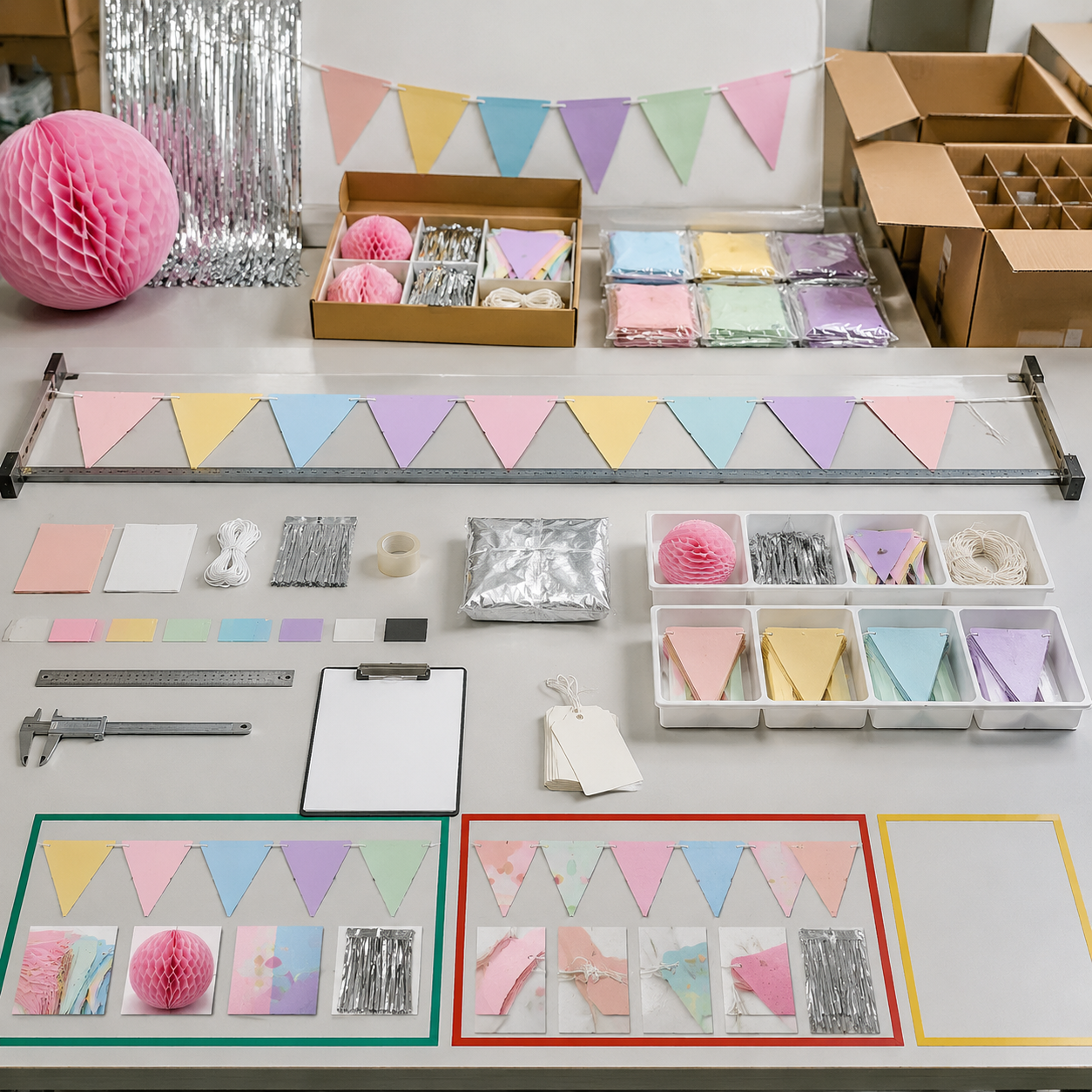
| Paper garland | Paper description, finished length, element dimensions and count, spacing, sequence, color reference, cord construction, attachment method, and packing orientation | Dimensions, component count, cut-edge condition, sequence, attachment result, visible contamination, color comparison, and pack identity |
| Tissue decoration | Tissue description, finished form, layer arrangement, opening method, bonding method, hanging component, and pack protection | Tears, deformation, adhesion, layer consistency, opening result, staining, component presence, and packing condition |
| Metallic-film fringe curtain | Film description, finished width and drop, strip pattern, backing construction, attachment method, surface criteria, and folding method | Dimensions, strip consistency, backing condition, attachment, scratches, creases, contamination, and packing orientation |
| Printed banner | Substrate, artwork revision, character sequence, print position, color reference, hole or slot position, cord, and pack contents | Artwork identity, sequence, registration, print condition, dimensions, hole or slot position, assembly, and completeness |
| Mixed decoration kit | Component list, quantity per pack, assortment rule, permitted substitutions, assembly items, instructions, and sealing method | Component identity, count, assortment, mismatch, substitution, damage, instruction presence, and pack seal |
For every characteristic, state the target, tolerance or comparison rule, inspection method, equipment, sample treatment, defect class, and evidence format. When appearance is compared with a controlled sample, identify its approval status, custody, viewing conditions, and precedence relative to the written specification.
The supplied Jewelry Pre-Shipment QC Guide describes comparing finished jewelry with a golden sample and technical specifications. That supports only the general concept of a controlled sample-and-specification comparison. Its description of third-party inspection access concerns that jewelry supplier's own practice; it does not establish access at a party decoration manufacturing site or at Joyline Party Supply. Site access, stock access, record access, photography, notice, and reinspection rights must be accepted in the applicable quote or contract.
Contract the Sampling, Defect, and Hold Decision
A reference to AQL alone is not a complete inspection instruction. If the buyer selects a published sampling standard or a custom plan, the RFQ should identify:
- The standard title and edition when a standard is relevant and selected by the buyer.
- The lot definition and whether different SKUs, revisions, colors, or production batches may be combined.
- The sample-selection method and the party responsible for selecting units and cartons.
- The inspection level or corresponding custom-plan parameter.
- Buyer-defined defect classes, acceptance values, and treatment of unclassified findings.
- The handling of inaccessible, replacement, or destructively checked samples.
- The result terminology and the buyer role authorized to make the commercial release decision.
Using a sampling standard does not certify a supplier, product, factory, or inspection provider. Exclude any certification claim unless a current document identifies the holder, issuer, site, scope, product coverage, and validity relevant to the quoted order.
Build the defect catalogue around observable criteria and agreed dispositions. A finding may be assigned a buyer-defined hold rule when it conflicts with the approved construction, prevents intended assembly or use, exceeds a stated appearance limit, damages saleable packaging, creates a quantity mismatch, or conflicts with the buyer-approved destination matrix.
For a failed or incomplete result, require a written decision covering affected stock, segregation, sorting or rework, replacement, additional testing, rejected-goods control, reinspection, schedule effect, closure evidence, and release authority. Full-lot sorting for a named characteristic should not be represented as evidence about characteristics that were not checked.
Europe Destination Evidence in the Quality Control Inspection RFQ
For procurement purposes, do not collapse EU, EEA, UK, and country-specific destinations into a generic Europe row. The supplied research sources do not establish which legal requirements apply to a particular party decoration SKU or placement route. The matrix below is therefore a document-routing control, not a statement of legal applicability.
| Destination route | Buyer-controlled input | Supplier quote response | Inspection boundary |
|---|---|---|---|
| EU member state | Name the destination country and attach the current buyer-approved requirement, labeling, artwork, and evidence matrix for the SKU | Identify each proposed document by title, issuer, date, product or material identity, and stated scope | Compare available records and production marking with the approved matrix without inferring legal sufficiency from appearance |
| Non-EU EEA destination | Name the country and attach a separately verified destination matrix | Respond to that destination rather than relying on a broad Europe or EU statement | Record only the comparisons authorized by the current buyer-approved review |
| UK route for Great Britain | Identify Great Britain explicitly and provide its approved evidence and artwork matrix | State the documents and applied product or packaging information proposed for that route | Do not substitute an EU, EEA, or generic UK matrix for the Great Britain matrix |
| UK route for Northern Ireland | Identify Northern Ireland explicitly and provide the buyer-approved placement-route matrix | State the documents and applied information proposed for that route | Keep the result separate from the Great Britain result when required by the buyer's current review |
| Country-specific overlay | Name the country and provide any approved language, warning, importer, packaging, registration, or waste-information instruction | Confirm the exact SKU, pack level, artwork revision, and supporting document used | Inspect the approved fields and escalate discrepancies without deciding legal applicability |
The buyer's compliance owner should verify current requirements against official sources for the actual material, intended use, age grading where relevant, packaging, destination country, and placement route. Do not insert a standard, marking, declaration, test, registration, or producer-responsibility requirement into the final RFQ until its relevance has been established for that SKU and route.
An inspector may compare production with buyer-approved artwork, specifications, and listed documents. The resulting report is not a substitute for product classification, legal review, laboratory work, registration, or destination-specific due diligence.
Worked Quote Assumptions for Party Decoration Inspection
Every value below is a buyer-created example assumption from this article and must be verified in the supplier quote. The scope is a proposed Europe-bound party decoration order, and the as-of context is the calendar issue date printed on the signed supplier quote. These values are not Joyline Party Supply terms, product specifications, capacity data, acceptance limits, or recommended order parameters.
| Example data point | Assumption, derivation, source, scope, and as-of context | Required quote control |
|---|---|---|
| Lot allocation | Example assumption to verify: 12,000 finished units allocated across 4 SKU revisions for the proposed Europe-bound order as of the signed supplier quote issue date. Source: buyer-created calculation in this article. Derivation for the same scope and as-of date: 12,000 finished units / 4 SKU revisions = 3,000 finished units per SKU revision. | Confirm or replace the ordered and inspection-ready quantities for every SKU revision. |
| Export-carton quantity | Example assumption to verify: 24 finished units per export carton for the proposed Europe-bound order as of the signed supplier quote issue date. Source: buyer-created calculation in this article using the assumed 12,000 finished units. Derivation for the same scope and as-of date: 12,000 finished units / 24 finished units per export carton = 500 export cartons. | Confirm unit counts, carton counts, assortment, and treatment of any partial carton. |
| Controlled sample custody | Example assumption to verify: 1 sealed approval sample per SKU revision for the proposed Europe-bound manufacturing run as of the signed supplier quote issue date. Source: buyer-created calculation in this article using the assumed 4 SKU revisions. Derivation for the same scope and as-of date: 4 SKU revisions x 1 sealed approval sample per SKU revision = 4 sealed approval samples. | Identify approval status, custody, production-site availability, and the conflict procedure. |
| Garland dimension | Example assumption to verify: 3.00 m finished length per sampled paper garland unit with a buyer-selected tolerance of +/- 0.03 m per sampled unit for the proposed SKU as of the signed supplier quote issue date. Source: buyer-created calculation in this article. Derived interval for the same scope and as-of date: 2.97 m to 3.03 m per sampled unit. | Confirm or replace the target and tolerance, then accept the measurement method, sample handling, and defect classification. |
Use confirmed quote values to price inspection time, stock and carton access, sample handling, carton resealing, destructive-check replacement, report delivery, corrective-action verification, and reinspection. Do not carry an illustrative value into the purchase order without written confirmation.
Quote-Ready Response Schedule
The supplied ceramic-sector How to Evaluate a Ceramic Tableware Manufacturer page frames capacity, specialization, recent test reports, and factory-audit evidence as supplier-evaluation questions. Those questions do not establish party decoration capability, capacity, test status, audit results, or product quality. They support only a request for current, order-specific evidence.
The supplied furniture-sector Standard B2B Furniture Supplier Checklist includes factory audit, sample approval, quality inspection, third-party QC, and lead-time verification as checklist categories. These categories can inform party decoration RFQ questions, but they do not prove a supplier's access policy, quality status, manufacturing performance, or schedule.
Require a line-by-line response to this schedule:
| RFQ response line | Buyer supplies | Supplier confirms or excepts |
|---|---|---|
| Order identity | Purchase-order reference, SKU, revision, quantity, intended use, named European destination, and approved manufacturing location | The records and location proposed for the order |
| Product definition | Material specification, bill of materials, artwork, color reference, construction and packaging drawings, component list, and controlled sample | Record availability, revision alignment, and unresolved conflicts |
| Change control | Approval procedure for material, component, artwork, process, packaging, or manufacturing-location changes | Notice, approval, cost, and schedule treatment |
| Inspection stages | Selected checkpoints and measurable readiness conditions | Available operations, stock status, notice period, and responsible contact |
| Sampling and defects | Lot formation, sample selection, defect classes, acceptance rules, destructive checks, and replacement-sample treatment | Full acceptance or a clearly priced exception |
| Inspection access | Site, stock, records, photography, quantity reconciliation, waiting time, cancellation, and reinspection terms | Access scope and all associated charges or constraints |
| Reporting | Order and site identity, inspection date, lot quantities, sample selection, measurements, defects, photographs, packing findings, and destination-document comparisons | Report format, delivery point, timing, and responsible contact |
| Corrective action | Segregation, sorting, rework, replacement, rejected-goods control, additional testing, closure evidence, and reinspection | Responsibility, timing, cost, and affected-stock traceability |
| Shipment release | Named buyer authority and written hold instruction | Shipment remains held until the contracted evidence and corrective action are accepted |
Source Traceability, Methodology, and Limitations
| Supplied source | Limited use in this article | Not supported by that source |
|---|---|---|
| Quality Control and Inspection Sourcing | Distinction between in-process quality control and end-of-line or final inspection | Party decoration inspection frequency, sampling parameters, supplier performance, or service availability |
| Jewelry Pre-Shipment QC Guide | Controlled sample-and-technical-specification comparison concept | Party decoration criteria or transfer of that jewelry supplier's third-party access practice |
| How to Evaluate a Ceramic Tableware Manufacturer | Prompts for requesting current capacity, specialization, test-report, and audit evidence | Party decoration capability, capacity, test status, audit results, or product quality |
| Standard B2B Furniture Supplier Checklist | Checklist categories for audit, sample approval, inspection, third-party QC, and lead-time verification | Party decoration supplier access, quality status, schedule, or manufacturing performance |
| Vincent Xi author profile | Author name and Editorial Author role | Manufacturing, factory-visit, inspection, laboratory-test, certification-review, or customer-outcome experience |
Methodology: The supplied pages were reviewed only for the limited concepts identified above. Cross-sector product and supplier claims were not transferred to party decoration manufacturing. Those concepts were converted into buyer-controlled RFQ fields, inspection gates, and evidence requests. The numerical section contains arithmetic derived solely from assumptions labeled for verification in the supplier quote.
Limitations and verification: The supplied external pages are commercial or cross-sector sources, not official evidence of regulatory applicability for a party decoration SKU. Publication and access dates were not provided in this article package. Before contracting, verify source currency, SKU revision, material composition, intended use, manufacturing location, destination country, inspection access, lot and sampling parameters, test plan, report format, packaging configuration, quote, schedule, corrective-action procedure, and release authority. Verify regulatory questions against current official sources with a qualified compliance professional or laboratory. Any inspection result remains limited to the stated sample, documents, location, time, methods, and observed conditions.
Author basis: The approved Joyline Party Supply profile identifies Vincent Xi as an Editorial Author. The profile provides no approved basis for manufacturing, factory-visit, inspection, laboratory-test, certification-review, or buyer-outcome experience claims, and none are made here.
Discuss Your Requirements
Review our manufacturing capabilities, then share your specifications for a supplier-fit review.