Party Decoration Sourcing Product Development Capability for United States Buyers
Byline: Vincent Xi, Editorial Author, Joyline Party Supply
```json { "@context": "https://schema.org", "@type": "BlogPosting", "headline": "Party Decoration Sourcing Product Development Capability for United States Buyers", "author": { "@type": "Person", "name": "Vincent Xi", "jobTitle": "Editorial Author", "url": "https://joylinepartysupply.com/authors/vincent-xi/" }, "publisher": { "@type": "Organization", "name": "Joyline Party Supply", "url": "https://joylinepartysupply.com/" } } ```
United States B2B buyers should purchase party decoration sourcing product development capability as a gated work package, not as a catalog reprint. The supplier has to convert a theme brief into production-intent artwork, a process-matched physical sample, United States-ready labels and pack-out, and a QC method that can repeat that sample in bulk. If the RFQ reply cannot name construction, print process, substrate, age grade, test plan, and carton data, there is no development offer to buy.
Award the line when each party-decoration SKU is mapped to a process family, United States legal copy is frozen on the dieline, bulk is released only from a pre-production sample, and landed cost is quoted with cube, origin, and Incoterm. Decline a brochure that reprints OEM/ODM slogans and lists CPC, ASTM F963, CPSIA, or EN71 without a SKU-specific test plan.
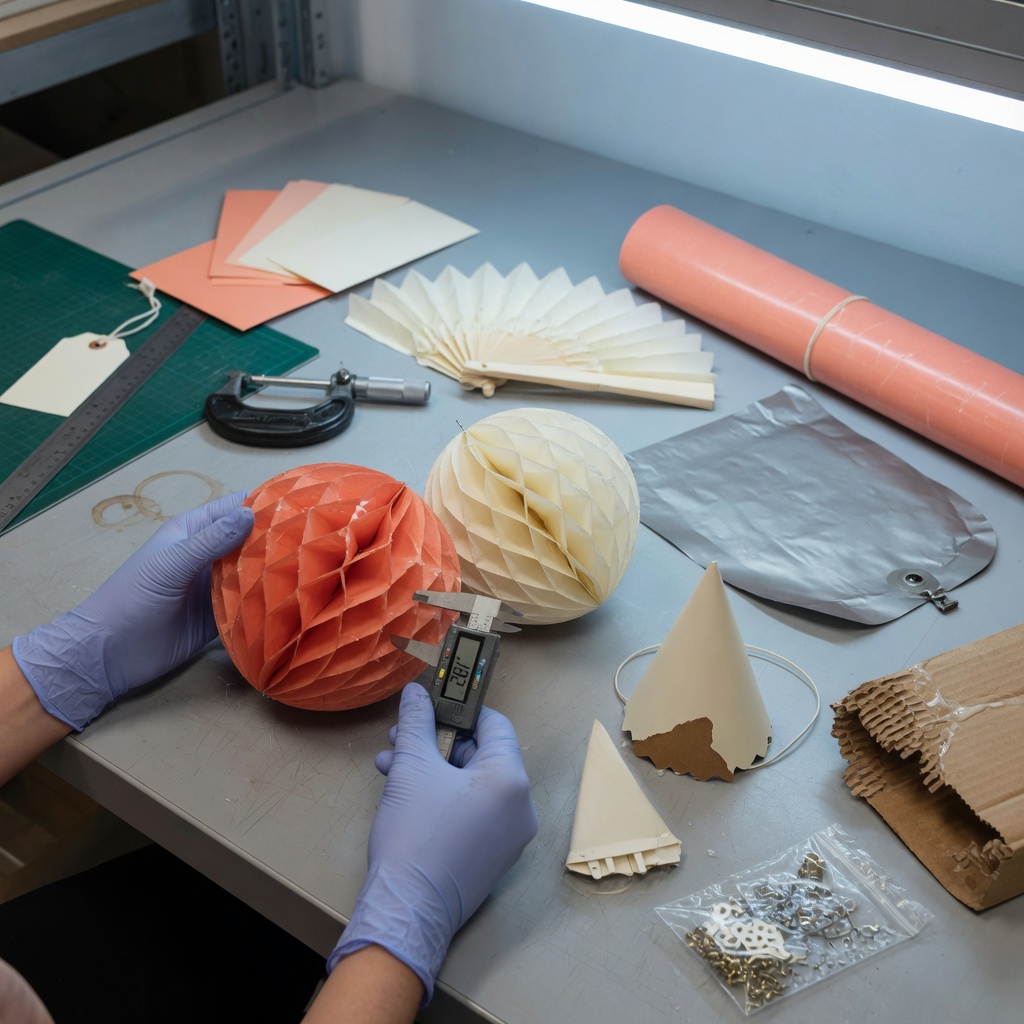
A paper banner, honeycomb ball, foil balloon, party hat, table cover, and photo prop do not share one factory route. Tooling, print, adhesives, compression recovery, and labeling diverge, and OEM reprint, ODM theme work, and private-label pack-out are different objects of procurement. Public OEM/ODM pages in this category describe theme development, in-house design, sampling windows, low MOQ, and children's-product document lists. Those pages are source context for how vendors describe capability. They are not lot certificates and not Joyline factory results. Use them to tighten the RFQ, then verify on samples, measurements, and lab reports.
How this procurement brief was derived
This page synthesizes three public manufacturer service pages as source context: GleeParty's custom party decoration OEM/ODM page, Sunbeauty's customized party supplies manufacturing solutions page, and Customcy's custom party decor manufacturer page. Every exact figure below is either a manufacturer-stated claim from those pages or an example calculation labeled for quote verification. United States labeling and children's-product controls are buyer checkpoints to confirm against current CPSC, CBP, and (for food-contact tableware) FDA primary texts at RFQ time. This article does not report factory audits, lab results, customer outcomes, prices, or search-demand metrics.
Procurement decision sequence before the RFQ
Run this sequence once per SKU, then issue one RFQ package. Do not compare vendors until the object of procurement is named.
- Classify the article: process family (paper converting, film/balloon, formed plastic, sewn/glued hat, or kit), intended user, décor-only versus play value, and whether the item will be sold in the United States as a children's product.
- Choose one path: OEM reprint, ODM theme, private-label on an existing shape, or new tooling/construction. Mixing paths on one line item hides setup cost and test scope.
- Freeze the US-facing spec: dimensions and tolerances, substrate, print process, hardware, forbidden licensed IP, pack-out, and English legal copy on the dieline.
- Define the sample ladder: design mock-up, engineering sample, then a pre-production (PP) sample from the intended process. Only the PP sample should release bulk.
- Attach the test and QC plan: methods by classification, lab identity where third-party testing is required, golden-sample retention, and reject rules.
- Quote landed cost, not piece price: Incoterm, carton cube and weight, proposed HTS (broker-confirmed), origin, tooling ownership, and freight window.
- Award on evidence IDs: PP sample ID, BOM freeze, test-report IDs if required, and PO reject rules for color, dimension, and pack-out.
What party decoration product development actually has to deliver
Map every SKU to a process family before comparing price:
- Paper converting: banners, fans, honeycomb, garlands, backdrops; GSM; print method; lamination; string and hardware.
- Film and balloons: foil registration, latex size and print area, valve type, inflation warning copy.
- Formed plastics and props: tool type, wall thickness, molded color versus paint, snap-fit versus glue.
- Hats and soft components: stitch versus glue, elastic, print method.
- Kits: bill of materials, polybag gauge, header card, UPC, inner and master pack.
A development-capable vendor can produce this sequence: written spec and risk classification; 2D mock-ups and, if the shape is new, 3D mock-ups; a prototype; a pre-production sample from the intended process; packaging dielines and barcode proofs; a US-matched test plan; a golden sample retained by both parties; a bulk QC plan tied to that sample.
Sunbeauty describes an in-house design workflow with 2D/3D mock-ups, then sampling and prototyping, then production, QC, and packaging, and states sampling and prototyping in 2–5 days (Sunbeauty customized party supplies manufacturing solutions). That 2–5 day window is manufacturer-stated (unit: calendar days; scope: that company's published customized party-supplies workflow; as-of: the cited public page, which is not independently timestamped in the source excerpt). In the RFQ, require the vendor to state whether those days are digital mock-ups, handmade models, or process-intent samples, and whether destination courier time to a United States address is included.
GleeParty describes a range from simple OEM to complete party theme development, with OEM/ODM, private label, packaging design, and a listed compliance set that includes CPC, ASTM F963, CPSIA, and EN71 (GleeParty custom party decoration service). Treat that list as a vendor's stated support, not a certificate for the buyer's SKU. EN71 is a European toy standard some exporters bundle; it does not replace United States CPC documentation or ASTM F963 third-party testing when the item is a children's product.
Customcy describes consultation and design, private-label product development, OEM manufacturing, prototyping and approval, and bulk shipping, and states a low MOQ starting at 50 units (Customcy custom party decor manufacturer). The 50-unit figure is manufacturer-stated (unit: finished units; scope: that company's published custom party-decor offer; as-of: the cited public page). Confirm whether 50 units applies to the buyer's process, whether it is per SKU or mixed order, and whether plates, dies, or molds are extra.
United States specification, labeling, and compliance controls
Keep the RFQ specific to United States entry, retailer onboarding, and intended user. Do not accept a generic "export standard" binder.
Classify before you design. Confirm on current CPSC materials whether the SKU is a children's product: in US practice, that class covers items designed or intended primarily for children 12 years of age or younger (unit: years of age; scope: US children's-product classification; as-of: verify the current CPSC definition at RFQ). Party hats, character props, favors with play value, and "kids' birthday" kits often fall in that class because of marketing and reasonably foreseeable use, not because the buyer prefers a lighter document set. Record intended user, age grade, and play value in the spec. Misclassification is a detention and recall risk.
If it is a children's product, require a written test plan that names the ASTM F963 edition the lab will use, CPSIA chemical methods, small-parts assessment where the construction warrants it, tracking-label layout, and a Children's Product Certificate based on third-party tests at a CPSC-accepted laboratory on the actual construction to be imported. A brochure that lists CPC, ASTM F963, and CPSIA is not that plan. Do not reuse a cousin SKU's report if ink, substrate, coating, hardware, or size changed.
Confirm current CPSC numerical limits in the RFQ rather than copying a brochure. Common buyer checkpoints to re-read on the current CPSC text include lead in paint or similar surface coatings at 90 ppm, total lead content in children's-product substrates at 100 ppm, and specified phthalates in children's toys and child care articles at 0.1% (1,000 ppm) (units: ppm or percent by weight; scope: US children's-product chemical limits where those rules apply; as-of: verify the current CPSC/CPSIA figures and product-class fit at RFQ). If the item is intended for children under 3 years of age, require a small-parts method such as 16 CFR 1501 on the actual construction (unit: years of age; scope: small-parts assessment trigger; as-of: verify current CPSC text). These figures are regulatory checkpoints, not a Joyline lab result and not a certificate for an untested SKU.
If it is not a children's product, still lock country-of-origin marking, truthful material callouts, any balloon or choking caution required by the construction, California Proposition 65 review if California distribution is in scope, and mechanical or flammability review for worn items. Latex balloon caution copy, where the construction is a latex balloon, is a separate labeling checkpoint (including the under-8 years of age warning language in current 16 CFR 1500.19 materials; unit: years of age; scope: latex balloon caution class; as-of: verify the current CPSC text). Food-contact plates, cups, and straws are not cleared by a toy standard; they need food-contact evidence matched to polymer or paper and use condition (FDA requirements to confirm with counsel and the lab).
Label copy is a development deliverable. Freeze English cautions, tracking-label fields (importer or manufacturer identity, production location, date or batch), origin, and barcode placement on the dieline before PP approval. A theme-correct sample with empty legal panels is not an approvable United States SKU.
Product development capability: OEM, ODM, and private-label decision table
Use one path per SKU. Compare vendors on evidence, not on slogans.
| Buyer decision | Path | RFQ inputs to lock | Evidence to compare | United States gate before PO or ship |
|---|---|---|---|---|
| Reprint buyer art on a known construction | OEM | Print-ready art, color standard, substrate GSM or film gauge, die-line, finish | Strike-off from the bulk print process; plate/die ownership | Origin mark, legal copy, and barcode on the real pack |
| Factory designs a theme the buyer brands | ODM | Theme, age grade, SKU count, forbidden licensed IP, color story | 2D/3D mock-ups, material callouts, sample calendar, design-file ownership | Test plan on the ODM construction, not a look-alike |
| Brand an existing factory shape | Private label | Logo, claims, header/hangtag, inner bag, carton marks, GTIN | Dieline, scan-grade barcode, carton cube and ply | Tracking label if children's product; no unverified material claims |
| New shape, size, or polymer/paper | Tooling / new construction | Dimensions with tolerances, 3D file or hand sample, material spec, volume | Tool quote, prototype, first-article measurements | Tests on the tooled item only |
| Substitute "eco" or special materials | Material change | Named method for any compostable or recycled claim; ink and adhesive | Mill certs, ink SDS, lab method for the claim | Substantiate the US-facing claim; do not print a compostable claim on an untested PE bag |
Customcy's page also mentions unique shapes and biodegradable materials. If that claim is required, name the method and the component it applies to. "Biodegradable" without a method is not a spec.
Sampling, MOQ, and lead-time trade-offs
Speed and fidelity trade off. A 2–5 day sample (Sunbeauty, manufacturer-stated on the cited page) can approve form and color direction. It cannot approve foil registration, honeycomb recovery after compression, or glue bonds if the sample was hand-built with a different adhesive or print process. Split approvals:
- Design sample (mock-up or handmade): theme and size only.
- Engineering sample: construction, hardware, and folds.
- Pre-production (PP) sample: intended line, inks, tools, and pack-out. Only the PP sample should release bulk.
Example calculation (assumption to verify in the supplier quote, not a market statistic): 4 SKUs × 3 colorways × 2 physical sample rounds = 24 samples before bulk release (unit: physical samples; scope: this example program; as-of: quote-dependent). State who pays for samples, revisions, and express freight to a United States address, and whether sample days pause for factory holidays.
A 50-unit MOQ (Customcy, manufacturer-stated) can support a test colorway on some converting work. It may not absorb plate, die, or mold cost. Ask for setup cost as a separate line and for unit cost at example RFQ volume brackets of 50, 200, 500, and 1,000 units per SKU (those brackets are request points, not industry averages). Confirm mixed-SKU MOQ rules and leftover print or film ownership.
Clock lead time from written PP approval, not from first artwork. Require a calendar that separates artwork days, sample days, third-party test days, production days, and freight days under the Incoterm you will buy. Brochure phrases such as "quick sampling" or "short lead time" are not usable until those units are defined.
Landed cost and delivery controls for United States orders
Do not compare development quotes on FOB piece price alone. Require the same workbook tab to show:
- Incoterm and named place (FOB port versus DDP warehouse)
- Pieces per inner, inners per master, master dimensions (cm), gross weight (kg), CBM to three decimal places
- Supplier-proposed HTS (buyer still confirms with a United States broker)
- Origin and manufacturer identity for tracking labels; broker review of duty and origin-risk at the planned entry date
- Tool and plate ownership versus payment terms
- Export carton-mark layout for DC check-in
- Who pays third-party lab fees and whether testing starts only after PP freeze
- For ocean, ISF data readiness and an invoice description that names the actual articles
Example calculation (assumption to verify in the supplier quote, not a catalog cube): a master carton of 60 cm × 40 cm × 40 cm is 0.096 CBM (0.60 m × 0.40 m × 0.40 m; unit: cubic metres; scope: this example export carton; as-of: quote-dependent; measure the actual shipper). A lighter paper SKU can still lose on CBM if honeycomb cartons ship half-empty. Put cube, origin, and proposed HTS next to unit price so design choices stay attached to landed cost.
For ocean entries, treat Importer Security Filing as a timed control: current CBP ISF practice requires filing 24 hours before cargo is laden aboard a vessel destined to the United States (unit: hours before lading; scope: US ocean ISF; as-of: verify the current CBP ISF rule at RFQ). A kit should not hide regulated components inside a generic "party set" line that cannot be classified.
RFQ checklist for product development capability
Attach this list to the RFQ. Each item is a specify, compare, verify, approve, or order action.
- Specify the SKU list by process family, intended user age, décor-only versus play value, and whether the item will be sold in the United States as a children's product.
- Specify dimensions and tolerances (flat size, assembled size, GSM/gauge) and the measurement method for honeycomb recovery, banner length, and hat circumference.
- Specify color with a physical chip or measured LAB target and the bulk print process, not only the mock-up process. If a numeric pass/fail is required, state it as a buyer request (example assumption to verify in the quote: ΔE 2.0 on the agreed illuminant; unit: CIELAB ΔE; scope: this RFQ color gate; as-of: quote-dependent). Do not treat that example as a factory default.
- Specify the artwork package: print-ready vector files, fonts outlined, bleed, dieline layers, included revision rounds, and 3D files if the shape is new.
- Specify IP and file ownership: no unlicensed characters; who owns artwork, 3D files, plates, and molds after payment.
- Specify pack-out: polybag gauge, header, GTIN, inner/master, carton ply, mixed versus solid SKU, barcode scan-grade target the pack must meet.
- Specify United States label copy: origin, tracking-label fields if applicable, balloon or small-parts cautions, and any counsel-directed Proposition 65 marking.
- Compare mock-up capability (2D/3D file types, included revisions, calendar) against the workflow the vendor claims.
- Compare MOQ and setup per process; if 50 units is quoted, verify process fit and unit cost at the next three volume brackets.
- Verify sample type: digital versus handmade versus PP from the production process; refuse bulk release on mock-ups alone; state the United States sample ship-to and whether courier days are inside the sample calendar.
- Verify the test plan by SKU: ASTM F963 and CPSIA methods for children's products; food-contact methods for tableware; no EN71-only substitute for US children's products; CPSC-accepted lab identity for required third-party tests; who pays the lab.
- Verify QC and retention: incoming materials, print registration, visual AQL (vendor-stated, buyer-approved), barcode scan, kit completeness, carton drop, and golden-sample hold period at both parties.
- Verify the landed-cost workbook: Incoterm, carton cube, proposed HTS, origin, tooling amortization versus separate setup, and ocean ISF readiness if applicable.
- Approve then order: sign the golden sample and BOM freeze; restate PP sample ID, test report IDs, Incoterm, ship window, and reject rules for color, dimension, and pack-out on the PO.
Limitations and what to verify before award
The three manufacturer pages used as source context are public commercial descriptions. They were not audited for this article, and the excerpts do not supply a reliable last-updated date. "Low MOQ," "quick sampling," and "short lead time" are not standard units until the quote defines process, SKU mix, sample type, and whether calendars include testing and freight. A 50-unit converting MOQ does not transfer to a new injection tool. A 2–5 day prototype does not include United States transit or third-party lab time. Compliance names on a service page are not a CPC, and EN71 is not a US children's-product passport. Chemical limits, age grades, balloon cautions, and ISF timing above are buyer checkpoints against current CPSC/CBP texts; they are not certificates for an untested construction.
Joyline Party Supply publishes this brief so United States buyers can specify party decoration development work with procurement controls. The page does not convert third-party marketing claims into Joyline certifications, factory capacity, test results, or customer case studies. Confirm current CPSC, CBP, and FDA obligations, plus any retailer file that is stricter than the legal minimum, on primary sources and in the supplier quote. If a claim cannot be tied to a named method, a sample ID, or a report ID, keep it off the PO.
Discuss Your Requirements
Review our manufacturing capabilities, then share your specifications for a supplier-fit review.