Party Supply OEM Sustainability Sourcing Criteria for Malaysia
By Vincent Xi, Editorial Author
First-hand experience note: The published author profile identifies Vincent Xi as an Editorial Author. It provides no approved basis for a first-person factory visit, product test, certification audit, or customer outcome, so no such experience is claimed.
For Malaysian procurement teams, party supply OEM sustainability sourcing criteria belong inside the quote-comparison and release process. The objective is not to rate an OEM in the abstract. It is to determine whether a quoted party supplies manufacturing SKU has a defined construction, claim-specific evidence, comparable environmental data, manufacturing traceability, and controlled substitutions.
Start with the finished product and pack configuration. Require the OEM to identify its legal entity and manufacturing site, declare material layers and component masses, reproduce the exact environmental claim under review, and link that claim to current evidence. Quantitative results need a stated unit, product denominator, boundary, reporting period, method, assumptions, and source-data status. Missing evidence should remain not provided rather than being replaced by a favorable estimate.
The cited sources provide topics for RFQ due diligence, not proof about a particular supplier or SKU. The MU Group article discusses compostable plates, biodegradable decorations, recycled paper goods, and documentation names including FSC, BPI, and OK Compost. The Market Prospects article discusses management systems, environmental targets, material declarations, product carbon footprints expressed in kgCO2e per unit, recyclable inputs, and design for disassembly. The Nicro article discusses biodegradable materials, FSC paper products, reduced plastic packaging, compliance, customization, and scalable production. None of these discussions establishes coverage, certification, performance, or compliance for a quoted product.
Sustainability Sourcing Criteria for Malaysia Party Supplies Manufacturing
The following gates are buyer-authored controls for a Malaysia-bound RFQ. They are not statements about an OEM's current materials, systems, certifications, or production capability.
| Decision gate | Required RFQ return | Release condition | Hold condition |
|---|---|---|---|
| Quoted-product identity | Supplier legal entity, manufacturing-site address, supplier SKU, buyer specification revision, intended use, dimensions, unit mass, and pack configuration | The quote and sample use the same identified construction and revision | The product, site, revision, or pack basis is unclear |
| Material and packaging scope | Finished-product and packaging composition by mass, including coatings, inks, adhesives, laminates, fillers, and intentionally added components | Every claim-relevant component is declared and linked to the quoted SKU | A layer or component is omitted or described only with a broad marketing term |
| Claim wording | Exact proposed wording for the product, packaging, or commercial documents | The wording is supported by evidence covering the relevant product, material, site, and document holder | The wording is broader than the available evidence |
| Quantitative basis | Unit, finished-unit definition, boundary, data period, allocation method, assumptions, calculation method, and source-data status | Competing results use comparable products, denominators, and boundaries | A result lacks its calculation basis or cannot be normalized |
| Manufacturing control | Approved material codes, incoming checks, production records, final inspection fields, lot traceability, nonconformance handling, and release records | The finished production lot can be linked to approved materials and claim evidence | Traceability ends at a catalogue, generic material family, or undated declaration |
| Change control | Written notice and buyer approval for changes to material, formulation, sub-supplier, site, tooling, artwork, coating, ink, adhesive, or packaging | A claim-relevant change triggers documented re-review before production release | The quotation allows unrestricted substitution |
Apply the gates in order. Confirm the quoted SKU first, assess the exact claim second, normalize measurable fields third, and review manufacturing controls before award. A reported reduction is not comparable when another quote uses a different product construction, pack count, denominator, or calculation boundary.
Build the RFQ Around the Quoted SKU
The buyer should freeze the comparison basis before asking suppliers for sustainability data. This keeps the sourcing decision attached to the product being purchased rather than to general supplier marketing.
| RFQ section | Buyer-issued field | Mandatory supplier return |
|---|---|---|
| Destination and responsibility | State Malaysia as the destination sales market and identify the buyer's responsible importing or distributing entity | Legal entity, manufacturing site, quotation contact, and any declared exceptions |
| Product definition | Buyer SKU, specification or drawing revision, intended use, dimensions, tolerances, print, finish, and functional acceptance criteria | Supplier SKU, proposed construction, unit mass, sample reference, and every deviation from the buyer specification |
| Material definition | Required or prohibited materials, coatings, inks, adhesives, finishes, and packaging components where already determined | Finished-product and packaging composition by mass, including claim-critical inputs and source changes |
| Claim request | Exact sustainability claim requested for the SKU, or a statement that no public environmental claim is required | Exact proposed wording and an evidence register tied to that wording |
| Quote basis | Order basis, saleable-unit definition, pack configuration, sample stage, and production basis | Price basis, pack basis, declared assumptions, and a separate deviation register |
| Approval controls | Sample approval, inspection fields, release records, and changes requiring written consent | Proposed incoming, in-process, final-inspection, traceability, nonconformance, and change-control records |
Require the evidence register to identify each certificate, test report, calculation, declaration, or chain document; its holder; covered product or material; covered site; issue status; validity; and verification route. A catalogue mark or raw-material document should not be treated as finished-SKU evidence unless its scope supports the proposed claim.
The supplied evidence does not establish a Malaysia-specific statutory, labeling, laboratory, tropical-climate, or logistics requirement for the quoted SKU. Do not add such a condition as a source-backed requirement without separate verification. The buyer's chosen qualified Malaysian compliance adviser or laboratory should first confirm applicability to the intended product, material, use, label, and sales channel. The applicable requirement and supporting supplier document can then be added to the RFQ.
Match Sustainability Claims to Evidence
Evidence should follow the proposed wording. A generic sustainability document cannot resolve a product-specific claim when its holder, site, material, or SKU scope differs.
| Proposed claim or attribute | Evidence to request | Source context | RFQ decision |
|---|---|---|---|
| Compostable or biodegradable | Exact wording, covered SKU and material, applicable test or scheme basis, document holder, covered site, validity, and conditions for using any mark | MU Group discusses compostable plates and biodegradable decorations but does not establish coverage for the quoted SKU | Hold the claim until the product scope, evidence scope, and proposed wording align |
| Paper sourcing or FSC-related wording | Current document, holder, covered products and sites, relevant order-level chain records, validity, and permitted wording | MU Group and Nicro mention FSC-related documentation or paper products without proving a specific finished-product claim | Do not infer finished-SKU coverage from a catalogue mark or raw-material description |
| Recycled paper or recycled content | Finished-product composition, content basis, calculation or chain documents, product code, and covered production source | MU Group discusses recycled paper goods but supplies no content result for the quoted SKU | Approve only the content and wording supported for the finished product |
| Recyclable input or separable construction | Full composition, separability information, coatings and adhesives, proposed recovery route, and basis for the claim | Market Prospects discusses recyclable inputs and design for disassembly | Assess the actual construction separately from the availability of a recovery route for the intended use case |
| Product carbon footprint | Result in kgCO2e per finished unit, finished-unit definition, lifecycle boundary, data period, allocation method, assumptions, calculation method, and source-data status | Market Prospects discusses product carbon footprints expressed in kgCO2e per unit but provides no result for the quoted SKU | Compare results only when the product definition, denominator, and boundary match |
| Reduced plastic packaging | Baseline and proposed packaging composition and mass on the same saleable-unit basis, with unchanged protection and pack-performance criteria | Nicro discusses reduced plastic packaging without supplying a baseline or result for the quoted SKU | Hold a reduction claim if the pack count, product configuration, or protection basis changes |
| Facility environmental or energy management | Current system document or certificate, legal entity, site, scope, issuer, validity, objectives, reporting period, and verification route | Market Prospects discusses environmental and energy management as supplier-qualification considerations | Treat facility documentation as site evidence, not proof of a finished-product claim |
FSC, BPI, and OK Compost are names found in the supplied source discussion. Their appearance there does not establish a scheme requirement, current certification, or permission to use a mark. Any RFQ requirement is the buyer's sourcing practice unless a current applicable scheme document states otherwise. Verify the document holder, product and site scope, validity, and wording conditions before relying on it.
Normalize Manufacturing Quote Data Before Award
The Market Prospects source supports requesting product carbon information in a kgCO2e per unit format. It does not supply a value for any quoted SKU. Buyers should define unit as the same finished saleable unit across all quotations and freeze the lifecycle boundary before comparison.
Editorial example assumptions: Every numeric value below belongs only to a hypothetical unprinted paperboard plate in a Malaysia-bound RFQ dated 15 March 2026. The scope is one finished plate SKU and its primary packaging over a 12-month ordering period. The values are editorial assumptions, not supplier measurements or Joyline product specifications. Each value must be replaced and verified in the signed supplier quote, approved specification, and supporting records.
| Comparison field | Hypothetical value | Source and verification status |
|---|---|---|
| Demand | 100,000 finished plate units per 12-month ordering period | Editorial assumption for the hypothetical Malaysia RFQ dated 15 March 2026; verify in the signed supplier quote |
| Nominal diameter | 230 mm per finished plate unit | Editorial assumption for the same dated RFQ and SKU; verify in the approved product specification and supplier quote |
| Finished-product mass | 18 g per finished plate unit | Editorial assumption for the same dated RFQ and SKU; verify through the approved specification, measurement method, and supplier quote |
| Primary-packaging mass | 2 g per finished plate unit | Editorial assumption for the same dated RFQ, SKU, and pack scope; verify through the packaging specification and supplier quote |
| Product carbon field | 0.030 kgCO2e per finished plate unit using an assumed cradle-to-gate boundary | The unit format is informed by Market Prospects; the numeric value and boundary are editorial assumptions for the same dated RFQ and must be replaced by supported supplier data |
For that hypothetical Malaysia RFQ dated 15 March 2026, the normalized totals are derived as follows:
100,000 finished plate units x 18 g per finished plate unit = 1,800 kg of finished-product massover the assumed 12-month ordering period. This is an editorial calculation from the assumptions above and must be recalculated from verified supplier data.100,000 finished plate units x 2 g per finished plate unit = 200 kg of primary-packaging massover the same assumed 12-month ordering period. This is an editorial calculation from the assumptions above and must be recalculated from verified supplier data.100,000 finished plate units x 0.030 kgCO2e per finished plate unit = 3,000 kgCO2ewithin the assumed cradle-to-gate boundary over the same 12-month ordering period. This is an editorial calculation from the assumptions above and must be replaced by a supported supplier calculation.
Do not use these example values as acceptance limits or sourcing targets. In a live comparison, retain missing values as not provided, assess packaging on the same pack and protection basis, and compare carbon results only after the product definition, boundary, period, allocation method, and source-data quality are aligned.
Carry Sustainability Evidence Into Manufacturing QC
A document reviewed at quotation stage should remain linked to the approved construction and production lot. The buyer can make that linkage explicit through the following manufacturing controls.
| Manufacturing stage | Buyer control | Release evidence |
|---|---|---|
| Quotation and sample review | Record the supplier SKU, buyer revision, manufacturing site, material codes, packaging construction, proposed claim, and evidence register | Approved specification, identified sample, declared deviations, and reviewed evidence scope |
| Pre-production review | Identify claim-critical inputs and approved sub-suppliers before production | Material approvals and incoming-document requirements linked to the current evidence set |
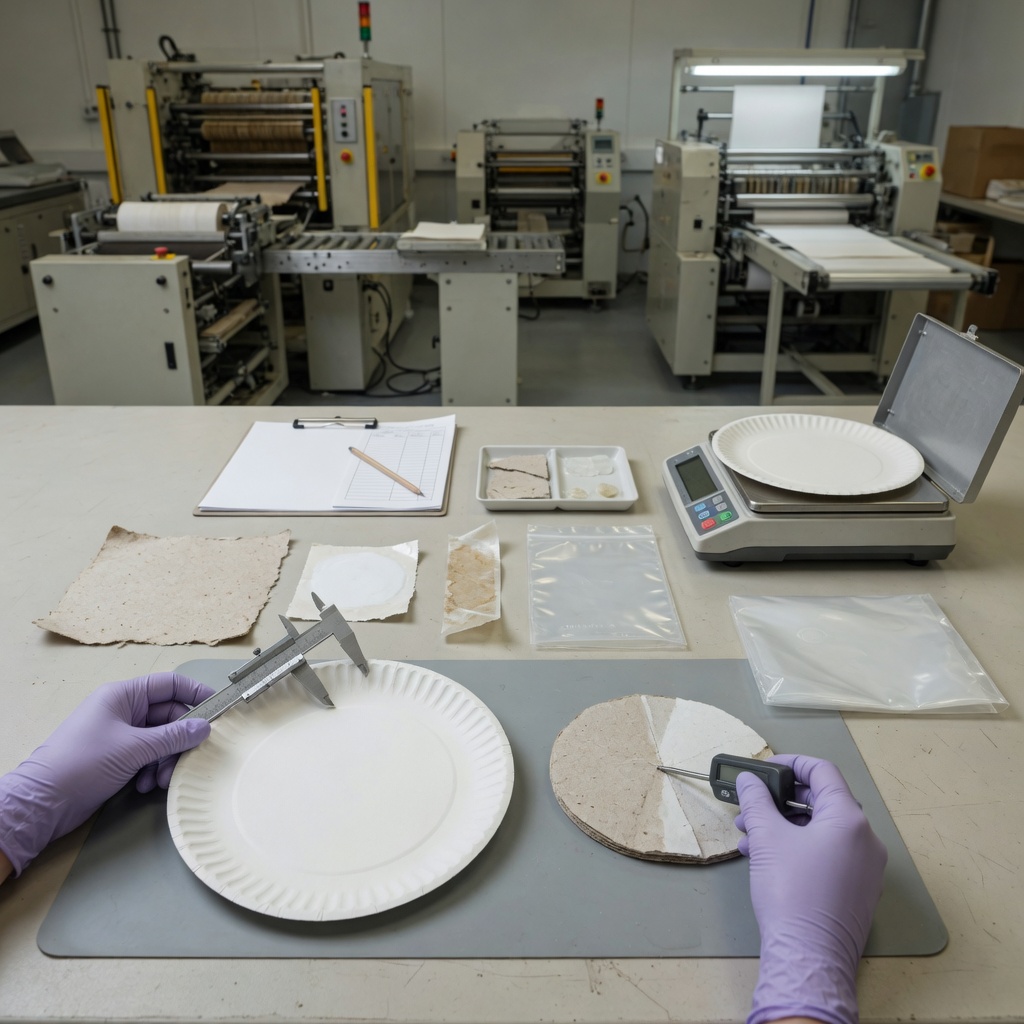
| Incoming and in-process QC | Check approved material identity and record buyer-defined dimensions, mass, converting condition, print, coating, and pack fields where applicable | Inspection records tied to the production order and material lots |
| Final inspection | Keep measurable product checks separate from documentary claim checks | Final inspection report, packaging record, traceability record, and resolved nonconformances |
| Shipment release | Link the purchase order, production lot, inspection report, approved material records, claim evidence, packaging record, and artwork revision | A release packet identifying the shipped lot and approved evidence set |
| Change review | Require written notice before a claim-relevant material, formulation, sub-supplier, site, tooling, artwork, coating, ink, adhesive, or packaging change | Buyer approval, updated sample or evidence where needed, and a documented effective lot |
The approved sample should not replace the written construction or evidence register. Visual and dimensional inspection can confirm product identity and specification conformity, while environmental wording still requires separate documentary verification.
Malaysia Quote Release Checklist
- [ ] Malaysia is identified as the destination sales market, with the buyer's responsible importing or distributing entity recorded.
- [ ] Every quoted SKU has a buyer specification or drawing reference and revision.
- [ ] Intended use, dimensions, tolerances, materials, coatings, inks, adhesives, print, packaging, and functional criteria are defined where relevant.
- [ ] The exact sustainability claim is stated for each SKU, or the RFQ states that no public environmental claim is required.
- [ ] Finished-product and packaging composition are returned by mass.
- [ ] The legal entity, manufacturing site, and claim-critical sub-suppliers are identified.
- [ ] Certificates, tests, calculations, declarations, and chain documents are listed in a SKU-linked evidence register.
- [ ] Document holder, product scope, site scope, issue status, validity, method, and verification route have been checked.
- [ ] Carbon information uses
kgCO2e per finished unitand states its boundary, period, assumptions, allocation method, calculation method, and source-data status. - [ ] Production-lot traceability connects approved materials and claim evidence to shipment release.
- [ ] Undeclared substitutions are prohibited and claim-relevant changes require written buyer approval.
- [ ] Any proposed Malaysia-specific requirement has been confirmed for the actual product and use case by the buyer's chosen qualified Malaysian compliance adviser or laboratory.
- [ ] Missing mandatory evidence remains
not provided, with award approval held until the gap is closed or formally accepted by the buyer.
Methodology, Source Context, and Limitations
Methodology: Factual statements were retained only where a supplied source or the published author profile supports them. Source topics were converted into buyer-controlled RFQ fields, evidence requests, comparison rules, and hold conditions. The numerical example is explicitly hypothetical. Its totals were derived by multiplying the assumed finished-unit demand by the assumed per-unit product, packaging, or carbon value within the stated SKU, date, boundary, and ordering-period scope.
Source context: The MU Group article is used only for its discussion of compostable plates, biodegradable decorations, recycled paper goods, and documentation names including FSC, BPI, and OK Compost. The Market Prospects article is used only for its discussion of management systems, environmental targets, material declarations, product carbon-footprint units, recyclable inputs, and design for disassembly. The Nicro article is used only for its discussion of biodegradable materials, FSC paper products, reduced plastic packaging, compliance, customization, and scalable production. The Vincent Xi author profile supports the author's name and Editorial Author role only.
Limitations and what to verify: The cited commercial articles are not Malaysian legal text, standard text, accreditation records, laboratory reports, supplier audit files, or evidence for a specific finished SKU. They do not establish an OEM's certification, regulatory compliance, composition, environmental performance, capacity, price, delivery result, or customer outcome. Before award, verify the current applicability of any Malaysia requirement; the holder, scope, validity, and permitted wording of each document; the complete product and packaging composition; calculation and test methods; approved-sample performance; production-lot traceability; packaging protection; and written change controls. Replace every hypothetical value with evidence from the supplier quote and supporting records.
Discuss Your Requirements
Review our manufacturing capabilities, then share your specifications for a supplier-fit review.