Party Supply Wholesale Supplier Product Development Capability for Europe
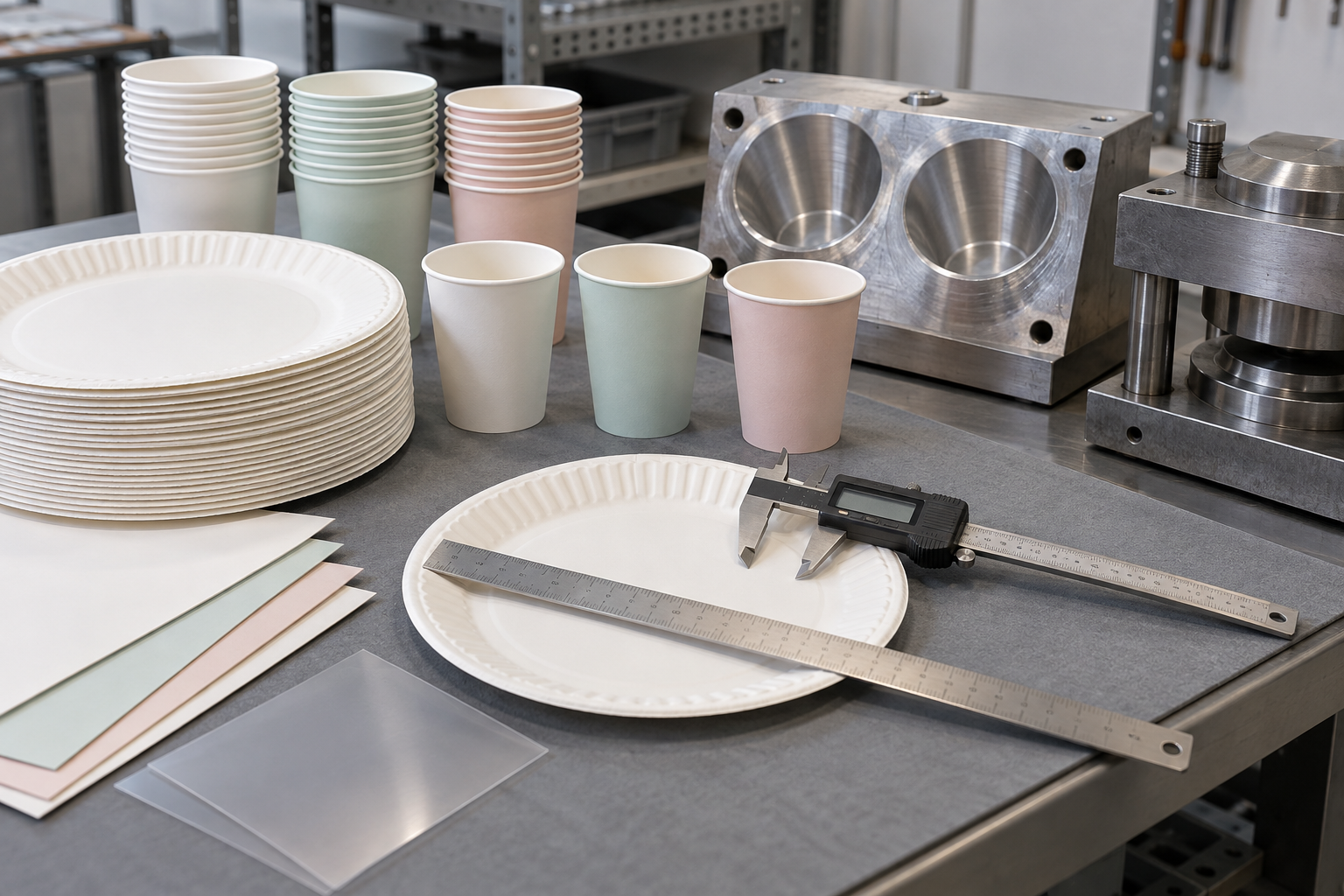
A European buyer should treat party supply wholesale supplier product development capability as a documented engineering and commercial process, not a marketing promise. For party supplies entering wholesale supply channels across Europe, contract approval requires separating open-stock products from custom-tooled components, locking sample and production schedules to calendar days or weeks, establishing legal ownership of intellectual property and forming dies, and auditing documentation against destination-specific safety directives. Published lead times and order minimums from commercial suppliers serve as comparative benchmarks only and do not represent Joyline Party Supply operational figures, minimums, or regulatory clearances.
Publicly available benchmark data from Chinese manufacturing groups provides structural references for development timelines. MU Group indicates that product samples for customized wholesale party supplies typically require 1–2 weeks, followed by 2–6 weeks to dispatch the initial production shipment, according to its supplier profile (MU Group). Sunbeauty indicates that prototype sampling typically takes 2–5 days and minimum order quantities start as low as 500 sets for multiple custom items (Sunbeauty). Both sources represent undated web excerpts from separate entities; their figures cannot be combined into an aggregate standard, nor do they reflect guaranteed execution schedules for an EU, EEA, or UK port of entry without written verification.
This analysis is authored by Vincent Xi, Editorial Author (https://joylinepartysupply.com/authors/vincent-xi/). It does not document an on-site factory inspection, personal trial, private client engagement, or internal Joyline laboratory evaluation. Any assertions requiring unverified first-hand observation are omitted.
Evaluating Product Development Capability for European Orders
Within European commercial procurement, product development capability represents a supplier's capacity to translate technical specifications into production-grade party tableware, decorations, or favor items that achieve repeat manufacturing accuracy within regulated thresholds. B2B buyers must differentiate between turnkey in-house manufacturers and trading agencies that outsource industrial execution.
YISOO notes coordination across product development, packaging design, factory production, and international logistics via contract manufacturing facilities in China and Southeast Asia, while stating that custom tooling and engineering support include in-house molding for proprietary shapes, custom designs built to buyer specifications, and direct communication with bilingual designers (YISOO). Regional manufacturing references to China or Southeast Asia define origin operations rather than target consumer markets; the procurement contract must explicitly name the European importing jurisdiction.
MU Group outlines an operational scope covering design conceptualization, factory sourcing, iterative development, quality assurance, scheduling, and market-tailored product customization (MU Group). Sunbeauty details an OEM/ODM pathway extending from structural sketching and prototyping to mass production and export, maintaining an internal design department for ODM concepts, proprietary trend development, custom mold fabrication, and integrated packaging engineering (Sunbeauty).
These external operational statements provide structural criteria for supplier evaluation. An outsourced contractor model requires explicit contract riders specifying the producing factory location, tool maintenance obligations, and financial liability for non-conforming pre-production batches. Conversely, a vendor claiming proprietary in-house toolmaking must substantiate that claim with formal tooling registers, engineering revision logs, and cavity drawings before scoring an RFQ submission.
Procurement teams must standardize five baseline specifications prior to tender release:
- Substrate and Geometry: Base material grade (e.g., virgin paperboard, bagasse, rPET), critical outer dimensions in millimetres with explicit tolerances, and open-stock versus proprietary tool status.
- Surface Decoration: Printing methodology (flexographic, rotogravure, offset), ink formulations, PMS pantone codes, and file validation protocols.
- Packaging Engineering: Primary inner wrap, outer carton ply rating, palletization dimensions, and distributor barcode labeling.
- Regulatory Dossier: Target territory documentation matching the specific EU, EEA, or UK legal regime.
- Commercial Framework: Order volume per SKU, batch development sequencing, delivery milestone dates, and governing Incoterms.
Europe Rules That Change the Product Development Brief
European product compliance is not a unified single-standard environment. Technical dossiers must differentiate among the European Union (EU), the European Economic Area (EEA), the United Kingdom (UK), and national deviations.
Within the EU single market, general consumer products fall under the General Product Safety Regulation (EU) 2023/988, enforceable since 13 December 2024. The GPSR imposes traceability obligations, mandatory technical documentation, and designated economic operator appointments. A factory ISO certificate or vendor self-declaration is legally insufficient without a complete technical dossier. Furthermore, party products classified as toys intended for children under 14 must comply with Directive 2009/48/EC on toy safety, requiring strict migration testing for chemical substances, mechanical safety reviews, and the CE mark. Food-contact items—including disposable paper plates, cups, and napkins—must comply with Framework Regulation (EC) No 1935/2004, Good Manufacturing Practice Regulation (EC) No 2023/2006, and, for synthetic coatings or plastics, Regulation (EU) No 10/2011. Chemical restrictions under REACH Regulation (EC) No 1907/2006 apply horizontally to all substrates. These regulatory references define legal statutory obligations of the respective EU instruments; they do not describe Joyline's internal quality management certifications or current documentation.
The EEA framework encompasses Norway, Iceland, and Liechtenstein, incorporating EU product safety directives only as adopted into the EEA Agreement. Buyers shipping directly to EEA nations must confirm whether specific revisions of EU regulations have entered formal regional enforcement. A generic EU declaration of conformity does not automatically cover independent national EEA statutes.
Great Britain (England, Scotland, and Wales) operates an independent statutory system requiring the UKCA mark where applicable, governed by UK product safety legislation. Northern Ireland remains aligned with relevant EU internal market rules under the Windsor Framework, necessitating CE marking rather than UKCA marking for covered categories. Additionally, individual EU member states enforce independent packaging Extended Producer Responsibility (EPR) registrations and linguistic labeling mandates (such as Triman labeling rules in France). Shifting a paper plate from purely decorative status to food-contact certification alters substrate barriers, ink selection, migration laboratory testing, and pre-production tooling sign-offs.
Sampling, Tooling, and Lead-Time Trade-offs
Comparing development proposals requires auditing physical tooling status, sampling definitions, minimum thresholds, and intellectual property terms.
Tooling classification determines capital requirements and delivery windows. Open-stock items utilize pre-existing forming dies and injection cavities, whereas custom product geometries require new tooling. YISOO references proprietary product shapes engineered through custom tooling (YISOO), and Sunbeauty cites custom tooling integration within its OEM/ODM process (Sunbeauty). Neither publication quantifies mold acquisition costs, steel alloy grades, cavity counts, or expected mold life measured in operational cycles. Without contractual clauses establishing mold ownership, a buyer cannot secure legal title over production tooling or prevent unauthorized third-party runs.
Sample classifications dictate lead-time reliability. Sunbeauty publishes a typical sampling window of 2–5 days, while MU Group publishes a typical range of 1–2 weeks for development sampling followed by 2–6 weeks to initial shipment. These measurements reflect supplier-reported estimates rather than verified empirical averages. A rapid 2–5 day sampling claim generally denotes digital mockups, flat-sheet print strike-offs, or unprinted rapid prototypes. An authentic production-tool sample derived from multi-cavity dies requires verified tool completion, machine calibration, and polymer/board conditioning. The RFQ must establish an unambiguous start gate: signed 2D/3D mechanical drawings, approved prepress artwork, verified substrate availability, and tool capitalization.
Published order minimums must be audited against production realities. Sunbeauty reports minimums as low as 500 sets for multiple customized products (Sunbeauty). In industrial party goods manufacturing, the definition of a "set" varies widely between a shrink-wrapped pack of 8 paper plates and a multi-item seasonal kit. A 500-unit floor is rarely economically feasible for high-cavity custom molding or rotary die-cutting requiring substantial setup scrap; buyers must confirm whether such low minimums apply exclusively to digital print overlays on existing blanks.
For planning purposes, combining the upper bounds of MU Group's stated timeline—2 weeks for sampling plus 6 weeks to initial shipment—produces an illustrative development window of 8 weeks. This calculation is strictly an example scenario for workflow modeling. It relies on undated source material, assumes no concurrent overlapping between sampling and fabrication, and excludes third-party European laboratory testing and ocean transit. Joyline Party Supply does not quote this illustrative timeframe as a standard commercial schedule.
Intellectual property and quality controls require contractual precision. While YISOO highlights direct access to bilingual designers to facilitate cross-border communication (YISOO), technical drafting support does not convey copyright or mold exclusivity to the buyer. If proprietary ODM artwork is adapted, contract riders must clarify exclusivity periods and geographical restrictions. Furthermore, none of the cited commercial sources specify statistical quality metrics such as Acceptable Quality Limit (AQL) levels, defect severity definitions, or ISO 2859-1 inspection tables. The buyer must explicitly stipulate quality acceptance standards in the purchasing specification.
Buyer Decision Table for Approving a Development Path
Each technical and contractual factor must be resolved before transferring tooling deposits or signing mass-production orders.
| Procurement Decision | Specification Requirement | Published Reference Benchmark | Mandatory Pre-Order Verification |
|---|---|---|---|
| Tooling Classification | Substrate grade, physical dimensions in mm, dimensional tolerances | Custom tooling referenced by YISOO and Sunbeauty; cavity count and tool cost unstated | Engineering drawings, steel grade, cavity configuration, and legal mold ownership deed |
| Sample Milestone | Clock trigger point, prototype method vs. off-tool sample | Sunbeauty: 2–5 days; MU Group: 1–2 weeks (undated supplier documentation) | Clear scope defining whether sample is a rapid prototype or mass-production off-tool sample |
| Mass Production Lead Time | Production volume, packaging spec, Incoterm, European destination | MU Group: 2–6 weeks to initial export dispatch | Written operational schedule confirming whether laboratory migration testing sits inside the window |
| Minimum Order Volume | Metric unit (pieces, retail packs, outer cartons), definition of a set | Sunbeauty: minimums as low as 500 sets for select customized SKUs | SKU-specific minimum order thresholds and tiered unit pricing schedules |
| Design & Engineering IP | CAD drafting, vector artwork assets, OEM vs. ODM designation | YISOO cites bilingual designers; Sunbeauty notes internal design department | Explicit assignment of mold title, design rights, and territorial exclusivity agreements |
| Regulatory Documentation | Destination jurisdiction (EU, EEA, UK), food-contact vs. toy status | General manufacturing coordination noted; statutory dossiers not published | Complete technical dossier, migration lab reports, Declarations of Compliance (DoC) |
| Batch Consistency | Drawing revision level, resin/board formulation, packaging bill of materials | Quality management claims published without inspection indices | Physical golden sample retention, AQL inspection parameters, and engineering change protocols |
RFQ Checklist
- Ask the supplier to state, for each SKU, whether production uses an existing tool or new tooling, and to provide mold ownership, cavity count, and estimated tool life in shots.
- Require the manufacturer to quote sample lead time and first-shipment lead time separately in days or weeks, specifying the start gate and whether EU, EEA, or UK laboratory testing time is included.
- Specify the destination market as EU, EEA, UK, or an individual member state, and state whether the item is general decor, food-contact ware, or a toy to align the compliance document list.
- Ask the supplier to define the minimum order quantity at the individual SKU level, clarify what constitutes a set, and state whether published volume thresholds apply to the quoted specifications.
- Require the manufacturer to fix material grades, dimensional tolerances in millimetres, print methods, and packaging counts on the approved production drawing prior to tooling.
- Specify commercial and legal ownership of CAD drawings, artwork files, and physical molds, including contractual restrictions preventing unauthorized resale or shared tool usage.
- Ask the supplier to identify the physical manufacturing location and document the quality control inspection regime, including defect classifications and sampling standards.
- Require the manufacturer to provide all regulatory declarations and test protocols for the named market before releasing tooling funds, noting any non-producible documentation.
- Require procurement comparisons to align identical Incoterms, order quantities, substrate specifications, and sample revision stages across all competing bids.
- Require final mass-production authorization to depend strictly on an approved golden sample, rejecting any undocumented alterations to materials, coatings, inks, or packaging.
How These Figures Were Derived and What to Verify
The numerical benchmarks cited in this analysis derive from public website content published by three party-goods manufacturing and trading companies: YISOO, MU Group, and Sunbeauty. The concrete data points extracted directly from their published literature are limited to: prototype sampling in 2–5 days (Sunbeauty); order minimums starting at 500 sets for selected custom lines (Sunbeauty); sample turnaround in 1–2 weeks (MU Group); and first-batch shipment execution in 2–6 weeks (MU Group). The 8-week delivery calculation represents an illustrative mathematical addition of MU Group's maximum published durations (2 weeks sampling plus 6 weeks production) to demonstrate workflow timing. No internal Joyline Party Supply operational figures, empirical cycle studies, or market demand statistics were utilized.
The external benchmarks lack source publication dates, material-specific context, and standardized operational baselines. They do not define contractual Incoterms, substrate compositions, or destination compliance verification. Furthermore, claims of integrated design capabilities, proprietary tooling, or factory coordination reflect supplier marketing descriptions rather than accredited independent audits. Procurement teams must treat these figures as baseline discussion points rather than contractual realities.
Prior to committing capital, buyers must verify: tooling ownership deeds and cavity configurations; prototype classifications and clock start gates; SKU-level minimum order quantities and tier pricing; substrate compliance with EU (Regulation (EC) No 1935/2004, GPSR (EU) 2023/988), EEA, and UK safety regimes; accredited laboratory test reports; and strict golden sample sign-offs. Until these technical parameters are formally executed, a party supply wholesale supplier product development capability claim is not an approval for Europe.
Discuss Your Requirements
Review our manufacturing capabilities, then share your specifications for a supplier-fit review.