Party Tableware OEM Quality Control Inspection for Europe
By Vincent Xi, Editorial Author
Author basis note: The approved author profile confirms Vincent Xi's name and Editorial Author role. It does not support a first-person manufacturing, factory inspection, product testing, certification, or customer-outcome claim, so none is made here.
For European B2B procurement, put the party tableware OEM quality control inspection plan into the RFQ before comparing quotations or authorizing manufacturing. The plan should define the inspected SKU, measurable requirements, production lot, inspection stages, evidence package, defect rules, and shipment-release decision.
Use separate destination rows for the EU, non-EU EEA destinations, Great Britain, Northern Ireland, and any country-specific requirements relevant to the order. The supplied sources do not establish one legal or documentary route for every European market. A destination-by-SKU evidence matrix is therefore more reliable than a quotation that refers only to European compliance.
This article provides an editorial RFQ framework. It does not state that Joyline or any candidate supplier follows these controls, holds a certification, meets a particular specification, or can manufacture the example products described below. Require each supplier to return its actual capabilities, deviations, records, costs, and lead-time effects in writing.
Europe Party Tableware Quality Control Inspection RFQ
Send every candidate supplier the same controlled inspection schedule. Require a response of Comply, Deviation, or Not offered for each requirement, supported by the applicable evidence and commercial effect.
| RFQ decision | Buyer requirement | Supplier return | Hold or approval rule |
|---|---|---|---|
| Product scope | Identify every SKU, set component, material, color, finish, artwork revision, quantity, and packing configuration | Completed SKU matrix with assumptions, exclusions, manufacturing site, and disclosed subcontractors | Do not compare prices until unmarked specification differences are resolved |
| Destination and use | Name each European destination and state the intended food-contact conditions, contact duration, temperature conditions, and single-use or reuse status | Destination-by-SKU applicability and evidence matrix | Hold technical approval while destination scope or evidence ownership is unclear |
| Controlled specification | Attach drawings, bill of materials, artwork, tolerances, test methods, packing requirements, and reference-sample controls | Signed specification and marked deviation list | Do not treat a generic quality statement as technical acceptance |
| Production lot | Define the lot by SKU, material batch, artwork revision, production period, line, site, and subcontractor where relevant | Traceability plan linking inputs, production records, inspected units, and cartons | Do not apply an inspection result to an undefined or mixed lot |
| Inspection sequence | Allocate incoming-material, first-production, in-process, packed-lot, and reinspection controls | Control plan with timing, frequency, records, owners, and hold points | Manufacturing and shipment proceed only under the agreed gate rules |
| Defect and sampling rules | Attach buyer-approved defect examples and state any contracted sampling basis | Inspector worksheet, selection method, raw results, and defect classification | Hold a report that omits the agreed selection or acceptance basis |
| Lot release | List every approval, report, declaration, deviation, packing record, and traceability record required before shipment | Lot-linked release file and unresolved-issue list | Release only after the required evidence passes or a named deviation receives written buyer disposition |
| Failed-lot control | Allocate containment, sorting, rework, replacement, reinspection, storage, and delay responsibility | Corrective-action workflow and commercial terms | Keep affected goods segregated and on hold until the agreed disposition is complete |
Freeze the SKU and Lot Specification
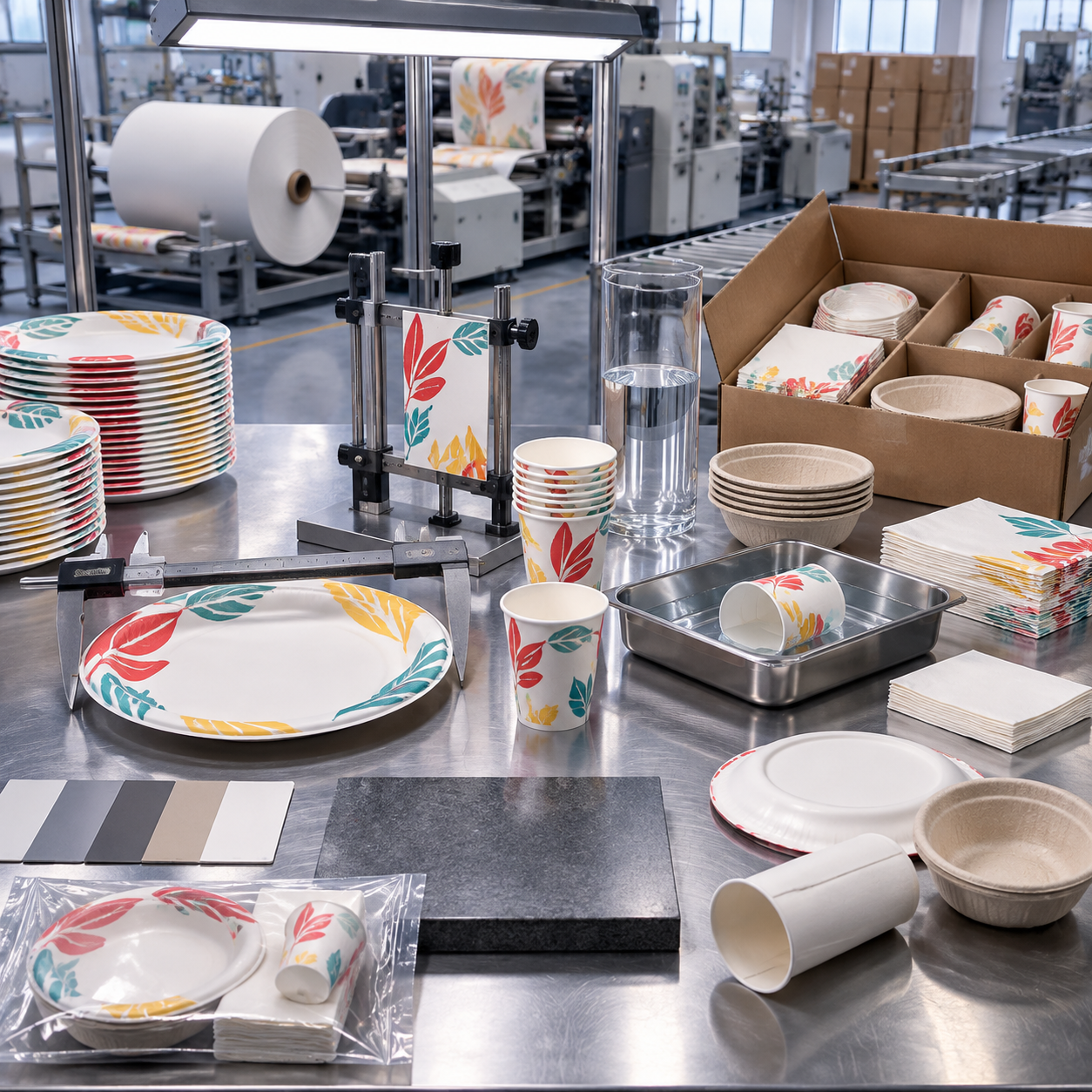
Create a controlled specification for each plate, bowl, cup, cutlery item, napkin, or mixed party tableware set. Phrases such as standard export quality, usual tolerance, and same as sample are not measurable unless the quotation identifies the approved sample, revision, test condition, and permitted variation.
The specification should cover:
- Commercial identity: Buyer SKU, supplier SKU, product description, quantity, set composition, variant assortment, manufacturing site, and subcontracted operations.
- Material construction: Applicable substrate, resin, fibre, ceramic body, glaze, alloy, coating, ink, adhesive, colorant, decoration, and food-contact component.
- Intended use: Food type, contact duration, serving or storage conditions, single-use or reuse status, and buyer-defined restrictions.
- Dimensions: Drawing revision, measurement points, target, unit, upper and lower limits, equipment, conditioning method, and rounding rule.
- Appearance: Artwork revision, color reference, print position, surface finish, rim or edge condition, viewing conditions, approved range, and boundary samples.
- Function: Buyer-selected leak, load, fit, separation, nesting, stability, handling, or thermal checks, including specimen preparation and acceptance rules.
- Packing: Unit count, set assembly, assortment, inner protection, carton construction, sealing, pallet requirements, shipping-mark source, and traceability-code position.
- Change control: Written approval before changing a material, formulation, coating, decoration, tool, process, manufacturing site, subcontractor, test method, or packing configuration.
For a mixed set, list every component and its permitted quantity in the finished pack. Request component-level evidence when materials, decorations, coatings, or intended contact conditions differ. Evidence for one component should cover the complete set only when the document's stated scope explicitly supports that use.
Convert Requirements into Measurable Checks
Every inspection line should identify the characteristic, SKU scope, target or limit, unit, method, equipment, conditioning, sample basis, manufacturing gate, raw result, and disposition. Approve these fields before production instead of allowing the final report template to define them later.
The values below are buyer-authored hypothetical assumptions only. They are not sourced industry limits, Joyline specifications, or candidate-supplier capabilities. Every exact value must be replaced or explicitly verified in the supplier quotation and signed specification.
| Hypothetical inspection item | Example assumption to verify in the supplier quote | Required raw record |
|---|---|---|
| Coated-paperboard plate diameter | For this hypothetical plate SKU only, verify a nominal diameter of 230 mm with a +/- 2 mm tolerance, measured across the agreed perpendicular axes after the specified conditioning | Individual readings, measurement points, equipment identifier, sample identity, and disposition |
| Coated-paper cup leak check | For this hypothetical cup SKU only, verify a fill volume of 250 mL, water conditioned to 23 +/- 2 degrees C, and an observation period of 30 minutes; the example acceptance condition is no visible external leakage | Actual fill volume, water temperature, start and finish times, sample identity, photographs, and observation |
| Printed plate artwork position | For this hypothetical printed plate only, verify a nominal artwork datum of 8 mm from the rim with a +/- 1 mm tolerance under the agreed fixture or measurement method | Measured offset for each selected sample and the approved artwork revision |
| Finished plate retail pack | For this hypothetical pack only, verify 20 plates per pack, with the approved SKU, color, artwork revision, and packing orientation | Actual unit count and identity result for each selected pack |
A supplier may quote a different value or method, but the deviation should be visible and priced. Technical acceptance occurs only when the buyer approves the revised requirement, method, evidence, and commercial effect in writing.
Set Manufacturing Inspection Gates
Specify which evidence must exist at each manufacturing stage. Do not use a final packed-lot inspection as a substitute for material, setup, or process records that were required earlier.
| Inspection gate | Buyer-specified checks | Required evidence | Buyer decision |
|---|---|---|---|
| Pre-production review | Destination, intended use, specification revision, bill of materials, artwork, sample status, test methods, defect catalogue, packing, and document ownership | Signed review record and unresolved-deviation list | Approve setup, return for correction, or stop |
| Incoming-material control | Identity and traceability of applicable substrate, resin, fibre, ceramic body, glaze, alloy, ink, coating, adhesive, or colorant | Supplier-lot reference, incoming result, and specified declaration or report | Accept, quarantine, or investigate |
| First-production approval | Construction, dimensions, fit, surface, rim, seams, print position, color reference, function, and pack setup | Raw measurements, photographs, failed-sample identity, and signed disposition | Continue, adjust and resubmit, or stop |
| In-process inspection | Buyer-selected characteristics that require monitoring during the run | Time- or quantity-linked observations and measurements | Continue, contain affected output, or stop |
| Packed-lot inspection | Carton selection, unit checks, functional tests, assortment, count, carton condition, packing configuration, and traceability | Selection record, raw results, photographs, and report | Release, hold, rework, or reject under the purchase-order terms |
| Corrective action and reinspection | Affected quantity, containment, correction, segregation, and readiness for reinspection | Corrective-action record and identification of rejected, corrected, and uninspected goods | Authorize reinspection or maintain the hold |
Define Sampling, Defects, and Release Rules
If the contract adopts a sampling standard, state its full title and edition, inspection level, lot-size basis, unit-selection method, and separate acceptance and rejection numbers for each buyer-defined defect class. The selected standard's requirements should be distinguished from buyer-specific limits and the supplier's own process controls. Do not attribute a supplier practice to a standard unless the applicable clause supports that statement.
The following defect classes are buyer-drafting prompts, not universal definitions from a cited standard:
| Buyer-defined class | Party tableware drafting examples | Detail to approve before inspection |
|---|---|---|
| Critical | Contamination, unapproved material, exposed sharp edge, wrong compliance identity, or another buyer-defined safety condition | Detection method, scope, evidence, and lot-hold rule |
| Major | Leakage under the contracted method, failure of a specified functional check, dimensional departure, unstable assembly, wrong artwork revision, missing component, or unusable pack | Measurement or test method, boundary sample, and disposition rule |
| Minor | Cosmetic departure outside the approved appearance range that does not prevent the stated intended use | Controlled reference, viewing conditions, location rule, and acceptance rule |
Avoid terms such as slight, obvious, or acceptable unless they point to a measurable limit, approved photograph, signed reference sample, or boundary sample. Require raw readings and test conditions rather than a pass-only summary.
Assign one documented disposition to each defined lot:
- Release: All inspection results and documents required by the purchase order meet their stated rules.
- Hold: A result is missing, outside its limit, tied to the wrong scope, or awaiting buyer review.
- Rework or sort: The supplier identifies the affected quantity, method, segregation controls, records, and reinspection readiness before work starts.
- Written concession: The buyer identifies the specific SKU, quantity, lot, deviation, destination, and conditions covered. The concession does not revise later production unless the controlled specification is changed separately.
- Reject or replace: Apply the purchase-order terms when the buyer does not accept the failure or effective containment has not been demonstrated.
Match Quality Control Inspection to the Material
Include only the rows relevant to the quoted party tableware. These are proposed RFQ fields, not claims that a product or supplier meets a particular requirement.
| Material family | Specification fields | Inspection and evidence requests |
|---|---|---|
| Paperboard or molded fibre | Fibre or board identity, barrier or coating, ink, adhesive, colorant, dimensions, rim profile, finish, and intended contact conditions | Material-lot traceability, dimensions, nesting, separation, edge condition, print position, odor criterion, and buyer-defined leak or load method |
| Plastic | Resin, additives, colorant, filler, coating, decoration, intended contact conditions, and reuse classification | Declaration tied to SKU, color, and decoration; wall consistency, flash, cracks, deformation, fit, odor criterion, and pack cleanliness |
| Ceramic | Body, glaze, decoration, dimensions, foot finish, color range, and intended contact conditions | Body and glaze references, requested process records, dimensions, warpage, chips, cracks, surface condition, decoration position, stability, and product-specific food-contact evidence |
| Metal or mixed material | Alloy or component identity, thickness, coating, joints, edge finish, dimensions, and contact conditions | Component-level declarations, dimensions, edge and joint condition, coating condition, fit, buyer-specified corrosion method, assembly, and pack verification |
Use Supplier-Reported Figures as RFQ Questions
A SOLECASA page displaying 25 February 2026 reports a tunnel-kiln temperature difference of +/- 5 degrees C for its stated ceramic process and water absorption below 0.5 percent for its own fired porcelain under the page's stated vacuum-test context (source). These are supplier-scoped statements, not independent audit findings, Joyline capabilities, market benchmarks, or transferable limits for another ceramic body or manufacturing site.
For a quoted ceramic SKU, use those source-specific figures only to prompt questions about the candidate supplier's actual body type, process control point, unit, limit, record frequency, equipment, specimen preparation, test method, sample basis, exception procedure, and report scope.
The Hosen checklist dated 16 May 2025 names ISO 9001 among documents a buyer may request (source). That checklist reference does not prove that Joyline, Hosen, or a candidate site holds a current certificate. If a certificate is submitted, verify the named holder, site, certified scope, stated edition, issuer, validity period, and current status at the time of RFQ review. Do not treat a management-system certificate as product-specific conformity evidence for the inspected lot.
An ECQA commercial article dated 14 February 2025 discusses specification, supplier verification, sample evaluation, commercial terms, and pre-shipment inspection in a manufacturing-origin sourcing workflow (source). Use that source as procurement-process context only. It does not verify a candidate supplier, production lot, Joyline capability, or European legal requirement.
Verify European Destination Evidence
Keep the legal and documentary review tied to the actual SKU, material, decoration, intended use, destination, and party responsible for placing the goods in that market. The commercial sources supplied for this article are research prompts, not official consolidated legal texts.
| Destination scope | What the supplied evidence supports | RFQ control |
|---|---|---|
| EU destination | An undated UFamcooks commercial article names Regulation (EC) No 1935/2004 in an adjacent stainless-kitchenware sourcing context (source) | Verify the current official text, product applicability, material-specific measures, economic-operator responsibilities, and destination requirements before approval |
| Non-EU EEA destination | No supplied source establishes how the cited EU measure applies to every non-EU EEA destination | Name the destination separately and assign current applicability review to the responsible importer or qualified adviser |
| Great Britain | No supplied source establishes current Great Britain requirements for the quoted SKU | Require a Great Britain-specific applicability and evidence row instead of relabeling an EU document |
| Northern Ireland | No supplied source establishes current Northern Ireland requirements for the quoted SKU | List Northern Ireland separately from Great Britain and obtain current product-specific confirmation |
| Germany | The same undated UFamcooks article flags LFGB as a German consideration within its adjacent stainless-kitchenware scope (source) | Use the reference only as a country-specific verification prompt; it does not establish applicability to every party tableware SKU or prove product compliance |
| Other named European destination | No supplied source establishes every national measure, language obligation, or enforcement expectation | Add a destination-specific row and assign responsibility for current confirmation before production approval |
For each report, declaration, or certificate, compare the named manufacturer, site, SKU, material, color, decoration, coating, intended contact conditions, method, issue date, and stated scope with the order. Record mismatches as evidence gaps rather than assuming equivalent coverage.
Require a Lot-Linked Return Package
The supplier quotation and purchase order should identify the documents required for technical approval and shipment release.
| Return item | Minimum scope | Release use |
|---|---|---|
| Marked RFQ response | Every requirement answered as Comply, Deviation, or Not offered, with cost and lead-time effects | Quote comparison and deviation approval |
| Controlled specification | SKU, material, intended use, dimensions, artwork, function, packing, destination, and revision | Production authorization |
| Inspection control plan | Lot definition, gates, checks, methods, frequency, owner, records, and hold points | Manufacturing control |
| Raw inspection report | Selected-unit identity, carton selection, readings, observations, test conditions, photographs, defects, and disposition | Packed-lot decision |
| Destination evidence matrix | Covered SKU, material, decoration, contact conditions, market, document owner, and evidence status | Destination-specific technical review |
| Corrective-action and reinspection file | Affected scope, containment, correction, segregation, evidence, and reinspection result | Disposition of a failed or held lot |
| Release index | All required records linked to the defined SKU and lot, with unresolved deviations identified | Shipment authorization |
Link balance payment and shipment release to the agreed gates and written disposition of every nonconformity. Do not release a held lot solely because a revised summary says it passed; require the underlying measurements, test conditions, selection record, photographs, correction evidence, and signed disposition specified in the RFQ.
Evidence Method and Limitations
| Source context | Retained support | Boundary |
|---|---|---|
| Vincent Xi author profile | Vincent Xi's name and Editorial Author role | Does not support manufacturing, inspection, testing, certification, or customer-result experience claims |
| ECQA commercial workflow, dated 14 February 2025 | Procurement-process discussion involving specification, verification, samples, terms, and pre-shipment inspection | Does not verify a candidate supplier, production lot, Joyline capability, or European legal applicability |
| Hosen manufacturer checklist, dated 16 May 2025 | Supplier-evaluation prompts and the document-request context attributed above | Does not establish certification, candidate capacity, product conformity, or a market-wide requirement |
| SOLECASA ceramic quality-control page, displaying 25 February 2026 | The supplier-scoped ceramic process figures attributed above | Does not establish independent audit results or transferable limits for another SKU, body, process, or factory |
| UFamcooks stainless-kitchenware article, with no publication date established in the supplied package | Adjacent commercial prompts to investigate the named EU and German references | Does not establish current law, applicability to every party tableware material, or compliance of a quoted SKU |
Methodology: Statements from the supplied pages were retained only with their source context, displayed date when available, unit where relevant, and stated scope. Supplier-reported figures were converted into RFQ questions rather than specifications or capability claims. All unsourced numerical values are explicitly labeled as hypothetical buyer assumptions to replace or verify in the supplier quote. The proposed controls link evidence to the SKU, material, manufacturing site, lot, and European destination.
Limitations and items to verify: The cited commercial and supplier-authored pages are not presented as official consolidated legal texts, independent factory audits, or product-specific laboratory evidence for the buyer's SKU. This article does not verify Joyline manufacturing capability, candidate-supplier performance, certification, regulatory applicability, or conformity of a production lot. Before placing an order, verify current destination requirements, legal classification, national measures, material identity, laboratory competence, report validity, certificate scope, test conditions, dimensions, tolerances, sampling rules, packaging performance, manufacturing sites, subcontractors, and quotation assumptions. The signed specification, approved samples, current product-specific evidence, and lot-linked inspection records should control the purchase and shipment decision.
Discuss Your Requirements
Review our manufacturing capabilities, then share your specifications for a supplier-fit review.