Party Tableware Sourcing Product Development Capability for United Arab Emirates Procurement
By Vincent Xi, Editorial Author Joyline Party Supply · Author profile
Procurement answer. United Arab Emirates retailers, distributors, and event wholesalers should treat party tableware sourcing product development capability as an award gate, not as catalog copy. If the collection needs proprietary shapes, private-label art, coordinated plates, cups and napkins, or retail-ready packs, approve tool payment or a bulk purchase order only when the quote attaches design control, custom tooling, molding or converting, dated sample gates, packaging development, and SKU-specific compliance files. If those files are missing, score the offer as catalog wholesale with new print, or reject it.
Three public pages used for this briefing give capability language that buyers can convert into evidence objects. A manufacturer positioning page states in-house bilingual designers, custom tooling and R&D with in-house molding for proprietary shapes, packaging development, private labeling, trend forecasting, and FDA/LFGB positioning (YISOO). An OEM sourcing-partner article states theme research, design, factory sourcing, private label, quality control, and logistics aimed at faster sampling (MU Group). A wholesaler-selection guide states Pantone printing, coatings, matching sets, physical samples with mockups, quality control, and retail packaging (SUNBEAUTY). Those sentences are a request list. They are not mold contracts, laboratory reports, plant-entity proofs, or United Arab Emirates import files.
This briefing does not claim factory visits, tests, awards, certifications, client names, or customer outcomes.
Evidence method, author basis, and limits
Author. Visible byline: Vincent Xi, job title Editorial Author, URL https://joylinepartysupply.com/authors/vincent-xi/. No years of experience, certifications, factory tours, or first-person production claims are used. The approved experience basis is that author profile only.
Method. Capability language is attributed to three public source excerpts supplied for this briefing: a wholesale manufacturer positioning page, an OEM sourcing-partner article, and a wholesaler-selection guide. Claims below are mapped to those URLs. No invoices, audit reports, tool drawings, or laboratory certificates were attached to those excerpts. Research sources support editorial capability claims only; they are not keyword-demand evidence.
Concrete data points
- 9 companies listed in the SUNBEAUTY roundup titled Top 9 High-Quality Party Tableware Wholesalers (unit: listed firms; scope: that guide's editorial selection only; as-of date: not stated in the supplied excerpt; source: the SUNBEAUTY URL in cited sources).
- Example calculation/assumption to verify in the supplier quote: 3 matching components—plates, cups, and napkins—in one theme and colorway (unit: SKUs in a coordinated set; scope: one private-label drop; not a published MOQ).
- Example calculation/assumption to verify in the supplier quote: 2 proprietary shapes that require new mold tools rather than catalog cavities (unit: unique mold tools; scope: one launch; confirm cavity count, steel grade, expected life, storage site, and ownership on the quote).
- Example calculation/assumption to verify in the supplier quote: 1 locked digital mockup gate and 1 physical pre-production sample gate before mass production (unit: approval gates; scope: one SKU family).
- Example calculation/assumption to verify in the supplier quote: 5 retain pieces per SKU after shipment (unit: pieces retained; scope: one purchase order; not a published factory rule).
Limits / what to verify. The excerpts omit United Arab Emirates duty and tax rates, statutory labeling rules, warehouse climate data, mold lead times, commercial MOQs, and dated test reports. A named standard on a website is not a shipment certificate. Complete landed cost and document lists with the importer of record and the supplier quote. Public “faster sampling” language is not a calendar-day lead time.
Claim-to-source map for this RFQ gate
Use this map so marketing copy cannot substitute for files. Each row restates public-page language as an evidence object United Arab Emirates buyers should demand on the quote.
| Public-page language | Source context | Treat as | Required evidence object | Reject or hold if missing |
|---|---|---|---|---|
| In-house bilingual designers; packaging development; private labeling | YISOO manufacturer positioning page | Request list, not a named designer contract | Named design owner, file types, revision cap, language set, art-ownership clause | No signed art gate before print |
| Custom tooling and R&D with in-house molding for proprietary shapes | YISOO manufacturer positioning page | Claim of process control | CAD or dimensioned drawing, cavity list, tool-ownership or escrow, first-article plan, quoting legal entity vs plant address | No tool payment |
| FDA/LFGB positioning | YISOO manufacturer positioning page | Company's public practice, not shipment evidence | Current report on the finished printed or coated article, report date, unique ID, finish named | Do not put a food-contact claim on the PO |
| Theme research, design, factory sourcing, private label, QC, logistics; faster sampling | MU Group OEM article | Service map | Dated sample gates, named plants, named subcontractors, sample process vs production BOM | Price as a broker layer if sites are unnamed |
| Pantone printing; coatings and finishes; matching sets; physical samples with mockups; QC; retail-ready packaging | SUNBEAUTY wholesaler-selection guide | Pass/fail checklist for private-label collections | Shared art package, color standard on production substrate, PPS from production-intent process, pack dieline | Do not score a theme name as a matching set |
The SUNBEAUTY selection of 9 firms is that publisher's undated editorial list, not a laboratory ranking or a factory audit sample (SUNBEAUTY).
What product development capability covers in party tableware procurement
For this buyer task, product development capability is the supplier's ability to turn a written brief into manufacturable party tableware—structure, decoration, and pack-out—under dated gates that survive a purchase-order audit.
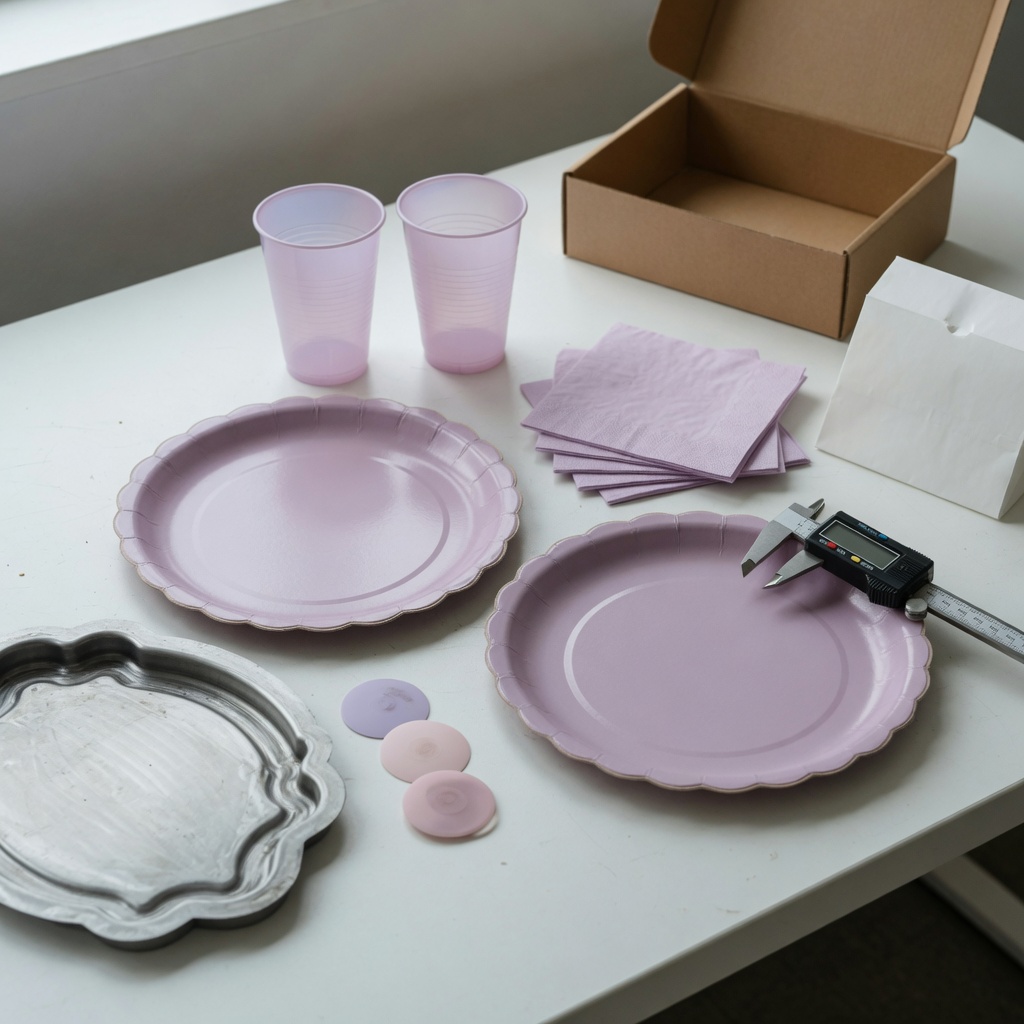
Split the work on paper before comparing unit price: design, toolmaking, forming or converting, print, coating, pack engineering, and the document pack. A reprint-only vendor may quote a lower unit price and a shorter first-drop calendar on stock silhouettes; treat that as a commercial trade-off to verify on the quote, not as a measured industry average. An in-house molding claim supports proprietary rims and cup profiles only if the quoting legal entity, plant, and tool shop are disclosed and a first-article plan is attached (YISOO).
A sourcing-partner model that includes theme research, design, factory matching, private label, QC, and logistics can reduce coordination only when sample gates are dated and plants are named (MU Group). If those functions are resold without named sites, price the offer as a broker layer.
The wholesaler-guide tests—full-color Pantone printing, special coatings and finishes, coordinated matching sets, physical samples with mockups, quality control, and retail-ready packaging—are practical pass/fail checks for private-label collections (SUNBEAUTY). Apply them to the SKU family on the RFQ, not to homepage copy. Pantone is a color-communication reference the buyer specifies; it is not a factory certification.
Decision trade-off. Catalog cavities plus new print can reduce cash and calendar before the first shippable carton if the quote confirms it. Proprietary tools increase silhouette control and increase cash and calendar before that carton. Score that trade-off on the quote. Do not treat either path as proven cheaper from this briefing.
Award controls for this gate
- No CAD or dimensioned drawing, no tool-ownership or escrow clause, no first-article plan → do not approve tool payment.
- Theme name without one shared art package and one color standard → do not score it as a matching set.
- Invoice legal entity does not match the forming plant and no subcontractor is named → hold the award.
- Food-contact claim with no current report on the finished printed or coated article → do not put the claim on the PO.
- Sample substrate, ink, or coating differs from the production bill of materials → do not freeze artwork or PPS.
- Extra color, coating, or print process added after the report date → treat the food-contact file as stale until reissued on that finish.
- Catalog cavity sold as an “OEM collection” with new print only → classify as reprint wholesale, not as product development capability.
United Arab Emirates RFQ fields that stay attached to the product
Keep the decision on party tableware, not on a generic country guide. Name United Arab Emirates as the ship-to market and channel inside the same RFQ that covers molds, samples, and pack-out.
Specify customer type (retail, cash-and-carry, hospitality, or event wholesale), inner and outer counts, pack languages your customer requires, carton marks, Incoterms, pallet or carton pattern, and which party prepares destination documents. Do not take duty, VAT, or mandatory label-language rules from this briefing—those figures and statutes were not in the supplied sources. Ask the United Arab Emirates importer of record to complete landed cost after the supplier quotes product, tooling, and freight-related lines separately.
If paperboard or coated ware needs moisture or compression limits in your warehouse, write those limits as buyer specifications. Climate storage guidance is omitted because it was not in the excerpts.
Minimum attachments that must travel with the RFQ
- SKU list and bill of materials intent (board or resin, ink, coating, pack).
- Catalog versus proprietary shape list, with CAD or dimensioned sketches for any new cavity.
- Matching-set rule (shared art, color standard, finish family).
- Pack dieline intent: inner count, sleeve or tray, master carton, barcode owner.
- Document list the importer of record will file, mapped to SKU and finish.
- Tooling as a separate, amortizable line with ownership after payment or escrow until first-article sign-off.
Tooling, molding, and proprietary-shape trade-offs
Shape is the slowest variable to change after steel is cut and the easiest to copy if you stay on catalog cavities. Treat custom tooling, R&D, and in-house molding language as a contract object: drawings, cavity list, tool life, storage site, and ownership after payment (YISOO). Apply the award controls above; do not approve tool payment on homepage wording.
Trade-offs to score on the quote (not as sourced measurements)
- Catalog cavity and new print: lower tool cash and shorter first drop if the quote confirms it; weak exclusivity of silhouette.
- New proprietary mold: brandable profile; higher cash, longer first-off-tool calendar, and IP clauses to negotiate before steel is cut.
- In-house mold shop: fewer handoffs if the claim is true; requires entity match or a named subcontractor.
- Outsourced tool shop: possibly lower tool price; extra revision lag and IP leakage risk.
Specify grams or board caliper, nest height, rim geometry, denest, and fill line as buyer specifications. For the 2-shape example assumption (unit: unique mold tools; scope: one launch; example calculation/assumption to verify in the supplier quote), demand a per-tool line item, cavity count, expected tool life, storage location, modification rights, and first-article dimensions against the drawing.
Sampling, color, artwork, and packaging development
Sampling is the visible output of product development capability. Use published language about faster sampling to request dated gates, not to assume a lead time (MU Group). Use Pantone printing, coatings, matching sets, physical samples with mockups, and retail-ready packaging as the contents list for those gates (SUNBEAUTY).
Gates to print on the quote
- Optional theme board: dated, sourced, and rejectable without penalty.
- Structural dieline and forming or converting specs.
- Color standard on the actual production substrate.
- Digital mockup of product and pack.
- Physical sample in production-intent material (not a printout glued to a stock plate if you are buying formed ware).
- Pre-production sample after tooling.
- Pack prototype: inner count, sleeve or tray, master carton.
Example assumption to verify in the supplier quote: 1 mockup round plus 1 pre-production sample round (unit: approval gates; scope: one SKU family); extra rounds priced; sample freight and piece count stated. Matching-set rule for the 3-component example (unit: SKUs in a coordinated set; scope: one private-label drop): plates, cups, and napkins share one art package and one color standard. A shared theme name without shared files is not a set.
Full retail packaging development can raise artwork time and unit cost; bulk cartons can cut pack cost and may fail a retailer's listing pack, which you must attach if it applies. Freeze artwork file type, revision cap, remaining change fee, and who owns print plates or screens before mass production.
Compliance wording versus shipment evidence
FDA and LFGB appear as compliance positioning on one manufacturer page (YISOO). Keep three layers separate:
- A standard's requirement: the test method and limit in a regulation or in the customer's written spec. This briefing does not quote those limits because they were not in the excerpts.
- A company's public practice: website text that the firm provides compliance support.
- Shipment evidence: a current report on the finished printed or coated article, with report date and unique ID.
This briefing does not state that any factory is certified. Coatings and extra colors change the test matrix; require the report to name the finish. United Arab Emirates buyers should list the files the importer of record will file, then map each file to a SKU. Website strings are not files.
Buyer decision table for product development capability
Each row is a specify, compare, verify, or approve action for party tableware procurement.
| Score this | Specify in the RFQ | Evidence to collect | Trade-off to verify | Approve only if |
|---|---|---|---|---|
| Design | File types, revision caps, copy languages | Tableware art workflow, not unrelated categories | More rounds vs. frozen errors | Signed art gate before print |
| Custom tooling | Shape count, cavities, life, ownership | Tool quote plus drawings | Exclusivity vs. time and cash | Ownership or escrow is written |
| In-house molding | Which SKUs are formed at the quoted plant | Plant address matches invoice entity, or named subcontractor | Control vs. audit load | Entity match or disclosure |
| Matching set | 3-SKU example: plate, cup, napkin | One color standard and dieline package | Color lock vs. mill complexity | Visual or numeric color standard agreed |
| Color | Pantone or equivalent list, process, substrate | Drawdown on production stock | Extra colors vs. plate or screen cost | Signed color standard |
| Coatings | Finish per SKU | Process sheet plus test implication | Look vs. extra tests | Finish listed on the test plan |
| Physical samples | Material, process, from-tool or not | Written sample policy | Speed vs. representativeness | PPS from production-intent process |
| Packaging | Inner/outer, label fields | Dieline plus prototype | Retail-ready vs. bulk cost | Pack signed with language set |
| Private label | Logo, legal line, barcode owner | Proof with importer details | Brand control vs. time | Proof matches the legal entity |
| QC | AQL as the buyer specifies, stage, photo rules | Written tableware QC protocol | Tight AQL vs. reject cost | Protocol attached to the PO |
| Compliance support | Document list for the UAE importer | Current SKU-level reports | Broad claim vs. file quality | Reports match material and print |
| Logistics | Incoterms, marks, pallet pattern | Packing-list template | Speed vs. protection | Marks include PO and SKU |
Except the 9-firm count from the SUNBEAUTY guide (unit: listed firms; scope: that guide's editorial selection only; as-of date: not stated in the supplied excerpt), numbers in this table—including the 3-component set—are example assumptions to verify in the supplier quote.
RFQ checklist for party tableware procurement
Specify the collection
- Name the product family: party tableware SKUs (plates, cups, napkins, plus any cutlery) and units per inner and outer pack for the United Arab Emirates channel.
- State catalog versus proprietary shapes; attach CAD or dimensioned sketches if proprietary.
- State the matching-set rule for the 3-component example: shared art, color standard, and finish family.
- Attach pack-copy languages required by your customer (do not assume a legal default from this page).
- State Incoterms, carton marks, pallet or carton pattern, and whether tooling is a separate, amortizable line.
Specify the product development work you are buying
- Require a written split of design, toolmaking, molding or converting, print, and pack engineering.
- Require mold ownership, cavity count, expected tool life, storage location, modification rights, and maintenance responsibility after payment.
- Require Pantone or equivalent references and a drawdown on production substrate.
- Require packaging deliverables: dieline, barcode owner, and retail mockup, or a written bulk-only statement.
- If theme input is requested, require a dated board and the right to reject it without penalty.
- Require sample piece count, which process the sample comes from, who pays sample freight, and the price of extra rounds.
- Require artwork file type, revision cap, remaining change fee, and ownership of print plates or screens.
Compare offers
- Compare tool charges as a separate line from unit price.
- Compare sample gates included, paid extras, and any calendar-day dates printed on the quote (no lead time is taken from the sources).
- Compare one shared art package versus three disconnected plants for the matching set.
- Compare QC stage (inline or pre-shipment), AQL as you specify, and report format.
- Compare which party books destination handling into the United Arab Emirates.
- Compare invoice legal entity against named plant and every disclosed subcontractor.
Verify before tool payment
- Verify the quoting legal entity against the plant; name every subcontractor.
- Verify food-contact files cover the finished printed or coated article; website FDA/LFGB text is not the file (YISOO).
- Verify sample material equals the production bill of materials (board or resin, ink, coating).
- Verify color on the real substrate under an agreed light condition.
- Verify carton marks, inner/outer counts, and any handling limits you wrote.
- Verify first-article dimensions will be recorded against the drawing before remaining tool payment.
Approve and order
- Sign artwork and pre-production sample with version, date, and remaining change fee.
- Freeze the bill of materials: material, ink, coating, pack.
- Place the PO with SKU, quantity, price, Incoterms, sample-reference ID, and AQL.
- Set a pre-shipment inspection window; state retain-sample quantity as an example assumption to verify in the supplier quote (for example 5 pieces per SKU; unit: pieces retained; scope: one purchase order).
- Hold remaining tool payment until first-article dimensions are recorded against the drawing.
Repeat orders
- Reconcile shipped cartons to the signed pack-out.
- Store retain samples, reports, and mold-condition notes with the PO for the next run.
Close the decision on evidence, not on homepage claims
OEM pages and wholesaler roundups are useful for building a request list. They are not contracts. Map YISOO's designers, in-house molding, packaging development, and FDA/LFGB positioning to drawings, tool clauses, and current reports (YISOO). Test MU Group's design-to-logistics model with dated samples and named plants (MU Group). Treat the SUNBEAUTY selection of 9 firms as that publisher's undated editorial list, not a laboratory ranking (SUNBEAUTY).
For United Arab Emirates procurement, the decision on this page remains party tableware sourcing product development capability: whether the supplier can design, tool, sample, pack, and document this collection on this purchase order. If the quote cannot attach those files, treat it as catalog wholesale, not as product development.
Discuss Your Requirements
Review our manufacturing capabilities, then share your specifications for a supplier-fit review.