Custom Printed Foodservice Packaging · 2026-07-22 · 8 min read
Biodegradable Paper Cup Printing Lead Time and Artwork Checklist for B2B Buyers
A practical RFQ checklist for importers, distributors, retail buyers, brand founders, and procurement teams ordering custom printed biodegradable paper cups. It covers biodegradable paper cup printing lead time, cup dielines, artwork approval, coating claims, MOQ by SKU, tolerances, packing data, and compliance evidence. Planning numbers are example RFQ assumptions as of 2026-07 for one custom printed biodegradable paper cup SKU and must be verified in the supplier quote, proof, sample record, document file, inspection record, and final packing sheet.
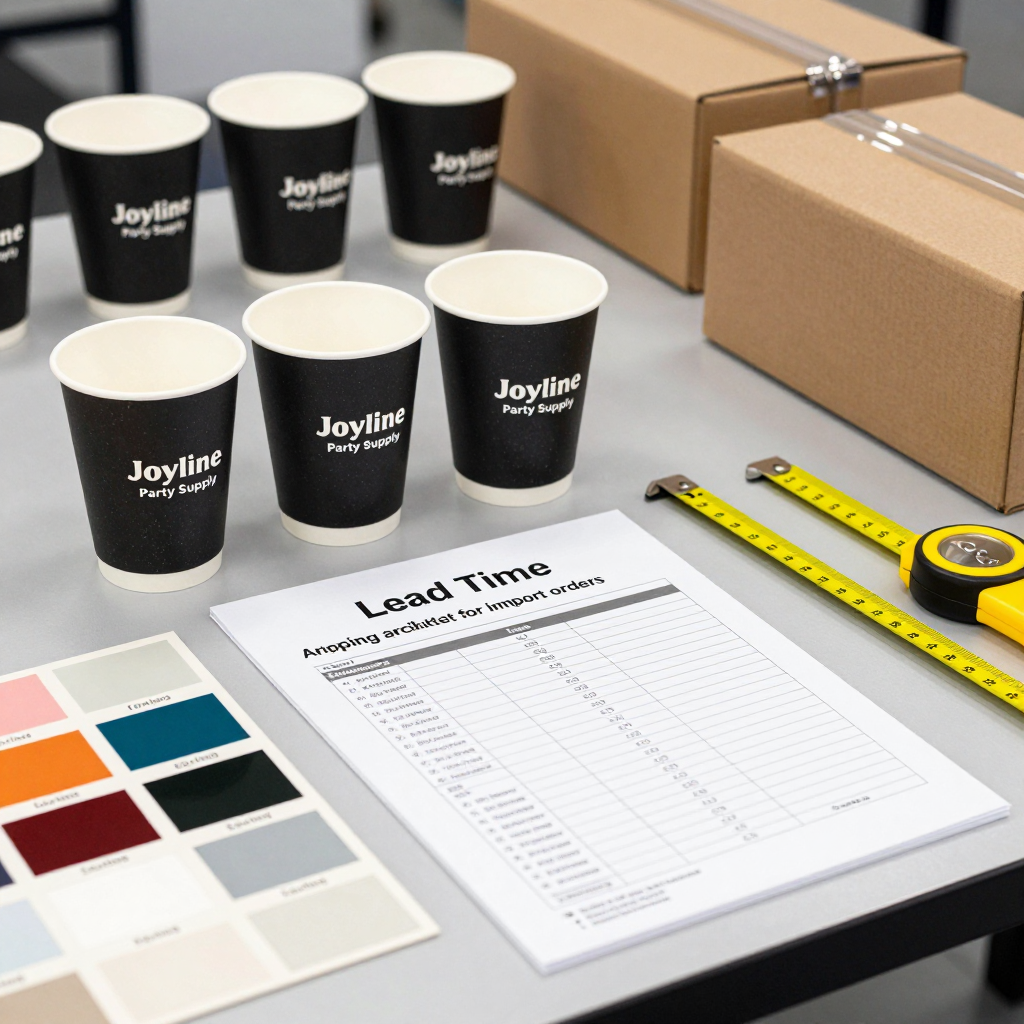
Buyer Comparison Table
| Factor | Option A | Option B | Buyer note |
|---|---|---|---|
| Lead-time basis | Total calendar path from final artwork approval and physical sample approval to goods ready for inspection | Factory production days only | Use total calendar timing for launch planning. Production days alone can exclude artwork rebuilding, cup dieline correction, proof changes, sample review, compliance document checks, carton-label approval, and export booking. |
| Artwork input | Editable vector file on the supplier's cup dieline, with color targets, barcode file, legal copy, and approval owner | Logo screenshot, retail rendering, flattened PDF, or unverified paper cup template | Editable files reduce prepress questions. Unverified artwork should be quoted with separate artwork rebuilding time and a written approval step before plate making, flexo printing, offset printing, or digital printing. |
| MOQ quote | MOQ stated per size, design, coating type, colorway, and production run | One total order quantity without SKU rules | A 120,000-cup program can still fail MOQ if it is split into too many cup sizes, regional labels, coating structures, or artwork versions. Ask suppliers to price each SKU separately. |
| Biodegradable claim control | Coating type, finished-cup evidence, report scope, report date, and destination-market wording checked before print approval | Generic eco, green, biodegradable, or compostable wording accepted in the quote | The claim should follow the evidence, not the sales copy. A coating description is not the same as a current finished-cup document for the exact quoted paperboard, coating, ink, and cup format. |
| Sample approval | Physical formed cup approved with dated artwork version, material structure, photos, and conditions | Digital proof approved without a cup sample | A PDF can check layout. A formed cup checks rim curl, side seam, bottom seal, taper distortion, odor, stacking, color shift, barcode readability, and sleeve fit. |
| Packing data | Carton size, cup count, gross weight, sleeve format, labels, pallet plan, and inspection access confirmed before mass production | Packing details collected after goods are finished | Late packing decisions can affect freight class, warehouse receiving, carton relabeling, final inspection access, retail presentation, and cup-mouth deformation risk. |
Start with the order decision, not the artwork
The biodegradable paper cup printing lead time is not only a printing schedule. It depends on cup size, board selection, barrier coating, artwork readiness, sample approval, document review, carton packing, and the date when the supplier is allowed to release mass production.
If the buyer has not fixed the sales market, cup use, and claim wording, the supplier cannot safely quote the finished cup. A hot-drink cup for cafe service, a cold sampling cup for events, and a retail party-pack cup can require different paperboard grades, PLA coating or water-based coating questions, label rules, and evidence files.
If the cup is part of a wider seasonal set, keep the approval path narrow. One late change to color, barcode, or environmental wording can affect matching paper cups with logo, bulk gift bags wholesale, custom balloons with logo, and other wholesale party decorations in the same launch.
- Send cup volume, rim diameter, bottom diameter, height, wall type, paperboard structure, coating type, print coverage, target use, and destination market in the first RFQ.
- Separate the commercial design name from the production SKU. Suppliers need one clear SKU record per cup size, artwork version, coating, packing method, and carton label.
- Ask the supplier to mark quote assumptions for MOQ, coating stock, board stock, plate charge, proof route, sample timing, carton count, and document availability.
- Use exact product language in the RFQ, such as custom printed biodegradable paper cups, single-wall coated paper cups, or biodegradable paper cups with logo, instead of only saying eco cups.
Build the lead-time calendar backward
Use the required warehouse date as the anchor. Work backward through local delivery, customs clearance allowance, international freight, export documents, final inspection, carton closing, mass production, sample approval, proofing, artwork correction, and material confirmation.
For planning only, allow 5 to 7 business days for prepress and sample preparation, 15 to 25 business days for mass production, and 3 to 5 business days for final inspection and export document preparation. These are example RFQ assumptions as of 2026-07 for one custom printed biodegradable paper cup SKU and must be verified in the supplier quote; they are not a supplier promise.
The quote should say which event starts the clock. Deposit receipt, final artwork approval, physical sample approval, board stock confirmation, coating stock confirmation, and raw material arrival are different triggers, and each can move the launch date.
- RFQ line: "Please quote total calendar lead time from final artwork approval and physical sample approval to goods ready for final inspection."
- RFQ line: "Please state whether timing depends on board stock, coating stock, plate making, sample approval, holiday capacity, or carton-label approval."
- Approval owners to name: design, barcode, food-contact wording, disposal claim, carton mark, sample approval, and production release.
- Freight check: do not approve an air-freight backup until carton cube, gross weight, loading quantity, and stack-height limits are known.
- Low-risk wording for launch plans: use expected goods-ready date, inspection window, and ship-date target instead of treating factory production days as the full buying calendar.
Artwork checks before plate making
A biodegradable paper cup artwork checklist should start with the supplier's dieline for the exact cup size and forming setup. A paper cup is tapered, so centered logos, wraparound backgrounds, vertical graphics, QR codes, barcodes, and seam-crossing artwork can move after forming.
For planning only, 3 mm bleed and 2 mm safe margin are example artwork assumptions as of 2026-07 for one tapered paper cup dieline. Actual bleed, safe area, seam allowance, rim non-print area, bottom non-print area, barcode quiet zone, and distortion compensation must follow the supplier's current dieline for the quoted cup.
Approve a formed sample when the design has full-bleed dark ink, small reversed text, QR codes, retail barcodes, metallic-effect colors, or a background that must align across the side seam. A flat proof is not enough for those risks.
- Required files: editable vector artwork, supplier dieline, press-ready PDF, barcode file, color targets, legal copy, disposal-claim copy, and carton-mark artwork if needed.
- Check points: seam side, taper direction, print area, bleed, safe area, color target, ink coverage, barcode quiet zone, QR code size, legal-copy height, batch/date-code space, and sleeve orientation.
- RFQ line: "Please confirm whether small type, dense ink coverage, dark seam areas, QR codes, and barcode size are suitable for the quoted material and print process."
- Version rule: after proof approval, any change to copy, barcode, color, environmental claim wording, or SKU label needs written confirmation of cost and schedule impact.
- Process terms to confirm: flexographic printing, offset printing, digital proof, plate making, first article, cup forming, rim curling, bottom sealing, side-seam bonding, sleeve packing, and export carton sealing.
Choose coating language carefully
A biodegradable paper cup is not defined by paperboard alone. The buyer needs the barrier coating, coating side, adhesive, ink system, intended temperature use, and disposal route before approving any environmental claim.
For planning only, 190 gsm to 320 gsm board weight is an example RFQ assumption as of 2026-07 for common single-wall and heavier custom paper cup briefs. The quoted board grade, gsm, coating weight, coating side, and finished-cup specification must come from the supplier's order-specific specification sheet.
Source contexts checked for this procurement note include U.S. FDA 21 CFR food-contact reference context, EU Regulation (EC) No 2023/2006 on good manufacturing practice for food-contact materials, EN 13432 compostability reference context, and ASTM D6400 compostability reference context. These references do not certify Joyline Party Supply or any order unless current, matching documents are supplied and verified.
- RFQ line: "Please identify board grade, gsm, coating type, coating side, intended liquid temperature, and whether the structure is for hot drinks, cold drinks, or dry use only."
- RFQ line: "Please provide food-contact documents for the destination market that match the quoted board, coating, ink, and finished-cup use where applicable."
- Claim-control line: "If biodegradable or compostable wording is requested, please identify the tested component or finished cup, standard reference, report date, report holder, and whether the report covers the exact quoted structure."
- Do not treat industrial compostability, home compostability, recyclability, biodegradable wording, and plastic-free wording as interchangeable claims.
- Relevant material terms to clarify: virgin paperboard, kraft paperboard, white paperboard, PLA coating, aqueous coating, water-based barrier coating, ink system, adhesive, inner coating, outer coating, and finished-cup structure.
Price the MOQ by SKU
Custom printed biodegradable paper cups MOQ should be read at SKU level. A buyer may have enough total demand but too little volume per cup size, coating type, colorway, theme, print method, language version, or regional artwork file.
For planning only, ask for pricing at 30,000 cups per design, 50,000 cups per design, and 100,000 cups per design using the same cup size, coating, print coverage, packing method, and freight term. These are example RFQ assumptions as of 2026-07 for one cup size and one artwork version; actual MOQ can be higher or lower depending on supplier setup, cup forming tools, print process, board stock, coating stock, and schedule.
Unit price is not the whole comparison. Buyers should separate sample cost, plate cost, dieline work, artwork rebuilding, compliance document handling, inner packing, export carton printing, retailer labels, final inspection support, spare cartons, and overrun or underrun allowance.
- RFQ line: "Please state whether MOQ applies per design, per size, per coating type, per colorway, per purchase order, or per production run."
- RFQ line: "Please quote the same structure at 30,000 cups, 50,000 cups, and 100,000 cups per design, and list all setup charges separately."
- Repeat-order question: confirm whether print plates or digital files are stored, how long they are kept, and whether a repeat order needs a new sample after storage.
- Risk point: retail multipacks need exact carton math, so confirm overrun and underrun rules before production starts.
- Quote comparison terms to standardize: EXW, FOB, carton count, net weight, gross weight, print color count, inner sleeve format, carton label, sample route, inspection access, and document scope.
Approve the sample with tolerances attached
A usable printed paper cup sample approval record should name the sample date, artwork version, cup size, board structure, coating type, print method, color target, observed deviations, test notes, and approval condition. That record is what the buyer uses later if a shipment dispute involves seam position, color, odor, leakage, barcode readability, or count.
For planning only, rim diameter tolerance of plus or minus 1 mm, cup height tolerance of plus or minus 2 mm, and side-seam alignment tolerance of plus or minus 2 mm are example RFQ assumptions as of 2026-07 for one printed paper cup SKU. The supplier must confirm real tolerances based on tooling, forming process, material, and cup size.
For planning only, a 30-minute standing-water check is an example RFQ assumption as of 2026-07 for one printed paper cup SKU. Buyers should verify liquid temperature, fill level, sample size, test duration, acceptance criteria, and whether the test reflects actual use.
- Common rejectable defects: leakage, strong odor, delamination, sharp rim, weak rim curl, crushed cup mouth, bottom-seal failure, side-seam lifting, unreadable barcode, wrong artwork, wrong count, and damaged carton.
- Inspection checkpoints: incoming board, coating continuity, first article, print registration, forming, rim curl, bottom seal, side seam, odor, nesting, leak check, carton count, and carton label.
- RFQ line: "Please attach first article photos and final inspection photos showing rim, bottom seal, side seam, print position, sleeve packing, carton label, and carton closing method."
- Evidence rule: keep the approved sample and a retained shipment sample so claims can be checked against the same physical reference.
- Buyer note: a supplier's general tolerance sheet is useful, but the purchase order should still identify the tolerances accepted for the exact biodegradable paper cup SKU.
Get carton data before the freight quote
Cup packing is a product decision and a freight decision. Sleeves, inner bags, kraft inners, retail bands, bulk stacks, carton labels, and pallet rules affect damage risk, inspection access, receiving, and landed cost.
For planning only, use 1,000 cups per export carton, a 50 cm by 40 cm by 45 cm carton envelope, and a 15 kg gross-weight ceiling as example RFQ assumptions as of 2026-07 for one medium cup SKU. Actual carton count, carton cube, gross weight, net weight, pallet pattern, and loading quantity must be confirmed before freight booking.
Retail buyers should lock carton labeling before production closes. Late carton-mark changes can require relabeling, delay inspection release, or cause warehouse receiving problems.
- Packing fields: cups per sleeve, sleeves per carton, cups per carton, inner packing material, carton length, carton width, carton height, gross weight, net weight, pallet pattern, and loading quantity.
- Label fields: master carton mark, SKU label, country-of-origin marking, retailer routing label, barcode label, batch number, carton seal method, and mixed-SKU rules.
- Inspection access: confirm whether cartons can be opened and resealed without damaging retail presentation or failing receiving requirements.
- Risk point: carton compression strength, moisture exposure, pallet overhang, and mixed-SKU consolidation can deform cup mouths or affect stackability.
- Freight RFQ wording: "Please quote carton dimensions and gross weight before shipment booking, and confirm whether packing data is estimated or final."
What to send in the RFQ package
Send one controlled RFQ pack instead of scattered files. It should include cup size, use case, material preference, coating requirement, destination market, requested claim wording, order quantity by SKU, artwork files, dieline request, proof route, sample route, document request, inspection requirement, packing request, carton data request, freight term, and target ship date.
Ask the supplier to return a marked quote. The marked quote should identify open assumptions, lead-time trigger, excluded costs, MOQ basis, artwork risks, document limits, sample timing, packing data, and any condition that can change price or schedule.
Publication basis: the visible byline and Article structured data author are Vincent Xi, jobTitle Editorial Author, with the profile URL https://joylinepartysupply.com/authors/vincent-xi/. The source context for this attribution is the Joyline Party Supply author profile.
Methodology note: all MOQ, lead-time, tolerance, carton, artwork-margin, board-weight, and test-duration figures in this article are example RFQ assumptions as of 2026-07 for one custom printed biodegradable paper cup SKU. They show how buyers can structure supplier questions and should not be treated as supplier promises, test results, legal advice, or universal specifications.
Limitations: this procurement note does not claim factory testing, client outcomes, certifications, current certificates, or product compliance for any specific order. Buyers must verify supplier documents, destination-market rules, artwork proofs, physical samples, inspection results, and final packing data before approving mass production or printed disposal claims.
- Source contexts used: Joyline Party Supply author profile for byline attribution, public FDA 21 CFR food-contact context, EU Regulation (EC) No 2023/2006 GMP context, EN 13432 compostability reference context, and ASTM D6400 compostability reference context.
- Minimum RFQ fields: destination market, food-contact use, hot or cold use, cup size, board structure, coating type, intended disposal claim, required documents, quantity by SKU, target warehouse date, freight term, carton limits, pallet needs, inspection requirement, labeling rules, artwork format, dieline status, color target, barcode, legal copy, proof owner, sample owner, and final release owner.
- Clean supplier response request: "Please return a marked quote showing confirmed items, assumptions, missing information, lead-time trigger, MOQ basis, excluded charges, sample route, document scope, and final carton data status."
Related Joyline Party Supply pages
- custom balloons with logo
- paper cups with logo
- bulk gift bags wholesale
- wholesale party decorations
- custom party supplies manufacturer
FAQ
What should buyers include in a biodegradable paper cup printing checklist?
Include cup size, rim diameter, bottom diameter, height, target use, board gsm, coating type, destination market, intended disposal claim, MOQ by SKU, artwork files, supplier dieline, proof route, physical sample route, color targets, barcode position, tolerance fields, QC checkpoints, compliance documents, carton data, freight term, and approval owners.
How long is biodegradable paper cup printing lead time before shipment?
For planning only, 5 to 7 business days for prepress and sample preparation, 15 to 25 business days for mass production, and 3 to 5 business days for final inspection and export document preparation are example RFQ assumptions as of 2026-07 for one printed biodegradable paper cup SKU. Actual timing depends on board stock, coating type, artwork status, sample approval, quantity, holiday periods, and supplier capacity confirmed in the quote.
Is a digital proof enough for biodegradable paper cup artwork approval?
A digital proof can check copy, dieline placement, color callouts, barcode position, and claim wording. A physical formed sample is safer when the design has full-bleed color, fine text, dark backgrounds, QR codes, barcodes, tight logo placement, seam-crossing artwork, or environmental wording that must be reviewed before production.
What documents should importers request for biodegradable paper cups?
Request destination-market food-contact documents, material specification, coating statement, ink or printing safety statement where applicable, and compostability or biodegradability evidence if those claims appear in artwork or sales copy. If EN 13432 or ASTM D6400 is referenced, ask whether the current report covers the exact finished cup structure and intended market claim.
What artwork issues delay printed paper cup orders?
Common delay points include missing editable artwork, wrong dieline, unclear seam position, unconfirmed color targets, small legal copy, barcode quiet-zone problems, late disposal-claim edits, QR code distortion, and multiple approval owners. One final production-release owner reduces version confusion.
How should importers compare custom printed biodegradable paper cup quotes?
Compare the same cup size, board weight, coating type, hot or cold use, print method, color count, MOQ basis, sample route, document set, carton packing, freight term, inspection requirement, and lead-time trigger. A lower unit price is not comparable if it excludes setup charges, sample cost, special packing, document handling, inspection support, or realistic carton data.
Ready to quote this project?
Send specs, quantity, customization needs, destination, and deadline.
Request a quote