Custom Balloons and Party Supply Procurement · 2026-07-19 · 9 min read
Custom Balloon Color Matching Pantone Approval Guide for Import RFQs
A practical custom balloon color matching Pantone approval guide for import buyers specifying Pantone-matched latex balloons, inflated sample approval, MOQ fields, pigment and print controls, carton estimates, inspection checkpoints, and compliance-file review. Byline: Vincent Xi, Editorial Author, https://joylinepartysupply.com/authors/vincent-xi/.
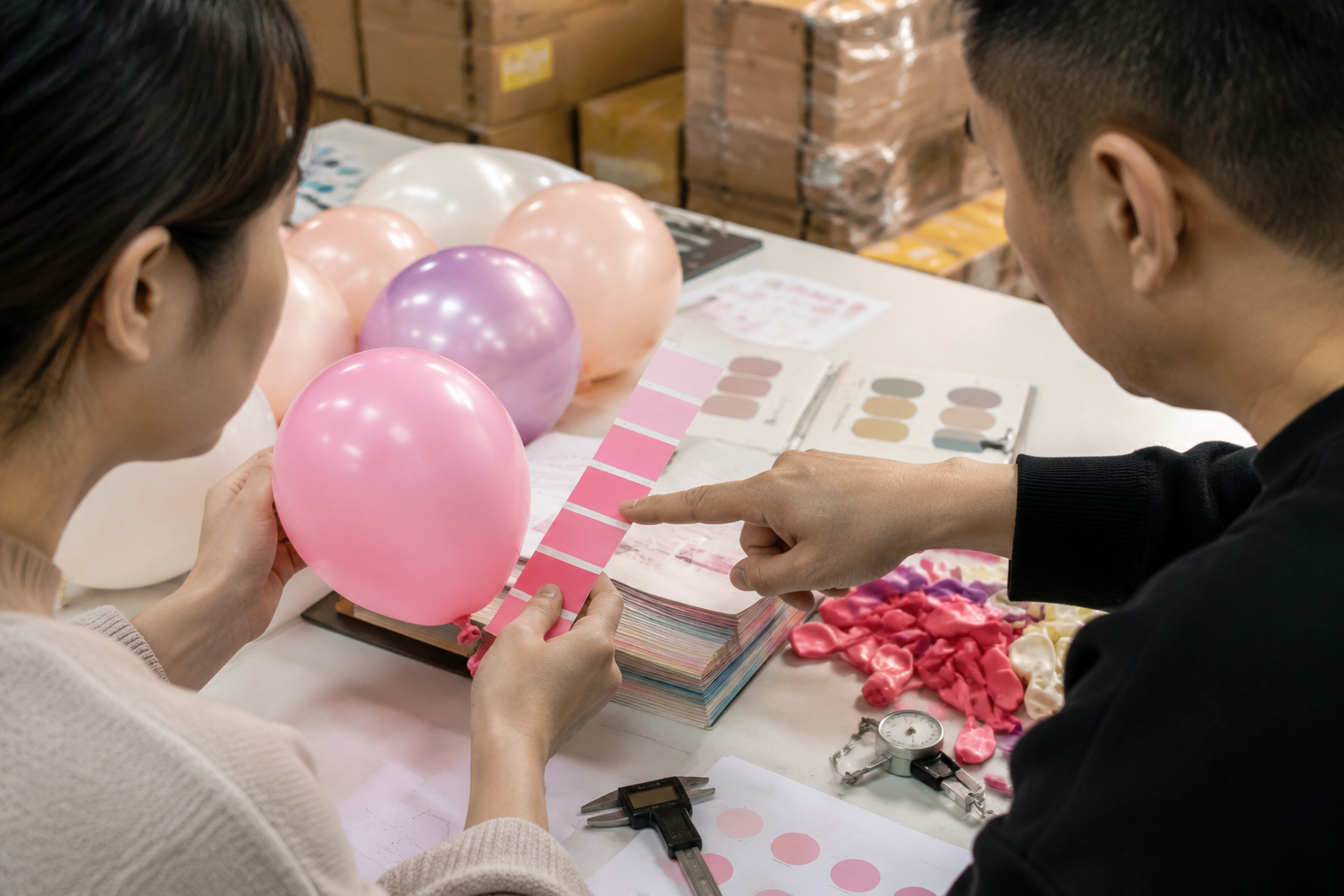
Buyer Comparison Table
| Factor | Option A | Option B | Buyer note |
|---|---|---|---|
| Color target | Physical Pantone reference plus approved inflated balloon master sample. | Instrument-supported CIE L*a*b* values plus visual review. | For most retail balloon programs, the signed physical sample is the commercial reference. Add L*a*b* only when the RFQ names the instrument, lighting, measurement point, inflation condition, and pass-fail value. |
| Latex review condition | Review after inflation to the buyer-specified diameter for the ordered size. | Review only flat latex, uninflated pieces, supplier photos, or digital proofs. | Inflated review reduces dispute risk because latex becomes thinner as it stretches and the color can lose saturation. |
| MOQ basis | Example assumption to verify in the supplier quote: 5000 pieces per Pantone color, per balloon size, per artwork line, as of the buyer's RFQ date. | Example assumption to verify in the supplier quote: 10000 pieces per Pantone color, per balloon size, per artwork line, as of the buyer's RFQ date. | Ask the supplier to restate actual MOQ by color, size, finish, pigment changeover, print method, artwork, packing format, and shipment lot. |
| Sample calendar | Example assumption to verify in the supplier quote: 5 to 7 working days for a first pigment drawdown or basic inflated sample after full Pantone and material confirmation, as of the buyer's sample request date. | Supplier-confirmed longer timing when logo printing, header cards, barcodes, warning artwork, or mixed-color sets must be sampled together. | Do not merge color approval with final retail pack approval unless the launch calendar allows a correction round. |
| Tolerance rule | Example buyer-controlled rule to verify: Delta E*ab not greater than 2.0 unitless under the buyer's named method, as of the buyer's color approval date. | Visual approval only against the signed physical master sample. | Pantone references do not create a universal latex-balloon tolerance. The buyer must define the measurement method or rely on physical master-sample control. |
| Production lead time | Example assumption to verify in the supplier quote: 15 to 25 calendar days after written color, artwork, packaging, and compliance-artwork approval for a standard single-SKU line, as of the PO release date. | Supplier-confirmed longer timing for mixed-color sets, retail packaging, assorted party kits, or multiple print colors. | The production clock should start after all approvals are complete, not after partial artwork handover. |
| Freight estimate | Example calculation to verify in the supplier quote: 500 pieces per export carton, carton size 40 cm by 30 cm by 28 cm, equals 0.0336 cubic meter per carton, as of the buyer's freight estimate date. | Example calculation to verify in the supplier quote: 10000 pieces at the same packing plan equals 20 cartons and 0.672 cubic meter before pallet allowance, as of the buyer's freight estimate date. | Freight estimates change when retail bags, inserts, header cards, barcode labels, or mixed party kits are added. |
Use Case: When Pantone Control Is Worth Specifying
Use a written custom balloon color matching Pantone approval guide when the balloon color affects sell-through, planogram consistency, retailer approval, private-label branding, event-series matching, or reorder continuity. If the color is only a broad seasonal shade, the buyer may accept a supplier stock color. If the color must match a retail story such as wedding white, school colors, pastel rainbow, black-gold birthday, or a brand launch palette, the RFQ needs physical sample control.
The first buyer decision is what must match. A balloon body color, printed logo ink, retail bag color name, carton label, online listing image, and reorder reference can all use different controls. Treating them as one color field creates later disputes because the factory, packaging team, inspector, and retailer may be checking different items.
- Specify the product family before sampling: round latex balloon, long modeling balloon, foil balloon, matte latex balloon, pearl latex balloon, chrome-look latex balloon, translucent latex balloon, printed logo balloon, or mixed party decoration set.
- State whether the buyer is approving a body color, logo ink color, neck imprint, retail bag film, header card artwork, insert sheet, carton color code, online color name, or coordinated shade across paper cups with logo and bulk gift bags wholesale.
- Record the physical reference: Pantone code, suffix, guide type, buyer guide condition, approved chip if supplied, and whether the chip must be returned with the sample.
- Example planning size reference to verify in the supplier quote: 10 inch nominal latex balloons and 12 inch nominal latex balloons are common buyer inquiry sizes for party programs, as of the buyer's RFQ date, source buyer-side RFQ planning assumption; this is not a factory size commitment.
- For repeat retail programs, require a retained master sample, batch note, color name, SKU, PO reference, and carton mark that can be reused on reorder quotes.
Decide the Color Target Before Asking for Price
A supplier cannot price custom latex balloon Pantone approval cleanly if the RFQ says only 'match Pantone blue.' The quote needs to know the substrate, finish, inflation condition, print method, packing format, and whether the target is a must-match color or a closest-commercial-match color.
Pantone references are useful because they give buyer and supplier a shared starting point. They are not a guarantee that latex will visually copy a paper guide. Latex pigment, wall thickness, dipping process, finish, and inflation change how light passes through the balloon.
- Pantone field: code, suffix, guide type, physical guide condition, buyer-owned chip reference if supplied, and acceptable alternate shade if the target is not achievable on the chosen material.
- Product field: balloon type, nominal size, intended inflated review diameter, material, finish, neck shape if relevant, and whether color is molded body color or printed surface color.
- Material field: natural latex, foil film, biodegradable-positioned latex claim if used by the supplier, clear latex, translucent latex, opaque latex, or specialty finish material; require the supplier's written description and any supporting documents.
- Finish field: standard opaque, matte, pastel, pearl, metallic-look, chrome-look, translucent, clear, or foil film.
- Print field: logo artwork file version, ink color, print method, print side count, print area, registration expectation, opacity expectation, and whether white underbase is required.
- Approval field: visual approval against a signed physical master sample, or a measurement-supported rule with the named instrument, lighting, sample preparation, inflation condition, and pass-fail value.
Latex Must Be Judged After Inflation
The buyer decision here is simple: approve the color as it will be sold or used. A flat latex sample may look deeper than the final inflated balloon because stretching thins the wall and changes opacity. That shift matters most for light pastels, translucent colors, chrome-look finishes, pearl effects, and dark colors that need strong logo contrast.
Set the inflated balloon sample approval condition in the RFQ. The supplier should label the sample with Pantone target, material, finish, nominal size, intended inflated review diameter, print method, sample date, quote version, and sample number. Without that label, the buyer may not be able to connect the approved sample to the later purchase order.
- Approve the inflated balloon body before approving mass production.
- Keep the uninflated sample only as a packing and appearance reference, not as the main color decision point.
- Require a logo print sample on the actual balloon color and finish when the order includes a brand mark, slogan, icon, barcode-related artwork, or event graphic.
- Reject a sample when inflation makes the color visibly too light, too gray, too warm, too cool, uneven, or more translucent than the commercial target.
- Do not use supplier photos as final approval for brand-sensitive colors unless the buyer has written photo-only approval into that specific RFQ.
MOQ and Lead Time: Quote by Color, Not Just Total Order
Pantone matched balloons MOQ can change because each shade may require separate pigment preparation, material handling, dipping checks, first-piece checks, print setup, packing separation, and cleaning. A total quantity target is not enough. The quote should show MOQ by Pantone color, balloon size, finish, artwork line, retail pack, and shipment lot.
For budget screening, a buyer can use provisional numbers and replace them after supplier confirmation. Example MOQ planning assumption to verify in the supplier quote: 5000 to 10000 pieces per Pantone color, per balloon size, per artwork line, as of the buyer's RFQ issue date, source buyer-side planning assumption. Example first sample timing assumption to verify in the supplier quote: 5 to 7 working days after Pantone code, material, finish, and sample format are confirmed, as of the buyer's sample request date, source buyer-side planning assumption. Example production timing assumption to verify in the supplier quote: 15 to 25 calendar days after written approval of color, artwork, packaging, and required compliance artwork for a standard single-SKU line, as of the PO release date, source buyer-side planning assumption.
- Ask whether MOQ is calculated by Pantone color, size, finish, print plate, screen-print setup, digital print setup where applicable, retail pack, total PO value, or shipment lot.
- Ask whether sample fees are charged per color, per size, per pigment drawdown, per logo print setup, per retail pack, or per full mixed set.
- Ask whether matte, chrome-look, pearl, translucent, metallic-look, clear, or biodegradable-positioned materials change MOQ or lead time, and require the supplier's written basis.
- Confirm whether related SKUs can be combined in one order while each Pantone shade remains separately controlled.
- State that the lead-time clock starts only after color sample, print sample, packaging artwork, warning artwork, and packing specification are approved in writing.
Sample Approval: What the Buyer Should Sign
The signed sample is the buyer's main commercial evidence if production color drifts later. It should be physical, labeled, dated, and tied to the quote version and PO. A screen image can help during discussion, but it should not replace the physical master sample for retailer-facing color programs.
A useful custom logo balloon color proof pack includes the inflated balloon, the uninflated piece if packing appearance matters, the print sample if artwork is used, and the proposed retail or bulk packing. The approval note should say pass, reject, or conditional pass with the exact remaining correction.
- Sign approval when the inflated body color, logo ink, packaging color name, and pack appearance match the written specification within the stated tolerance.
- Reject when the inflated balloon looks visibly lighter, darker, grayer, warmer, cooler, mottled, streaked, or too translucent for the intended retail color.
- Reject when logo ink has weak coverage, poor opacity, smudging, pinholes, misregistration, or unacceptable color shift on the chosen balloon body.
- Use conditional approval only for a narrow open item, such as a barcode label correction after color, logo, and retail color name have passed.
- For retail programs, record the approved color name exactly as it will appear in merchandising files, carton labels, marketplace listings, and customer-facing assortments.
Inspection Points That Catch Color Drift Early
A pre-shipment inspection is late in the process. It can identify a bad lot, but it cannot easily fix color drift that began during pigment weighing, latex mixing, dipping, drying, printing, or mixed-color packing. Buyers with color-sensitive programs should require first-piece production comparison against the signed master sample before the full batch continues.
Sampling standards can structure inspection, but they do not certify color matching. ANSI/ASQ Z1.4 and ISO 2859-1 provide sampling-plan context for buyer or third-party inspection instructions. Example buyer inspection setting to verify with the inspector: major defects AQL 2.5 unitless and minor defects AQL 4.0 unitless, under the buyer's inspection instruction at the pre-shipment date, source ANSI/ASQ Z1.4 sampling context as applied by the buyer or third-party inspector.
- Incoming material check: pigment name or code, pigment batch reference, latex material identity, print ink reference, and restricted-substance documents requested for the destination market.
- Mixing check: trial piece or drawdown compared with the approved sample before full production continues.
- Dipping and drying check: wall thickness consistency, surface finish, color streaking, visible contamination, and shade stability before printing or packing.
- Inflation check: production color compared after inflation, not only in flat form.
- Printing check: logo color, opacity, registration, smudging, pinholes, handling resistance, and contrast against the balloon body.
- Sorting check: similar colors separated by inner bag, carton, or visible label so warehouse teams do not mix close shades.
- Packing check: correct assortment, inner-bag count, retail pack count, barcode label, warning statement, carton mark, and SKU-color link.
- Retention check: production samples kept from approved lots for claim review and reorder comparison.
When to Add a Measurement Rule
A Delta E rule can help when the buyer has the equipment, method, and inspector alignment to use it consistently. Without those details, a number can create false precision. Latex balloons are curved, elastic, and partly translucent, so sample preparation and measurement location matter.
Example buyer-controlled tolerance to verify with the supplier or third-party inspector: Delta E*ab not greater than 2.0 unitless between the approved master sample and production sample, measured under the buyer's named instrument, lighting, sample preparation, and method, as of the buyer's color approval date. Source context: buyer-defined acceptance example; Pantone does not create a universal latex-balloon pass-fail tolerance.
- Use visual master-sample approval when the buyer cannot define instrument, lighting, inflation, and measurement surface.
- Use an instrument-supported rule only when the supplier and inspector agree to the same method before sampling.
- Keep visual review even when measurements are used because surface effects such as pearl, metallic-look, chrome-look, and translucency may not be fully explained by one reading.
- Write the rule into the RFQ, quote, inspection instruction, and PO so it is not introduced after production.
Packaging and Carton Data Affect the Color Program
Color approval is not limited to the balloon. A retail unit may include printed bags, header cards, insert sheets, barcodes, warning text, color names, and assortment counts. A distributor bulk pack may use plain inner polybags and export cartons. A coordinated program may ship balloons with paper cups with logo, gift bags, banners, and other wholesale party decorations, so color names and carton labels need to stay aligned.
Use carton estimates only after the packing format is defined. Example carton calculation to verify in the supplier quote: 500 pieces per export carton with carton dimensions of 40 cm by 30 cm by 28 cm equals 0.0336 cubic meter per carton, for one quoted packing plan before pallet allowance, as of the buyer's freight estimate date, source buyer-side calculation. Example shipment volume calculation to verify in the supplier quote: 10000 pieces packed at 500 pieces per carton equals 20 cartons and 0.672 cubic meter before pallet allowance, for the same quoted packing plan, as of the buyer's freight estimate date, source buyer-side calculation.
- Specify inner pack count, retail pack count, master carton count, carton length, carton width, carton height, gross weight, net weight, and pallet requirement if used.
- Ask how similar shades will be separated by inner bag, carton, divider, or sticker label.
- Confirm SKU labels, color labels, PO labels, country-of-origin marking, importer routing labels, and retailer carton sequence labels where applicable.
- For mixed party programs, align balloon color names with packaging files for gift bags, cups, plates, banners, and other custom party supplies.
- Before freight booking, request final carton quantity, cubic volume, gross weight, and packing list data after packaging approval.
Compliance Files Are a Separate Approval
A balloon can match the requested shade and still fail the buyer's shipment release if compliance files are incomplete. The destination market should be named before sample approval because warnings, age grading, importer details, packaging language, and test-document scope may affect the final retail pack.
For the United States, ASTM F963-23, source ASTM International toy safety standard context as of its 2023 publication, may be relevant when the balloon product falls within applicable toy-safety scope. For the European Union, EN 71-3, source European toy safety migration-of-certain-elements context, may be relevant when the item is treated as a toy. These standards do not approve Pantone matching and do not prove supplier certification. Buyers should request current, product-specific documents and check whether reports match the ordered material, color, print ink, finish, and packaging.
- Request the test report number, issuing lab, report date, tested product description, material color, finish, print ink, and destination-market scope.
- Check whether reports cover the same balloon material, pigment color, print ink, surface finish, and packaging format being ordered.
- Request artwork proof for warnings, choking hazard language where applicable, age grading, importer details, barcode, country-of-origin marking, and retailer-specific labeling.
- Do not treat a generic certificate as proof that the ordered color and material are compliant unless the document can be traced to the actual item.
- For private-label retail programs, keep compliance files with the approved sample, PO, invoice, packing list, and inspection report.
RFQ Wording to Reduce Revision Rounds
The RFQ should force the supplier to confirm feasibility before sampling. That is the point where the supplier should say whether the Pantone target is realistic on the selected latex, finish, and print method, or whether a closest-match shade should be approved instead.
The quote should separate unit price, sample cost, pigment matching cost, setup cost, print plate or tooling charge if applicable, packing cost, inspection cost, and freight basis. A low unit price is not useful if later color-match fees, retail packing charges, or carton changes raise landed cost.
- Color target: Please quote custom latex balloons matched to Pantone [code and suffix] using [guide type]; confirm whether this target is achievable on [material], [finish], and [nominal size] before sample production.
- Inflated approval: Please provide an inflated physical sample for approval at [buyer-specified review diameter] and label the sample with Pantone target, material, finish, size, date, quote version, and sample number.
- Print color: Please confirm print method, ink color reference, print area, print side count, opacity expectation, and whether a white underbase or alternate ink system is required for this balloon body color.
- MOQ: Please quote MOQ separately by Pantone color, balloon size, finish, artwork line, retail packing format, and shipment lot; mark any exception where total PO quantity cannot be combined.
- Approval gate: Please do not start mass production until buyer has approved physical color sample, logo print sample, retail packaging artwork, warning artwork, and final packing specification in writing.
- Inspection: Please retain one approved master sample and compare first production pieces and pre-shipment samples against that master; confirm whether production samples can be sent before shipment release.
- Carton data: Please provide final carton quantity, pieces per carton, carton dimensions in centimeters, gross weight in kilograms, net weight in kilograms, and cubic volume after retail packaging approval.
- Compliance: Please provide current product-specific reports or documents showing tested product description, material color, print ink scope, report date, issuing lab, and destination-market applicability.
RFQ Field Checklist
Use this checklist as a supplier-facing attachment, not as an internal note only. The supplier should confirm each field, write not applicable where a field does not apply, or mark an exception before sampling.
Blank fields usually become cost, calendar, or claim problems later. The most common gaps are guide suffix, inflated review condition, material finish, pigment sample status, packing format, warning artwork status, and whether MOQ applies by color or by total order.
- Product: balloon type, material, nominal size, intended inflated review diameter, finish, logo print method, print side count, print location, and intended use.
- Color: Pantone code, guide suffix, guide type, body color, logo ink color, packaging color name, carton color code, and alternate acceptable shade if any.
- Quantity: requested total pieces, color breakdown, size breakdown, artwork breakdown, retail pack breakdown, reorder forecast if available, and whether related SKUs can combine for MOQ.
- Sample: sample type, number of samples per color, required sample deadline, delivery address, photo policy, physical approval requirement, and sample freight payer.
- Tolerance: visual master-sample approval or measurement-supported rule, lighting condition, inflation condition, rejection examples, and correction-round process.
- Packing: inner pack count, retail pack count, master carton count, carton size target, barcode, warning text, carton mark, pallet requirement, and retailer routing guide if any.
- Compliance: destination market, required test reports, restricted-substance documents, warning labels, importer file needs, age grading, and packaging language.
- Freight: Incoterms, port or warehouse destination, shipment mode, carton data deadline, consolidation needs with other party supply products, and final packing list date.
What to Verify Before PO Release
Before issuing the PO, replace every planning assumption with supplier-confirmed values. That includes MOQ, sample timing, production lead time, color target, physical approval sample, pigment system, latex material, print process, packing specification, carton data, inspection plan, and compliance-file scope.
For reorders, do not rely only on the previous PO description. Compare the retained master sample against the new production sample, confirm whether pigment or material references changed, and check whether packaging or destination-market documents need updating.
- Verify that the supplier quote repeats the exact color, material, finish, size, print, packing, carton, and compliance fields from the buyer RFQ.
- Verify that color approval, logo print approval, packaging approval, and warning artwork approval are complete before the lead-time clock starts.
- Verify that production samples are compared against the approved physical master sample, not only against a digital file.
- Verify that carton data is updated after final packaging approval and before freight booking.
- Verify that market compliance files match the actual ordered item and are current for the shipment destination.
- Verify color consistency across balloons, paper goods, bags, and decoration kits when the order is part of a larger custom party supplies manufacturer program.
Editorial Image Brief
Create a realistic procurement and QC bench for a B2B article about Pantone approval for custom latex balloons. The main subject should be inflated latex balloon samples in matte pastel, standard opaque, translucent, and metallic-look finishes arranged beside a physical color guide, blank supplier sample tags, an inflation sizing template, sealed clear inner polybags, and a carton specification sheet.
The scene should look like a buyer approval desk, not a party display. Include one printed logo test balloon with generic geometric marks instead of a real logo. Use even, color-neutral lighting so the comparison setup is clear. Avoid readable text, logos, watermarks, certificates, identifiable people, fake company identities, and impossible machinery.
- Visual priority: color matching, inflated physical approval sample, pigment sample control, logo print test, packaging plan, carton data, and QC handling.
- Composition: close desk-level view with balloon samples and color guide in the foreground, QC sheets and sealed inner bags in the middle, and kraft export cartons softly visible behind.
- Materials: latex balloons, printed ink sample, clear inner polybags, kraft export cartons, white QC paper sheets, physical color guide, blank sample tags, caliper or simple measuring tools, and inflation sizing template.
- Style: documentary product-procurement photography with accurate scale, neutral lighting, and restrained industrial export-site tone.
Related Joyline Party Supply pages
- custom balloons with logo
- paper cups with logo
- bulk gift bags wholesale
- wholesale party decorations
- custom party supplies manufacturer
FAQ
How should a custom balloon color matching Pantone approval guide be attached to an import RFQ?
Attach it as a buyer specification sheet. The sheet should list Pantone code and guide type, latex or foil material, finish, balloon size, inflated review condition, logo print color, packaging color name, sample requirement, tolerance rule, MOQ request, compliance market, and carton data request. Ask the supplier to confirm each field or mark exceptions before sampling.
Can a supplier match any Pantone color on latex balloons?
Not always. Latex changes appearance when stretched, and translucent, pearl, chrome-look, metallic-look, or pastel finishes can shift the perceived shade. Some colors may be close visually but not identical to a paper Pantone guide. Buyers should approve the actual inflated balloon material and finish.
Is a photo enough for Pantone approval on custom balloons?
A photo is useful during discussion, but it is weak evidence for final approval because camera settings, lighting, screens, and compression can alter color. For brand-sensitive orders or retail programs, approve a physical inflated sample under agreed viewing conditions and keep it as the master reference.
What MOQ should buyers expect for Pantone matched balloons?
MOQ depends on color, size, finish, printing, and packing. A practical planning assumption may be stated as 5000 to 10000 pieces per Pantone color, per balloon size, per artwork line, as of the buyer's RFQ issue date, source buyer-side planning assumption to verify in the supplier quote. The supplier's confirmed MOQ should replace the planning assumption before PO approval.
What should be included in a custom latex balloon Pantone approval sample?
Ask for an inflated balloon sample at the agreed review diameter, an uninflated piece if packing appearance matters, a logo print sample when artwork is used, and the proposed retail or bulk packing. Each sample should be labeled with Pantone target, material, finish, nominal size, sample date, quote version, and sample number.
What defects are most common in color-matched balloon orders?
Common defect risks include shade drift between sample and production, visible color change after inflation, mottled or streaked latex, weak opacity, print smudging, poor logo coverage, mixed shades packed together, wrong retail color name, missing color separation labels, and carton labels that do not match the contents.
Ready to quote this project?
Send specs, quantity, customization needs, destination, and deadline.
Request a quote