Custom Balloons Procurement · 2026-07-22 · Approximately 9 minutes, estimated from article length as of 2026-07-22
Custom Foil Balloon MOQ for Brand Activation Event Procurement
A practical importer RFQ guide for custom foil balloon MOQ for brand activation event procurement, covering per-SKU minimums, custom printed foil balloon specifications, sample approval, packing format, QC checks, compliance files, carton planning, and event delivery risk.
Buyer Comparison Table
| Factor | Option A | Option B | Buyer note |
|---|---|---|---|
| MOQ trigger | Stock-shape foil balloon with custom logo print | Custom die-cut foil balloon shaped like a product, mascot, bottle, pack, or event prop | For inquiry planning as of 2026-07-22, 3,000-10,000 pieces per printed stock-shape SKU is an example discussion range to verify in the supplier quote. Custom die-cut shapes may require tooling, inflated sample approval, seal-path review, and a different minimum order quantity. |
| SKU split | Same shape, same metallized film color, same artwork, same valve, same packing | Different city names, retailer versions, colorways, barcode labels, warning labels, or store kits | A supplier may accept one purchase order but still price each artwork or packing version as a separate production run. Ask for SKU-level MOQ and total PO minimum in the same quote. |
| Approval risk | Simple logo placement on a standard round, heart, star, number, or letter shape | Full-surface artwork, logo near a heat-seal line, metallic brand color, or artwork on a curved die-cut form | For display pieces, request both flat proof and inflated sample photos. A design that looks correct flat can distort after inflation. |
| Packing choice | Bulk packing for installers, warehouses, event agencies, or venue allocation | Individual retail packing or store-by-store activation kits | Retail and kit packing can add header cards, barcode labels, inserts, component counts, carton marks, and allocation checks. These operations may affect MOQ, lead time, unit price, and inspection scope. |
| Inspection basis | Supplier internal packing and visual check | Buyer checklist with defect classes and sampling plan | ISO 2859-1 can be referenced as a sampling-procedure context where relevant, but it is not a product certification and does not define balloon defects. Buyers still need a written leakage, valve, print, artwork, seal, and packing checklist. |
| Freight planning | Planned sea freight, air freight consolidation, or domestic warehouse allocation | Late courier replenishment before a fixed activation date | Foil balloons are light, but carton volume can drive freight cost. Ask for carton dimensions in centimeters, gross weight in kilograms, net weight in kilograms, carton count, and total cubic meters before comparing freight modes. |
Start With the Real MOQ Question
For custom foil balloon MOQ for brand activation event procurement, the useful question is not, "What is your lowest MOQ?" The better question is, "What is the minimum order quantity for this exact SKU, packing method, approval route, and delivery deadline?" A low number without SKU scope will not help an importer, distributor, retail buyer, or brand team compare suppliers or protect the event date.
Separate campaign need from production minimum. Campaign need is the quantity required for venues, stores, influencer mailers, retail displays, installer stock, or warehouse replenishment. Production minimum is the supplier's workable run size after artwork setup, printing, heat sealing, valve insertion or valve confirmation, inspection, packing, and export handling. The difference becomes leftover inventory, so ask for price breaks and repeat-order terms at the RFQ stage.
Define the SKU before asking for price. In this article, one SKU means one size, one shape, one artwork version, one metallized foil film color, one valve type, one print method, and one packing format unless the supplier confirms otherwise. If a campaign has several market names, retailer versions, barcode labels, or packing versions, the supplier may treat them as separate SKUs even when the brand identity is the same.
Match the custom printed foil balloon MOQ request to the use case. Installer bulk goods, retail-packed giveaways, store-window props, press-kit balloons, and shopping-mall display balloons need different controls. The more the order depends on allocation, labeling, or visual consistency, the less useful a bare MOQ number becomes.
- State destination country, delivery city, event launch date, and required warehouse arrival date in the first inquiry.
- List every artwork version, film color, valve requirement, and packing version before asking whether quantities can be combined.
- Ask for MOQ per SKU, total PO minimum, and price breaks that match the campaign forecast.
- Quote stock-shape foil balloons and custom die-cut foil balloons separately when both are possible.
- Keep sample approval, QC checklist, carton data, and compliance file review inside the MOQ discussion.
Practical MOQ Ranges to Discuss
For inquiry planning as of 2026-07-22, 3,000-10,000 pieces per printed stock-shape SKU is an example RFQ discussion range to verify in the supplier quote. The unit is pieces per SKU, the scope is stock-shape custom printed foil balloons, and the source context is procurement RFQ modeling for buyer comparison. Current film availability, print method, packing format, artwork coverage, and production schedule can move the real MOQ.
Custom die-cut foil balloon MOQ needs a different conversation. The supplier may need to check tooling, seal path, inflated shape, artwork distortion, valve position, film waste, and packing efficiency before confirming the minimum. A bottle-shaped or mascot-shaped balloon can fail commercially even if it is technically inflatable, because the brand shape may lose clarity after inflation.
Ask for SKU-level MOQ and PO-level MOQ together. As an example RFQ scenario to verify in a supplier quote as of 2026-07-22, a buyer may request 5,000 pieces of a stock round printed SKU, 5,000 pieces of a stock star printed SKU, and 2,000 pieces of a custom display-shape SKU. The total is 12,000 pieces across the purchase order, but the 2,000-piece display-shape SKU may still be below that item's workable minimum.
If the quoted minimum order quantity is too high, change the controllable variables first. Ask whether a standard shape, available film color, one-side print, supplier-standard self-sealing valve, bulk event packing, or longer production window reduces the minimum. Do not remove sample approval or leakage checks to force a lower number.
- RFQ line: Please quote custom foil balloon MOQ per SKU and total purchase-order minimum for the attached specification.
- RFQ line: Please state whether artwork text changes, city versions, color changes, valve changes, warning-label changes, or packing changes create separate SKUs.
- RFQ line: Please quote price breaks at 3,000 pieces, 5,000 pieces, 10,000 pieces, and 20,000 pieces per SKU as example tiers to verify as of 2026-07-22.
- RFQ line: Please separate tooling charge, sample charge, plate or setup charge, packing charge, and repeat-order terms.
- RFQ line: Please confirm the lowest MOQ option using supplier-standard shape, supplier-standard foil film color, and bulk event packing.
Decisions That Change the Supplier's Answer
Deadline changes the MOQ answer because production timing starts after approval, not after the first email. A quote that says "production time" should also say whether the clock starts after deposit, after artwork confirmation, after digital proof approval, after physical sample approval, or after material arrival. For fixed launch dates, ask for the latest safe approval date.
Artwork variation changes the run plan. Universal artwork can sometimes be produced efficiently. City names, retailer-specific versions, flavor callouts, campaign dates, barcode changes, and different warning labels may require separate proofing, print setup, labels, carton marks, and packing checks.
Packing can be the hidden MOQ driver. Bulk foil balloon packing uses fewer components and is usually simpler to inspect. Retail packs may need header cards, inserts, barcode labels, warning text, and individual polybags. Store kits add allocation risk because the buyer is not only buying balloons; the buyer is buying a counted set for each destination.
Sales channel affects compliance file control. A balloon used by trained installers for a private event may create different documentation questions from a retail-packed item sold to consumers. The importer or brand owner should define destination market, channel, intended user group, and label language before mass production.
- Deadline fields: artwork approval deadline, sample approval deadline, ex-factory target, freight cutoff, and warehouse arrival date.
- Artwork fields: version count, vector file format, color references, print sides, logo size, and heat-seal clearance.
- Packing fields: bulk inner bag, individual retail pack, store kit, city allocation, barcode label, and insert language.
- Quality fields: leakage test, valve check, heat-seal check, print position tolerance, packing count, and carton condition.
- Compliance fields: destination country, sales channel, age grading assumptions, warning label scope, and document validity expectations.
RFQ Specification Fields
Give suppliers a production brief, not a mood brief. Words such as premium, durable, event grade, and luxury do not price the order. A quote needs measurable fields, and unknown fields should be marked as assumptions for the supplier to confirm.
Size needs more than the commercial name. A balloon sold as an 18 inch stock shape uses inches as the commercial size label, while the supplier drawing may use flat size and inflated size in millimeters or centimeters. Ask for the drawing size and tolerance because wall grids, arches, fixtures, and photo backdrops can expose small alignment differences.
Material should be confirmed through the supplier's specification, not guessed from appearance. Ask for metallized foil film color, finish, supplier-standard film grade or requested thickness, print compatibility, and any effect on MOQ or sealing. If the buyer requests a thickness in micrometers, the supplier should confirm availability and whether it changes packing volume or production settings.
Valve choice should match the installer or end user. Helium inflation, air-fill installation, straw inflation, pump inflation, wall mounting, and mixed use may require different valve assumptions. If store staff will inflate the balloons, request simple instructions and a valve-function check in the inspection report.
- Product: custom printed foil balloon for brand activation event procurement.
- Shape: stock round, heart, star, number, letter, or custom die-cut shape with drawing reference.
- Size: commercial size in inches plus flat size and inflated size in millimeters or centimeters.
- Film: metallized foil film color, finish, supplier-standard grade or buyer-requested thickness, and print suitability.
- Print: one side or two sides, artwork coverage, print colors, Pantone target where relevant, and heat-seal clearance.
- Artwork: AI, PDF, EPS, or other vector format with outlined text or linked fonts provided clearly.
- Valve: self-sealing valve, straw valve, helium-compatible valve, air-fill valve, or supplier-standard valve to confirm.
- Inflation: helium, air, pump, straw, wall-mounted air-fill, or mixed installation method.
Sample Approval for Fixed Event Dates
Build the sample route into the RFQ. A practical approval path is digital proof, flat printed sample or film swatch, inflated sample where appearance matters, and written pre-production approval. Each stage should have an owner, a version number, and a deadline.
As an example planning assumption as of 2026-07-22, digital proofing may take 1-3 business days after usable vector artwork is received, physical sampling may take 5-12 business days depending on print and shape complexity, and mass production may take 15-30 calendar days after written sample approval. The units are business days or calendar days by process step, the scope is RFQ schedule modeling, and all timing must be verified in the supplier quote.
Do not approve mass production from the wrong sample. A flat proof may be enough for a simple logo on a stock shape, but it will not show how a logo bends on a custom shape, whether a valve interrupts the design, whether a heat-seal line cuts into artwork, or whether a metallic color changes under venue lighting. For display balloons, inflated approval is usually the more useful gate.
Keep the approval record specific. Record sample version, approval date, measured dimensions, color notes, inflation method, photos, packing notes, and accepted deviations. If the sample differs from the final order in film, valve, print method, or packing, write down the difference before production starts.
- RFQ line: Please provide digital proof lead time after receiving final vector artwork.
- RFQ line: Please quote flat sample cost, inflated sample cost, and courier cost separately.
- RFQ line: Please confirm whether the sample uses the same film, print method, valve, size, and packing as mass production.
- RFQ line: Mass production may begin only after written approval of sample version, photos, dimensions, and artwork placement.
- RFQ line: Please state production lead time counted from written sample approval.
Price Breaks and Charges to Separate
Use price breaks that answer a buying decision. Too many tiers create noise; too few hide setup economics. For inquiry planning as of 2026-07-22, 3,000 pieces, 5,000 pieces, 10,000 pieces, and 20,000 pieces per SKU are example tiers to verify because they show whether setup cost, packing labor, print run efficiency, or carton efficiency changes at practical activation volumes.
Separate the unit price from the charges that appear later. Custom tooling, plate setup, artwork adjustment, sample courier, retail header cards, barcode labels, insert printing, carton marks, and allocation packing can make a low unit price less attractive.
For die-cut work, clarify tooling control. Ask whether the tooling is exclusive, reusable, stored for repeat orders, shared across buyers, or charged again after artwork or shape changes. Tooling ownership should be written into the quotation or purchase terms, not assumed from the fact that the buyer paid a fee.
For distributor programs, ask about replenishment. A supplier may require a higher first order but accept lower repeat runs when the same shape, film, print setup, valve, and packing are reused. This is not automatic, so it belongs in the RFQ.
- Quote field: MOQ per SKU and minimum total PO quantity.
- Quote field: unit price at requested example tiers of 3,000 pieces, 5,000 pieces, 10,000 pieces, and 20,000 pieces per SKU as of 2026-07-22, if technically available.
- Quote field: tooling charge, plate or setup charge, proof charge, physical sample charge, and courier charge.
- Quote field: bulk packing price, individual packing price, header card price, barcode label price, insert price, and kit-packing labor.
- Quote field: buyer-specific inspection cost where applicable.
- Quote field: repeat-order MOQ, tooling reuse terms, artwork revision charge, payment terms, currency, and quote validity date.
Quality Risks Before Deposit
List defects before the deposit is paid. The event-use risks that usually matter most are leakage, weak heat seals, blocked valves, wrong artwork, wrong size, poor logo position, ink rub, film scratches, mixed SKUs, incorrect packing count, missing labels, and crushed cartons. A supplier cannot inspect against a checklist the buyer has not provided.
Define leakage testing in operational language. Ask the supplier to inflate sampled pieces, hold them for an agreed time, and record pass or fail. The hold time should be stated in hours in the supplier quote because it affects inspection labor and schedule.
Control print risk through the approved sample and tolerance notes. Ask for logo position tolerance, color target basis, print rub check, and heat-seal clearance. If artwork sits near a valve or seal edge, ask the supplier to mark that risk area on the proof.
For multi-location campaigns, packing accuracy can matter more than small cosmetic marks. A carton with the correct total quantity still fails the buyer if it contains the wrong city version, missing barcode labels, or uneven store-kit components. Require carton-level labeling and allocation checks before shipment.
- Critical defect examples: unusable valve, severe leakage, wrong artwork, wrong SKU, sharp contamination, or missing required warning label.
- Major defect examples: weak seal, blocked valve, visible print misregistration, wrong packing count, wrong barcode, mixed allocation, or poor carton condition.
- Minor defect examples: small handling marks that do not affect inflation, display, barcode use, or retail presentation.
- Inspection line: verify artwork version against approved proof before packing.
- Inspection line: verify valve opening, self-sealing function, and inflation method compatibility.
- Inspection line: verify inner-bag quantity, master-carton quantity, carton mark, barcode label, insert, and allocation code.
Sampling, AQL, and Inspection Scope
ISO 2859-1 may be referenced as a sampling-procedure context when sampling inspection is used. It provides procedures for sampling inspection by attributes. It is not a product certification, does not approve a supplier, and does not decide which balloon defects matter to the buyer.
Do not accept the phrase "AQL inspection" as a complete inspection plan. Ask for inspection level, AQL values where used, sample quantity, lot definition, defect classes, leakage method, photo requirements, and report format. If a third-party inspection company is involved, send the same checklist to the supplier and inspector.
Match the inspection to the sales route. Bulk installer balloons can tolerate different cosmetic issues than retail-packed foil balloons. Retail goods may fail because of wrong barcodes, missing warnings, poor individual packing, or inconsistent label placement even when the balloon inflates correctly.
Choose the inspection timing carefully. A final inspection after all goods are packed may be too late if rework requires new labels or carton marks. For high-risk artwork or custom die-cut shapes, ask whether inline checks during printing, heat sealing, and packing are available before final inspection.
- RFQ line: Please confirm whether inspection follows the buyer checklist, ISO 2859-1 sampling procedure, or supplier internal sampling method.
- RFQ line: Please define critical, major, and minor defects before production.
- RFQ line: Please include photos of print registration, valve position, inflated sample, inner packing, master carton, and shipping mark in the inspection report.
- RFQ line: Please confirm whether leakage testing is included and state sample quantity plus hold time in hours.
- RFQ line: Please confirm rework, replacement, discount, or shipment-hold process if inspection fails.
Compliance File Control
Compliance work starts with the product route. A promotional display item, a consumer giveaway, and a retail-packed balloon may raise different questions. The importer or brand owner should confirm the applicable rules for destination market, sales channel, age grading, packaging, and labeling.
For United States procurement, buyers may need to check labeling, chemical restrictions, and children's product rules depending on how the balloon is marketed and distributed. For European Union procurement, buyers may need to review REACH-related chemical documentation, toy-safety applicability where relevant, and packaging obligations. These are buyer-verification contexts, not a statement that every order has the same requirement.
Check the scope of every document. A useful report or declaration should identify the tested item, material or ink system, report date, issuing party or lab, tested standard, and result pages. A document for a different material system, packaging style, or product category may not support the purchase order.
Keep one controlled procurement file for the SKU. Include the signed quotation, specification sheet, artwork proof, sample approval record, compliance documents, QC checklist, inspection report, carton details, commercial invoice template, packing list template, and shipping marks. Repeat orders should reference this file instead of rebuilding specifications from scattered messages.
- RFQ line: Please provide available reports or declarations matching the foil film, ink system, product type, destination market, and order scope.
- RFQ line: Please state report date, issuing lab or issuing party, tested item, tested standard, and whether the document applies to this purchase order.
- RFQ line: Please confirm required warning label, age grading assumption, packaging language, and barcode location before mass production.
- RFQ line: Please do not substitute film, ink, valve, or packing material without written buyer approval.
- RFQ line: Please include compliance document review as a pre-production condition where required by the buyer.
Packing for Installers, Retail, and Store Kits
Packing is a production decision, not an afterthought. Bulk packing helps installers open and inflate many balloons quickly. Individual retail packing supports scanning, shelf presentation, instructions, and consumer handling. Store kits reduce local sorting but increase the risk of wrong component counts.
As an example packing assumption as of 2026-07-22, a buyer may request 50 pieces per inner bag and 500 pieces per master carton for uninflated stock-shape foil balloons packed for bulk event installation. The units are pieces per inner bag and pieces per carton, the scope is inquiry planning, and the ratio must be verified against balloon size, film stiffness, insert materials, carton strength, and freight plan.
Retail-ready packing should be quoted separately from bulk packing. Header cards, barcode labels, instruction inserts, multilingual warnings, hang holes, and individual polybags may require separate artwork approval and packing inspection. Mixing retail-packed and installer-bulk goods under one line item creates avoidable quote confusion.
For store kits, define the bill of materials. A kit may include foil balloons, ribbon, straws, adhesive dots, paper instructions, and related party supplies. Each component can carry its own MOQ, proofing step, substitution risk, and compliance document.
- Bulk packing field: pieces per inner bag, inner bags per carton, master-carton quantity, carton dimensions, and carton mark.
- Retail packing field: individual polybag, header card size, barcode format, warning text, language, insert, and hang-hole requirement where applicable.
- Kit packing field: bill of materials, component count, store allocation code, spare quantity, and kit-level inspection method.
- Carton mark field: PO number, SKU, artwork version, quantity per carton, carton number, gross weight, net weight, destination, and allocation code.
- Approval field: request photos of inner packing, carton packing, carton mark, and barcode placement before mass production packing.
Carton Volume and Freight Timing
Foil balloons are light, but air and courier costs can be driven by carton volume. A unit price comparison is incomplete until the buyer has pieces per carton, carton dimensions, gross weight, net weight, carton count, and total cubic meters.
As an example logistics calculation as of 2026-07-22, if one carton measures 50 centimeters by 40 centimeters by 35 centimeters, the carton volume is 0.07 cubic meters. If that carton holds 500 pieces, a 10,000-piece order requires 20 cartons and about 1.4 cubic meters before pallet allowance or extra protective packing. The units are centimeters, pieces, cartons, and cubic meters; the scope is planning math to verify in the supplier quote.
Break lead time into real stages. Artwork review, digital proof, physical sample, sample courier, buyer approval, material preparation, printing, heat sealing, packing, inspection, export booking, international freight, customs clearance, and final delivery are different schedule risks. A single lead-time line hides the step most likely to slip.
Name the Incoterm and place. EXW, FOB, CIF, DAP, and DDP create different cost and responsibility boundaries. A quote comparison should include Incoterm, named port or place, currency, quote validity, payment terms, document fees, carton fees, and export handling scope.
- RFQ line: Please provide pieces per carton, carton dimensions in centimeters, gross weight in kilograms, net weight in kilograms, total carton count, and total cubic meters.
- RFQ line: Please quote production lead time after written sample approval and separate it from freight transit time.
- RFQ line: Please state Incoterm, named port or place, currency, quote validity date, and included charges.
- RFQ line: Please provide carton photos or packing mockup photos before shipment for oversized display balloons.
- RFQ line: Please quote planned freight data and an emergency air-freight option separately if the launch date is fixed.
RFQ Template Language
Use a table and require every field to be answered or marked not applicable. This makes supplier replies comparable. It also keeps custom foil balloon MOQ, pricing, samples, compliance files, packing, carton data, and freight assumptions in one decision record.
Attach the artwork and the event context. The supplier needs vector files, shape references, desired display use, destination country, delivery city, required arrival date, packing preference, and forecast quantity. If the campaign is not final, mark assumptions clearly and ask which ones affect MOQ or price.
Control artwork changes before proof circulation gets messy. Ask what happens if marketing, legal, retail operations, or a distributor changes artwork after proofing. Late changes may require new proofing, plates, samples, labels, carton marks, or schedule changes.
The named author for this procurement note is Vincent Xi, Editorial Author, with author profile at https://joylinepartysupply.com/authors/vincent-xi/. This note uses structured buyer-side procurement fields, RFQ comparison logic, and public standards context without personal factory-visit claims, customer case claims, or unsupported certification claims.
- Please quote custom printed foil balloons for a brand activation event using the attached SKU table.
- Please state MOQ per SKU, total PO minimum, and whether mixed artwork versions can share MOQ.
- Please quote stock-shape and custom die-cut options separately if both are technically possible.
- Please confirm inflated size, flat size, size tolerance, film grade or thickness, film color, print side, print colors, valve, and inflation method.
- Please confirm digital proof time, sample time, sample cost, courier cost, and production lead time after written approval.
- Please state tooling charge, plate or setup charge, packing charge, inspection charge, and repeat-order terms.
- Please provide available compliance documents matching material, ink system, product type, destination market, and sales channel.
- Please provide carton quantity, carton dimensions, gross weight, net weight, total cubic meters, carton mark format, and allocation packing ability.
Evidence, Method, and Limits
This article uses a procurement-risk breakdown method. It separates MOQ drivers into specification, artwork setup, sample gate, QC risk, compliance file control, packing format, and logistics. Each driver is converted into RFQ fields so buyers can compare supplier quotes against the same scope.
Source context 1 is the first-party Joyline Party Supply author profile for Vincent Xi at https://joylinepartysupply.com/authors/vincent-xi/, used only to identify the named Editorial Author and role. Source context 2 is public standards and compliance-context review, including ISO 2859-1 as a sampling-procedure reference and market-specific buyer-verification categories such as chemical, labeling, packaging, and toy-safety review where applicable. These references do not claim product certification by Joyline Party Supply or any supplier.
The numerical data points are planning assumptions or example calculations, not fixed commercial promises. The 3,000-10,000 pieces per printed stock-shape SKU range is an example RFQ discussion range as of 2026-07-22 to verify in a current supplier quote. The 1-3 business days, 5-12 business days, and 15-30 calendar days timeline is an example schedule model as of 2026-07-22 to verify. The 50 pieces per inner bag and 500 pieces per carton packing ratio is an example packing assumption as of 2026-07-22 to verify. The 50 centimeter by 40 centimeter by 35 centimeter carton, 0.07 cubic meter per carton, 20 cartons, and 1.4 cubic meters for a 10,000-piece order are example logistics calculations as of 2026-07-22 to verify.
The main limitation is supplier variation. Current custom foil balloon MOQ, tooling charge, sample charge, production schedule, material availability, inspection method, compliance document scope, carton data, freight capacity, and freight cost must be confirmed in writing before a purchase order is issued.
- Verify MOQ per SKU and total purchase-order minimum.
- Verify what counts as one SKU before comparing quotes.
- Verify sample charge, tooling charge, setup charge, and repeat-order terms.
- Verify production lead time after written sample approval.
- Verify inspection sampling method, defect list, leakage test, and report format.
- Verify compliance documents by product scope, material scope, report date, destination market, and sales channel.
- Verify carton dimensions, carton count, gross weight, net weight, total cubic meters, and freight mode before shipment booking.
Visual Brief for Article Image
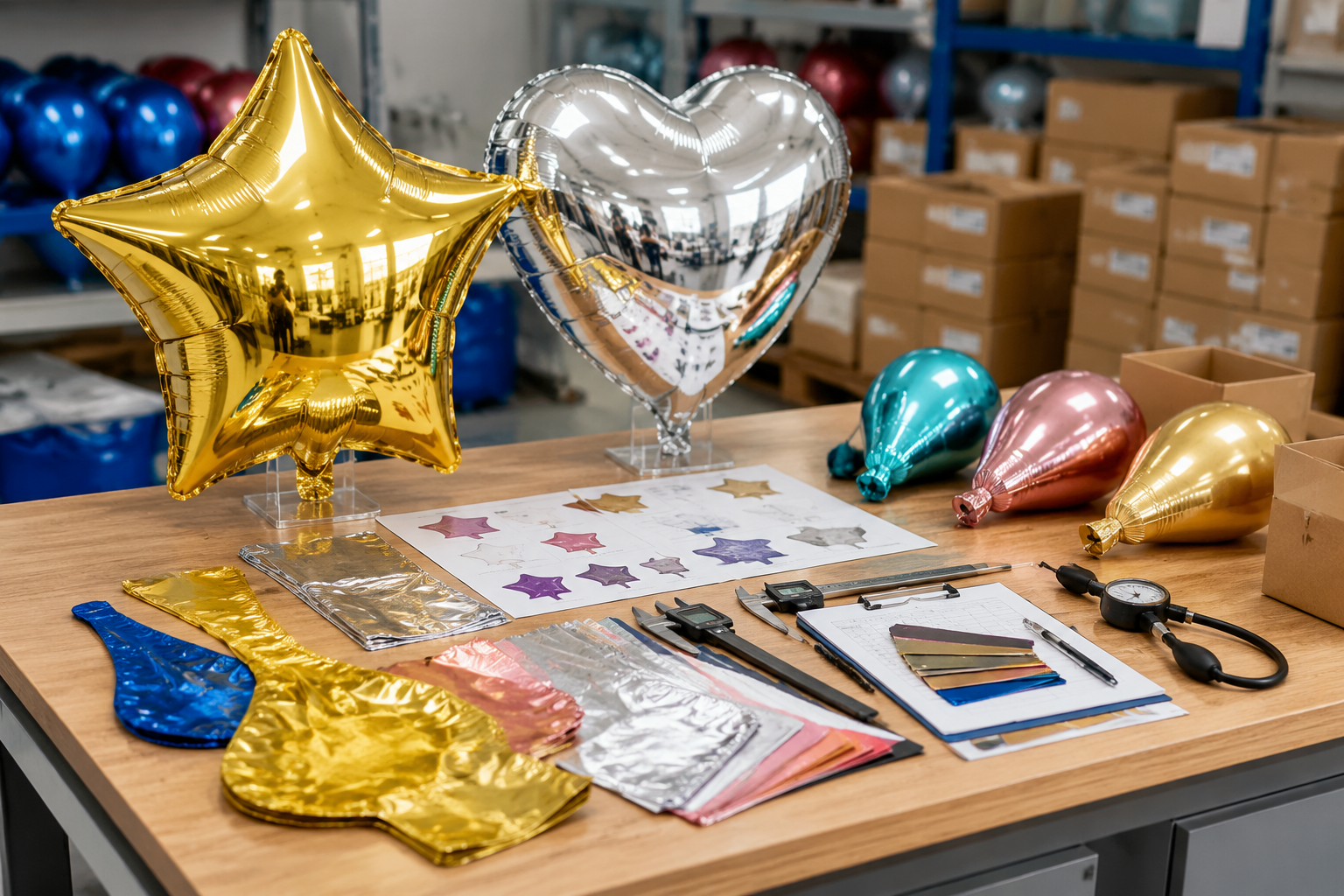
Create a realistic B2B procurement and QC desk scene for custom foil balloons used in a brand activation order. Show several uninflated metallized foil balloon samples on a clean inspection table, including a stock 18 inch round sample, a star sample, and a custom die-cut sample with no logos or readable text. Include one partially inflated logo-free round foil balloon so the viewer can see the valve, heat-seal edge, and curved surface.
Add practical procurement objects: a caliper measuring a sealed edge, a ruler used for dimension checking without readable numbers, a color swatch fan, clear polybags, ribbon rolls, blank sample approval tags, a carton with blank shipping labels, and an inspection checklist with unreadable placeholder lines. The scene should communicate MOQ discussion, sample approval, packing review, carton planning, and QC checks for export procurement.
Use neutral factory-office lighting, realistic silver and colored metallized film surfaces, visible heat-seal edges, accurate valve details, matte carton texture, and organized tabletop spacing. Do not include readable text, logos, watermarks, fake certificates, identifiable people, staged lifestyle party scenes, impossible machinery, exaggerated reflections, or decorative backgrounds.
- Primary objects: foil balloon samples, valve detail, heat-seal edge, caliper, ruler, color swatches, clear polybags, carton, checklist, ribbon rolls, and sample tags.
- Scene purpose: MOQ discussion, sample approval, packing review, carton planning, and QC inspection for a brand activation order.
- Style: realistic industrial export procurement image with neutral lighting, accurate material detail, and no readable branding.
Related Joyline Party Supply pages
- custom balloons with logo
- paper cups with logo
- bulk gift bags wholesale
- wholesale party decorations
- custom party supplies manufacturer
FAQ
What is a practical custom foil balloon MOQ for brand activation event procurement?
For inquiry planning as of 2026-07-22, 3,000-10,000 pieces per printed stock-shape SKU is an example RFQ discussion range to verify in the supplier quote. The scope is one stock shape, one artwork version, one metallized foil film color, one valve type, one print method, and one packing format. Custom die-cut shapes, retail packing, multiple artwork versions, special film colors, or tight event deadlines can change the MOQ.
Can several custom printed foil balloon designs be combined to meet one MOQ?
Sometimes, but buyers should not assume it. A supplier may accept one total purchase order while still requiring each SKU to meet its own minimum. Ask whether different artwork versions, film colors, valve types, print setups, warning labels, or packing formats share a setup. If each version needs separate proofing, printing, packing labels, and carton marks, the supplier may quote separate MOQ and price breaks.
What makes custom die-cut foil balloon MOQ different from stock-shape MOQ?
A custom die-cut foil balloon may require tooling review, seal-path checking, valve-position planning, inflated sample approval, and film-waste calculation before the supplier can confirm MOQ. A stock round, heart, star, number, or letter shape with custom print is usually simpler to quote, but the actual minimum still depends on artwork, film color, valve, packing, and schedule.
Which specification fields should be included in a custom foil balloon RFQ?
Include inflated size, flat size if available, size tolerance, shape, metallized foil film color, supplier-standard film grade or requested thickness, print side, print colors, artwork file format, color target, valve type, inflation method, packing ratio, carton limits, destination country, delivery city, required arrival date, Incoterm, sample requirement, QC checklist, and compliance document scope.
How should buyers approve foil balloon samples before mass production?
Use a written sequence: digital proof, flat printed sample or film swatch, inflated sample if shape or logo visibility matters, and signed pre-production approval. Record sample version, date, dimensions, color notes, inflation method, packing notes, photos, and accepted deviations. Mass production should start only after written approval of the production-representative sample.
Which defects matter most for event-use foil balloons?
The highest-risk defects are leakage, weak heat seals, blocked valves, wrong artwork, wrong SKU, poor logo position, print rub, film scratches, incorrect packing count, mixed allocation, wrong barcode, missing warning label, and carton damage. These issues can delay installation or create inconsistent brand activation displays.
Ready to quote this project?
Send specs, quantity, customization needs, destination, and deadline.
Request a quote