Custom Party Supplies Sourcing · 2026-07-20 · 10 min read
Custom Paper Plates Food Contact Compliance Sourcing Guide
Byline: Vincent Xi, Editorial Author, https://joylinepartysupply.com/authors/vincent-xi/. Practical buyer guidance for sourcing custom paper plates food contact compliance files, RFQ wording, paperboard GSM, coating options, print and forming risks, carton planning, sample approval, inspection checks, MOQ assumptions, and supplier comparison.
Buyer Comparison Table
| Factor | Option A | Option B | Buyer note |
|---|---|---|---|
| Document scope | Generic food-safe statement | Product-linked declaration plus report date, tested sample description, material stack, intended food use, and destination-market reference | Use option B for importer, distributor, and retailer files. Ask the supplier to mark whether each document covers the finished printed plate, coating, paperboard, ink, adhesive if used, or packaging material. |
| Plate specification | Nominal size only | Top diameter, usable flat diameter, rim height, paperboard GSM, piece weight, coating type, food-contact side, print side, finish, and retail pack format | Two plates with the same nominal diameter can differ in usable food area, stiffness, stack height, carton volume, coating performance, and document relevance. |
| MOQ basis | One MOQ for the whole order | MOQ separated by design, size, board stock, coating, print setup, packing format, and shipping schedule | Example planning assumption to verify in the supplier quote as of 2026-07-20: export custom printed paper plate orders may be planned at 10000 pieces to 50000 pieces per design and size. Actual MOQ depends on material purchase quantity, line scheduling, print setup, packing labor, and supplier capacity. |
| Lead-time control | One delivery estimate | Separate timing for artwork proofing, sampling, sample transit, production, inspection, booking, loading, and international transit | Example launch-calendar assumption to verify with the supplier as of 2026-07-20: artwork proofing may require 2 business days to 4 business days, pre-production sampling 5 calendar days to 10 calendar days, express sample transit 3 calendar days to 7 calendar days, and mass production 20 calendar days to 35 calendar days after deposit and sample approval. |
| Packing plan | Supplier decides packing after production | Buyer approves retail count, inner wrap, barcode location, carton quantity, carton dimensions, gross weight, pallet rule, and carton label before mass production | Carton cube can change landed cost. Ask for a packed-carton measurement after the packing sample or first production carton is available. |
| Inspection evidence | Final photos only | Defined checks for board, print, coating, forming, odor, oil or moisture screening, counts, barcode, carton labels, and AQL sampling if agreed | Photos are useful status evidence. They do not replace a release standard when the order has retailer, marketplace, or food-contact documentation exposure. |
Decide the Food Use Before the Artwork
A custom paper plates food contact compliance RFQ should start with the food condition, not the decoration. The supplier needs to know whether the plate will hold dry cake, snacks, moist food, oily food, hot-served food, cold food, or short-contact party food. That decision affects coating choice, document relevance, testing scope, odor risk, and whether printed decoration can sit near the food-contact surface.
State excluded uses as clearly as intended uses. If the product is not designed for microwave heating, oven use, direct flame, freezer storage, or prolonged liquid holding, put that in the specification before packaging artwork is approved. This prevents marketing copy from making claims the construction was never priced or documented to support.
The sales channel also changes the sourcing file. A supermarket private-label paper plate may need retailer document review and strict barcode control. A distributor bulk pack may care more about carton labels and warehouse handling. A marketplace pack may need stronger carton protection because parcel delivery can punish light, bulky disposable tableware.
- Buyer decision: define destination market, intended food condition, excluded uses, sales channel, pack format, launch date, and document expectations before requesting final price.
- Product scope: printed paper plate, paperboard, coating, ink, food-contact side, rim forming, inner packing, retail packing, master carton, and shipment preparation.
- Claims to keep out of artwork until documented: compostable, recyclable, plastic-free, PFAS-free, FSC, recycled content, microwave-safe, oven-safe, and any certification mark.
Author Basis and Editorial Scope
Visible byline: Vincent Xi, Editorial Author, https://joylinepartysupply.com/authors/vincent-xi/. Joyline Party Supply lists Vincent Xi in that editorial role. This article does not claim personal factory testing, client outcomes, certifications, legal approval, retailer acceptance, or laboratory work.
The purpose is procurement control. It helps buyers ask better questions before deposit, sample approval, production, inspection, and shipment. It does not replace market-specific legal review or current supplier documents for the exact custom paper plate construction.
- Best-fit readers: importers, distributors, retail buyers, brand founders, category managers, sourcing managers, promotional pack buyers, and procurement managers.
- Use case: branded, seasonal, private-label, event-specific, and coordinated partyware plates that may be sold with cups, napkins, balloons, gift bags, banners, table covers, and other party supplies.
RFQ Fields That Change the Price
A quote for a custom disposable paper plate described only by nominal size is not enough to compare suppliers. Ask each supplier to price the same diameter, usable flat diameter, rim height, paperboard GSM, coating, print method, print coverage, pack count, carton quantity, and document package. Otherwise a low price may simply mean a lighter plate, smaller food area, thinner coating, simpler packing, or weaker food-contact file.
The supplier should describe the material stack in plain language. A useful answer identifies the base paperboard, print layer, coating or barrier layer, lamination if used, and the food-contact surface. If the supplier cannot say which layer touches food, the buyer cannot judge whether the test report fits the product.
Ask for alternatives in a separate deviation table. A supplier may have a standard board weight, mold, coating, or retail pack that is cheaper than the requested version. That can be useful, but only if every difference is visible before sampling.
- Required quote fields: top diameter in millimeters, usable flat diameter in millimeters, rim height in millimeters, paperboard GSM, coating type, print method, food-contact side, print side, pieces per retail pack, pieces per carton, carton dimensions in centimeters, gross weight in kilograms, incoterm, and port of loading.
- Example RFQ quantity tiers to verify with the supplier as of 2026-07-20: 10000 pieces per design, 30000 pieces per design, and 50000 pieces per design.
- Ask for separate costs for sample fee, courier charge, print setup, tooling if any, testing or document update, retail packing, inspection support, and carton printing.
RFQ Wording to Send
Use one block that joins product, use, documents, and packing: "Please quote custom printed paper plates for food contact. Destination market: [country or region]. Intended use: [dry snacks / cake / oily food / hot-served food / cold food]. Excluded use: [microwave / oven / prolonged liquid holding if applicable]. Size: [top diameter in millimeters], [usable flat diameter in millimeters], [rim height in millimeters]. Material: [target paperboard GSM], [coating type], [food-contact side]. Print: [CMYK or spot colors], [coverage level], [finish], [artwork version]. Packing: [pieces per retail pack], [inner packs per master carton], [carton mark], [barcode location]. Please quote MOQ per design, sample lead time, mass-production lead time, unit price by quantity break, setup cost, sample fee, test document cost if any, incoterm, carton dimensions, gross weight, and document list."
Add a deviation instruction: "If your standard construction differs from our requested GSM, coating, diameter, rim height, packing count, or document package, quote it as an alternative and mark all differences before sampling." This keeps negotiation open without letting the specification drift.
Add change control early: "After sample approval, do not change paperboard GSM, coating, ink system, lamination, plate mold, rim profile, packing materials, barcode, carton quantity, or document basis without written buyer approval."
- Ask for a document table with document name, issuer, issue date, tested sample, covered material, destination market, and whether it covers the finished plate.
- Ask for the quote validity period, payment terms, earliest production slot after deposit, sample dispatch method, and final inspection window.
- For multi-design programs, require MOQ, sample status, production date, and packing status by design rather than by total order only.
Material Choices With Real Buyer Consequences
Paperboard GSM affects stiffness, stack height, forming behavior, and how the plate handles heavier food. It does not prove compliance by itself. The buyer should require the same GSM on the quote, specification sheet, approved sample tag, purchase order, and inspection checklist.
Example material planning assumption to verify in the supplier quote as of 2026-07-20: common disposable party paper plate projects for export may be quoted in a 250 gsm to 400 gsm paperboard range for many everyday party applications. This is not a universal standard or a claim for every product. The suitable board depends on diameter, rim profile, coating, food load, pack count, and buyer performance target.
Coating is both a performance choice and a document choice. PE coating, water-based barrier coating, dispersion coating, and other barrier systems can differ in grease resistance, moisture resistance, heat response, forming stability, recyclability claim support, and document scope. A buyer trying to reduce plastic language on pack should not assume the coating supports that claim in every market.
High ink coverage increases the need for control. Dark backgrounds, edge-to-edge patterns, metallic effects, and saturated seasonal colors can raise the risk of odor, setoff, rub marks, color drift, or document questions. If the artwork uses a metallic look, ask whether the supplier proposes metallic ink, foil stamping, film lamination, or a printed simulation.
- Material fields: paperboard GSM, coating type, ink system, food-contact side, print side, finish, lamination if any, adhesive if any, and supported claim documents.
- Dimension fields: top diameter in millimeters, usable flat diameter in millimeters, bottom flat diameter in millimeters, rim height in millimeters, stack height for a defined count, and piece weight in grams.
- Process risks: odor, ink setoff, coating break, oil leakage, moisture softening, rim cracking, off-center forming, warping, nesting issues, and contamination.
Printing and Forming Process Questions
Custom paper plate production can involve sheet printing, drying, die cutting, coating or coating verification, plate forming, stacking, counting, inner packing, and master-carton packing. The exact route depends on the supplier's equipment and construction, so buyers should ask how the approved artwork becomes the finished formed plate.
Print method matters for color control, setup cost, and MOQ. Offset printing, flexographic printing, spot-color work, and CMYK process printing can each create different proofing needs and different risks for registration, drying, rub resistance, and setoff. The buyer should ask which print method is quoted and whether the production method matches the sample method.
Forming changes the visible artwork. A design that looks centered on a flat dieline may shift after the rim is pressed. Keep logos, barcode areas, and important pattern elements away from the high-stress rim area unless the supplier has confirmed the forming tolerance on the actual mold.
- Process terms to clarify: sheet-fed printing, flexographic printing, offset printing, die cutting, plate forming, rim pressing, drying time, nesting, stack count, inner bagging, sleeve packing, and master-carton packing.
- Ask whether the sample is made by the same print method, coating, board GSM, mold, and packing method planned for mass production.
- For heavy-coverage designs, add checks for odor, ink transfer, rub marks, drying condition, color drift, and contact between printed surfaces in the stack.
Documents Worth Checking
A useful food-contact file links the document to the construction being purchased. Check the tested sample name, report issue date, issuer, test method or regulation reference, test conditions, result, and conclusion. Then compare those details with the quoted plate, coating, ink system, pack claim, and destination market.
Source context 1: the U.S. Food and Drug Administration food-contact substance framework under the Federal Food, Drug, and Cosmetic Act and related food-contact rules, reviewed as public buyer context on 2026-07-20. This helps buyers frame U.S. questions; it is not a statement that any specific paper plate is FDA approved.
Source context 2: Regulation (EC) No 1935/2004 on materials and articles intended to come into contact with food, reviewed through EUR-Lex as public buyer context on 2026-07-20. The regulation sets broad EU food-contact principles, including that materials should not transfer constituents to food in quantities that could endanger human health, bring unacceptable change in food composition, or affect organoleptic characteristics. It is not a supplier certification.
A raw-material report may still be useful, but it should not be treated as automatic coverage for the finished printed plate. Ask the supplier to explain what the report covers: base paperboard, coating, ink, adhesive, finished article, or packaging material.
- Request a food-contact declaration naming the product, material structure, intended use, destination market, issue date, and responsible supplier entity.
- Request test reports tied to the finished plate or relevant food-contact layer, with report date, tested sample description, test conditions, and applicable market reference.
- Request claim-specific evidence before approving artwork for compostable, recyclable, PFAS-free, plastic-free, FSC, recycled-content, or similar claims.
- Keep the approved artwork, signed specification sheet, sample approval record, food-contact documents, purchase order, inspection report, and shipment documents in one buyer file.
MOQ and Lead Time Without Guesswork
Custom printed paper plates MOQ should be quoted per design. A seasonal partyware range with several artworks can create several print setups even when the diameter and coating are the same. Ask whether the supplier can share board stock, coating, carton size, and shipment schedule across designs, but do not assume the mixed program satisfies MOQ automatically.
Example MOQ planning assumption to verify in the supplier quote as of 2026-07-20: many export custom printed paper plate programs may be planned at 10000 pieces to 50000 pieces per design and size. Complex finishes, uncommon molds, custom coatings, small retail packs, or retailer-specific packing can raise the practical MOQ.
Lead time should be divided into stages because each stage has a different owner. Example launch-calendar assumption to verify with the supplier as of 2026-07-20: artwork proofing may require 2 business days to 4 business days after print-ready files, pre-production sample making may require 5 calendar days to 10 calendar days after proof approval, express sample transit may require 3 calendar days to 7 calendar days, and mass production may require 20 calendar days to 35 calendar days after deposit and sample approval. Sea freight, customs clearance, and inland delivery need separate timing from the forwarder.
- Ask whether MOQ is driven by print setup, paper purchase, coating availability, forming line scheduling, retail packing labor, carton printing, or test-document updates.
- Separate proofing time, sample time, sample transit, production time, inspection time, booking time, loading date, international transit, clearance, and warehouse receiving.
- For repeat orders, ask whether the same setup fee, sample fee, document fee, and MOQ apply again.
Sample Approval Should Cover the Physical Plate
A digital proof only checks layout direction. It does not prove final ink, coating, gloss, rim forming, stiffness, odor, carton cube, or food-contact document coverage. For a new buyer, new artwork, new coating, heavy ink design, retailer pack, or changed material, approve a physical pre-production sample before mass production.
Check the sample as a product, not as a photo. Measure diameter and rim height, weigh pieces, open the pack and smell for unusual odor, bend the rim lightly, check nesting, inspect the food-contact surface, scan the barcode, count the retail pack, and compare the carton label with the purchase order.
If the supplier sends a digital print sample only for artwork placement, ask them to mark it as non-representative for final production. That prevents a later dispute about gloss, coating feel, color, food-contact document scope, or forming quality.
- Approve: plate diameter, usable food area, rim height, board GSM, coating type, food-contact side, artwork position, print color target, pack count, barcode, carton mark, and document list.
- Example buyer control point to verify with the supplier as of 2026-07-20: if the approved construction is 350 gsm paperboard for the quoted design and size, the supplier should not switch to 300 gsm paperboard without buyer approval and document review.
- Store the approved sample or signed sample photos with the purchase order and inspection checklist.
Specification Sheet Fields That Prevent Claims Later
The specification sheet should be short enough for production staff to use and detailed enough for inspection to enforce. Put the commercial SKU, supplier item code, plate dimensions, material stack, food-contact side, print side, print method, color reference, retail pack, master carton, barcode location, and carton label in one controlled file.
Tolerances need to be agreed before goods are packed. Paper plates are formed from sheet material, so diameter, weight, rim shape, stack height, and color can vary. If the buyer leaves tolerances unstated, the argument usually starts after shipment photos arrive.
Example buyer tolerances to verify with the supplier as of 2026-07-20: plate diameter may be controlled at plus or minus 2 millimeters per plate, plate weight may be controlled at plus or minus 5 percent per piece, retail pack quantity should match the purchase order at 100 percent of checked packs, and barcode scan should pass on approved retail packaging before shipment. These are example buyer-side tolerances, not universal standards.
- Core dimensions: top diameter, usable flat diameter, bottom flat diameter, rim height, stack height for a defined count, and piece weight.
- Artwork controls: dieline version, file version, color reference, print position tolerance, edge bleed, barcode size, retail pack layout, and carton mark layout.
- Packing controls: pieces per retail pack, pieces per inner pack, inner packs per carton, carton dimensions, gross weight, carton mark, pallet rule, and mixed-SKU rule.
- Inspection controls: defect classes, sampling standard if used, AQL level if agreed, sample size, carton sampling method, photo record, and release authority.
QC Points for Printed Paper Plates
Incoming board checks catch problems before printing cost is added. Inspect grade match, coating match, surface cleanliness, moisture-related warping, thickness consistency, odor, contamination, and batch identification. If the board does not match the approved material, production should pause for buyer review.
Print checks should focus on the risks that buyers actually see after distribution: registration, color drift, setoff, rub resistance, visible contamination, drying condition, odor, file version, and barcode placement. Heavy ink near the food-contact area should receive extra review because transfer and odor complaints are hard to fix after retail delivery.
Forming checks matter because a sheet can look acceptable before it is shaped. Inspect rim strength, cracking, uneven forming, off-center artwork, wrinkles, delamination, coating breaks, stack height, nesting, and the food-contact surface.
Source context 3: ISO 2859-1 is a sampling-procedure reference for inspection by attributes, reviewed as sampling-method context on 2026-07-20. Naming this standard does not mean a supplier is certified to it. It is relevant only when buyer and supplier agree to use it and define inspection level, acceptance quality limits, defect classes, and release authority.
- Critical defect examples: foreign matter, unsafe odor, wrong material, wrong food-contact side, visible contamination, or unapproved material substitution.
- Major defect examples: serious color mismatch, delamination, oil leakage, cracked rim, weak stiffness, wrong retail count, wrong barcode, mixed designs, wrong carton label, or carton damage affecting saleability.
- Minor defect examples: small print specks, slight shade variation within approved tolerance, or minor carton scuffing that does not affect saleability.
Carton Cube Can Change Landed Cost
Paper plates are light and bulky, so freight planning should start before the order is confirmed. Ask for carton dimensions in centimeters, gross weight in kilograms, pieces per carton, estimated cubic meters, pallet rule, and loading method. Then require an updated measurement from the packing sample or first packed carton.
Example carton calculation to verify in the supplier quote as of 2026-07-20: if one master carton measures 46 centimeters by 34 centimeters by 32 centimeters, carton volume is 0.050 cubic meters. If the carton holds 500 plates, an order of 50000 plates requires 100 cartons and about 5.0 cubic meters before pallets. If each carton has a gross weight of 9 kilograms, shipment gross weight is about 900 kilograms before pallets. This is a planning calculation only; actual values must come from the supplier's packed sample.
Retail packing should match the channel instead of the factory default. A club-store pack may need a higher count and stronger sleeve. A specialty retailer may need a smaller pack with premium graphics. A distributor may prefer bulk inner bags. A marketplace seller may prioritize carton compression because the selling unit may move through parcel networks.
- RFQ freight fields: incoterm, port of loading, destination port or warehouse, carton dimensions, gross weight, pieces per carton, carton count, estimated cubic meters, pallet rule, and loose-load rule.
- Retail packing fields: pieces per retail pack, sleeve or bag material, barcode, country-of-origin statement, warning text if required, recycling mark if supported, and hang-hole requirement if used.
- Warehouse risk points: weak carton board, excess empty space, unclear SKU labels, barcode placement errors, mixed designs, moisture exposure, and carton crushing during loading.
Supplier Comparison After Normalizing Specs
Do not rank a custom disposable paper plates supplier by unit price until the quoted plates are equivalent. Normalize diameter, usable area, board GSM, coating, print coverage, retail packing, carton quantity, carton dimensions, document package, inspection support, incoterm, and lead time.
Document discipline is part of supplier quality. A supplier that identifies report scope, asks about the destination market, and returns a complete specification sheet gives the buyer a clearer risk picture than a supplier that sends a low price with a generic food-safe line.
Negotiate cost levers before touching risk levers. It may be reasonable to adjust retail pack count, reduce empty carton space, simplify print coverage, or align carton format across designs. It is riskier to reduce board weight below the performance target, switch coating without document review, skip sample approval, or accept a report for a different construction.
For coordinated partyware ranges, ask for one production calendar by item. Plates, paper cups, napkins, balloons, gift bags, banners, and decorations can share a shipment only if each SKU has its own approved specification, sample status, packing rule, and document file.
- Score suppliers on specification clarity, document scope, sample accuracy, change-control discipline, QC cooperation, packing detail, and realistic scheduling.
- Compare total landed assumptions: unit price, setup, samples, testing or document updates, retail packing, carton cost, inspection cost, freight cube, duty basis, and reorder fees.
- For multi-SKU orders, request artwork approval date, sample approval date, material purchase date, production date, inspection date, and loading date by SKU.
Methodology, Source Contexts, and Limits
Methodology note: this article was developed from buyer-side RFQ structure for custom disposable tableware, common quotation variables used in export sourcing, and public regulatory or inspection source contexts. The focus is on information buyers should request before deposit, sampling, production, inspection, and shipment.
Source context 1: U.S. FDA food-contact substance framework under the Federal Food, Drug, and Cosmetic Act and related food-contact rules, reviewed as public buyer context on 2026-07-20.
Source context 2: Regulation (EC) No 1935/2004 for materials and articles intended to come into contact with food, reviewed through EUR-Lex as public buyer context on 2026-07-20.
Source context 3: ISO 2859-1 for sampling procedures for inspection by attributes, reviewed as sampling-method context on 2026-07-20.
Limitations and what to verify: this is procurement guidance, not legal advice or certification. Buyers should verify current destination-market food-contact rules, retailer manuals, test report relevance, product claims, labeling language, duty classification, freight cost, and inspection terms with qualified advisors and current supplier documents.
- Exact numeric values in this article are planning assumptions, example RFQ tiers, example buyer tolerances, or example carton calculations unless a public source context is named.
- MOQ, lead time, carton dimensions, carton weight, GSM, tolerances, and document fees must be verified against the supplier quote, approved sample, and purchase order.
- No certification, approval, client result, factory test, or retailer acceptance is claimed unless supported by a current document for the exact product and market.
Image Brief
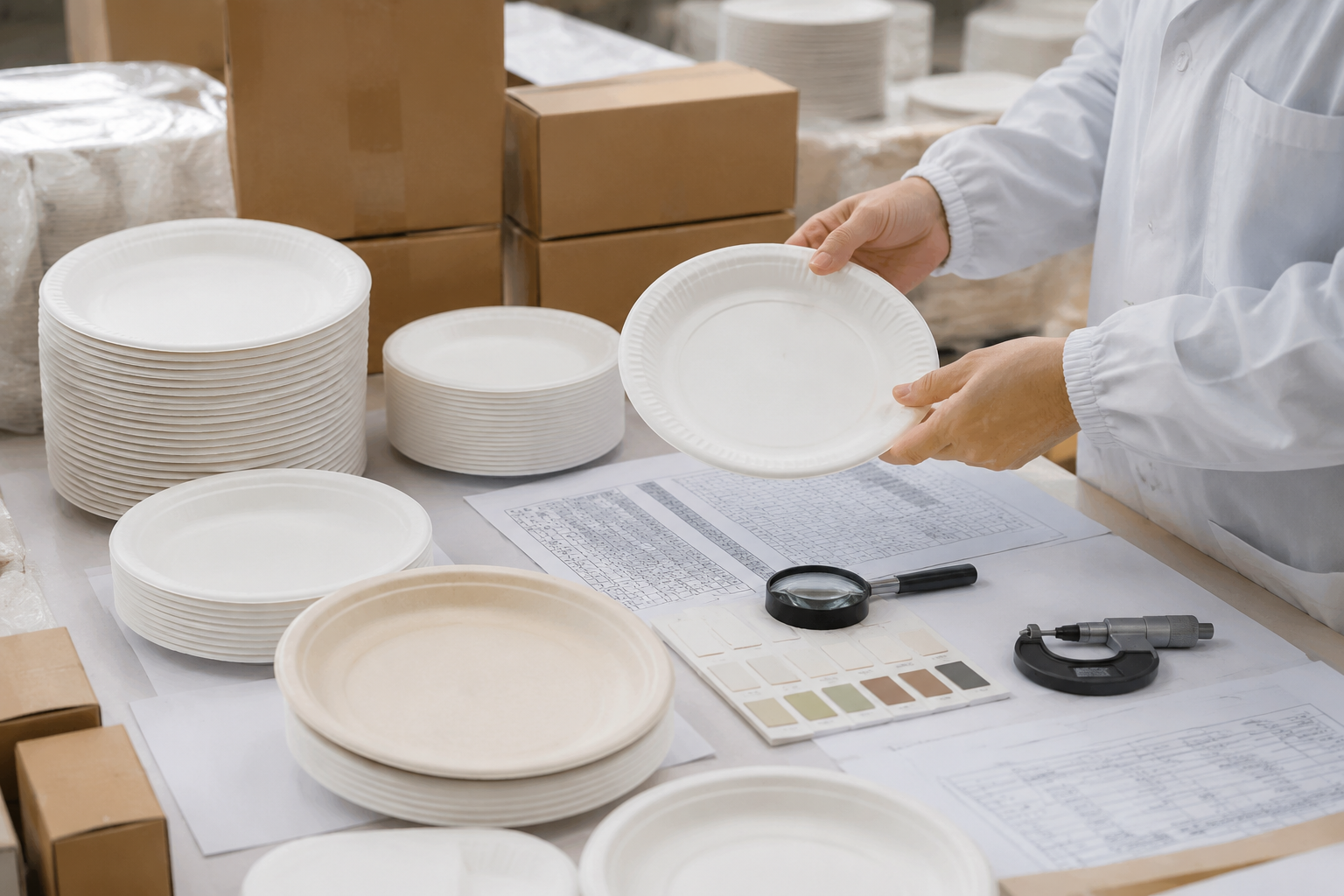
Create a realistic procurement and quality-control desk scene for custom printed paper plates. Show unbranded paper plates in several stages: a blank white paperboard plate, a printed plate with a simple abstract party pattern, a coated sample, a neat stack of finished plates, a caliper measuring rim height, a digital scale holding one plate without readable numbers, an inner polybag stack, a kraft master carton, and a clipboard-style specification sheet with generic lines and no legible text.
The scene should look like a B2B sourcing review, not a consumer party table. Use neutral daylight, realistic paper texture, visible paperboard edge thickness, shallow raised rims, matte coating, clean table surface, and space for a website header crop. Emphasize measurement, compliance paperwork, packing format, carton cube, and physical product details.
- Primary objects: custom paper plates, caliper, digital scale, coating sample, inner packing sample, kraft carton, specification sheet, and neatly stacked plates.
- Visual tone: practical, clean, industrial sourcing, neutral color balance, realistic proportions, and clear material detail.
- Avoid: readable text, logos, certification seals, watermarks, exaggerated colors, party clutter, identifiable faces, hands covering product details, impossible machinery, or unverifiable claims.
Related Joyline Party Supply pages
- custom balloons with logo
- paper cups with logo
- bulk gift bags wholesale
- wholesale party decorations
- custom party supplies manufacturer
FAQ
What should buyers include in a custom paper plates food contact compliance RFQ?
Include destination market, intended food use, excluded uses, plate diameter, usable flat diameter, rim height, paperboard GSM, coating type, food-contact side, print method, artwork version, quantity per design, retail pack count, carton quantity, carton dimensions, gross weight, document request, inspection terms, incoterm, and lead-time requirement. Ask whether each report covers the finished printed and coated plate or only a raw material.
What MOQ should buyers expect for custom printed paper plates?
Custom printed paper plates MOQ depends on size, board stock, coating, print setup, packing format, supplier schedule, and number of designs. Example planning assumption to verify in the supplier quote as of 2026-07-20: many export custom paper plate projects may be planned around 10000 pieces to 50000 pieces per design and size. Buyers should confirm whether MOQ is calculated per design, per size, per carton format, or across a mixed program.
Which documents help support paper plate food-contact suitability?
Useful documents may include a food-contact declaration, relevant test reports, material or coating information, and claim-specific evidence if the package uses environmental or restricted-substance claims. The document should match the product construction, destination market, and intended use. A generic food-safe statement is usually too weak for a serious importer, distributor, or retailer file.
How long can custom paper plate sample approval and mass production take?
Example launch-calendar assumption to verify with the supplier as of 2026-07-20: artwork proofing may take 2 business days to 4 business days, pre-production samples may take 5 calendar days to 10 calendar days after proof approval, express sample transit may take 3 calendar days to 7 calendar days, and mass production may take 20 calendar days to 35 calendar days after deposit and sample approval. Actual timing depends on season, material availability, print complexity, coating, packing format, and production capacity.
What defects matter most in custom printed paper plates?
Important defects include off-center printing, color drift, ink setoff, odor, coating breaks, delamination, warping, cracked rims, weak stiffness, oil leakage, wrong inner count, wrong retail count, barcode errors, carton compression, mixed designs, and wrong carton labels. Buyers should agree critical, major, and minor defect definitions before inspection.
Can one food-contact test report cover several custom paper plate designs?
Only if the tested material, coating, ink system, construction, intended use, and destination-market requirement remain relevant. A small artwork change may be lower risk than a coating, ink, lamination, or paperboard change, but buyers should not assume coverage. The supplier should explain report scope and identify when a new test or document update is needed.
Ready to quote this project?
Send specs, quantity, customization needs, destination, and deadline.
Request a quote