Custom Party Packaging · 2026-07-23 · 8 min read
Low MOQ Custom Party Favor Bags for Boutique Retailers: Buying Notes for Small Runs
Practical sourcing guide for boutique retailers buying low MOQ custom party favor bags, including MOQ per design, kraft paper and fabric material choices, print setup, retail-ready packing, carton volume, QC records, compliance files, and reorder planning.
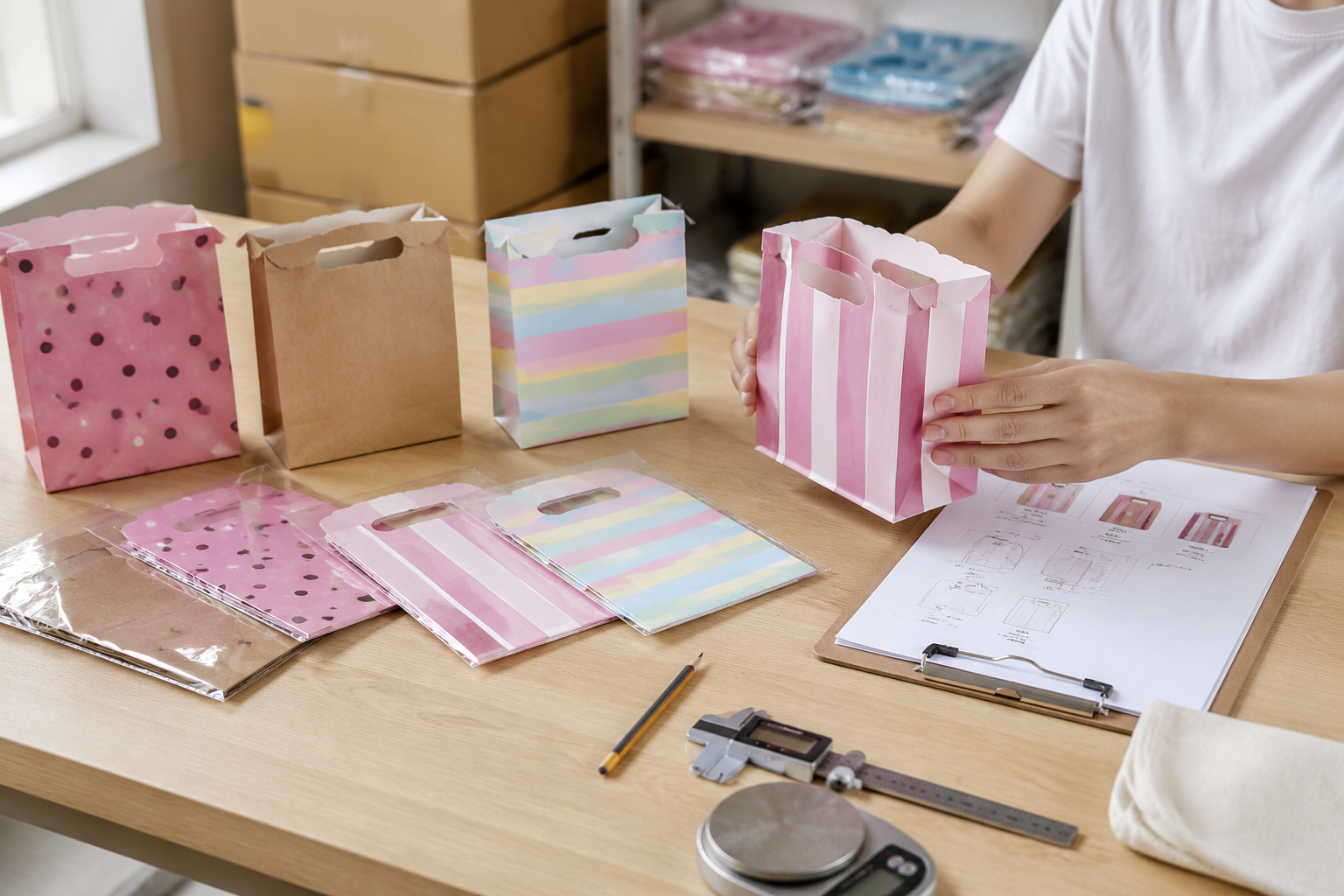
Buyer Comparison Table
| Factor | Option A | Option B | Buyer note |
|---|---|---|---|
| MOQ structure | 500-1,000 pcs in one design | 200-500 pcs per design across several designs | Ask what sets the MOQ: paper stock purchase, fabric cutting, print setup, bag forming, stitching, or packing labor. A 2,000-piece order split into four designs can still mean four proofs, four setup checks, four barcode checks, and four packing records. |
| Bag size | Supplier's existing size and die line | Custom size for a retail kit or shelf format | Existing sizes can reduce tooling and sampling time. Custom sizing should solve a real fit issue: contents, shelf tray, shipping carton, branded layout, or retail pack count. |
| Material | Kraft paper, white card paper, coated art paper | Non-woven fabric, cotton, organza, polyester, or satin pouch | Paper treat bags and kraft paper favor bags fold flat and suit many party retail ranges. Fabric pouches can support premium favor kits, but stitching, drawstring length, lint, and shade variation need closer control. |
| Print method | One-color screen print, flexo, or simple digital print | Full-color offset, foil stamping, embossing, spot UV, or heavy ink coverage | Separate print setup cost from unit cost. Premium finishes may improve shelf appeal, but they also add registration, scuffing, cracking, and rejection risks. |
| Sample approval | Digital proof plus blank stock sample | Pre-production sample using intended material and print process | A digital proof checks layout. A physical sample checks stiffness, handle pull, print opacity, folds, odor, barcode position, and actual retail appearance. |
| Packing format | Bulk packed loose by design | Retail pack of 6, 8, 10, or 12 with barcode, header card, or inner bag | Retail-ready packing can reduce receiving and repacking work. Specify pack count, label position, warning text, carton separation, and acceptable plastic use. |
| QC focus | General appearance check | Measured checkpoints for size, GSM, color, print placement, glue, handle pull, odor, barcode, count, and carton condition | Small runs have little spare stock. One carton of mixed or defective wholesale party favor bags can affect a boutique launch, so inspection fields should be agreed before production. |
| Freight basis | Express or air for urgent seasonal launch | Sea freight, LCL, or consolidated shipment for planned replenishment | Favor bags are often charged by carton volume rather than actual weight. Request CBM, carton dimensions, gross weight, net weight, and pieces per carton during quotation. |
Where Small Favor Bag Orders Go Wrong
A boutique order is not just a smaller version of a chain-store program. The selling window is shorter, the order has fewer spare units, and a barcode error or weak handle can remove a meaningful part of the launch quantity.
The first decision is the product role. A birthday treat bag, bridal shower pouch, boutique giveaway, subscription box insert, holiday capsule item, and favor kit component do not need the same material, closure, print coverage, or retail packing.
Buyers should define the selling format before asking for price. A loose bag, 8-pack, hangable retail pack, gift-with-purchase bag, and private label party supplies kit component all create different labor, labeling, carton, and inspection requirements.
- Sales channel: boutique store, e-commerce shop, event studio, party subscription box, marketplace bundle, pop-up display, or wholesale account.
- Selling unit: single bag, pack of 6, pack of 8, pack of 10, pack of 12, kit component, or promotional giveaway.
- Commercial limit: target landed cost per selling pack, acceptable setup fee, first order quantity, reorder quantity, and number of designs.
- Timing limit: launch date, warehouse date, seasonal event, reorder window, and latest acceptable ship date.
MOQ Questions That Change the Quote
The lowest MOQ is not always the best buying point. A supplier may produce 300 pieces, but the setup fee, sample cost, sorting labor, and courier freight can make the landed cost too high for the retail price.
Quantity per design matters more than total quantity. Four designs at 500 pieces each may share paper stock and bag size, but each artwork still needs proofing, color checking, SKU separation, barcode verification, and packing control.
Ask the supplier what drives the MOQ. If paper stock is the constraint, an existing kraft paper or white paper base may help. If print setup is the constraint, fewer colors or fewer artwork versions may help. If retail packing is the constraint, changing the pack format may matter more than changing the bag.
- Request MOQ by design, by total order, by size, by material, by print method, and by retail pack format.
- Ask for quote points such as 300, 500, 1,000, 2,000, and 5,000 pieces where workable.
- Confirm whether mixed designs can share paper stock, fabric base, handle, die line, carton size, label format, screen printing setup, or digital print setup.
- Ask whether reorder MOQ is lower after artwork, screen, plate, die line, or sample approval is already in place.
- Request the lowest workable MOQ, the most economical MOQ, and the reorder MOQ in the same quote.
Bag Specs to Confirm Before Sampling
A request for custom favor bags is too loose for production. The supplier needs the physical bag, the expected contents, the retail pack, the artwork position, and the inspection basis.
For paper favor bags, size should include width, height, side gusset, bottom gusset, and tolerance. Material should name the paper type, GSM, surface finish, inside color if relevant, handle material, handle length, and whether a bottom reinforcement card is needed.
For flat paper treat bags, clarify the closure. An open-top treat bag, fold-over top, adhesive strip, sticker closure, and header card format all change packing and customer use.
For fabric favor bags or drawstring organza bags, specify composition, fabric weight or density, drawstring material, cord length, stitch quality, seam allowance, print area, shrinkage expectation, and lint control.
- Paper bag fields: width, height, side gusset, bottom gusset, GSM, paper color, finish, handle type, handle length, glue area, and bottom reinforcement.
- Flat treat bag fields: finished size, flap length, closure method, food-contact-adjacent use, print side, header hole, and retail pack count.
- Fabric pouch fields: material composition, fabric weight, drawstring type, cord length, stitch quality, seam allowance, print area, shrinkage expectation, and lint control.
- Content fields: expected filled weight, item shape, sharp edges, fragrance or oil exposure, wrapped food proximity, and expected customer handling.
- Tolerance fields: size tolerance, gusset tolerance, handle position tolerance, print placement tolerance, and acceptable shade range.
Material Choices for Boutique Retail
Kraft paper favor bags work when the range needs a natural, craft, rustic, or simple party look. Kraft is also a practical base for one-color printing, but buyers should expect muted colors compared with white or coated paper.
White card paper and coated art paper support brighter color, pastel collections, and more polished shelf presentation. They can also show scuffs, cracked fold lines, and ink transfer more clearly, so packing protection matters.
Non-woven, cotton, organza, polyester, and satin pouches suit reusable or higher-value favor kits. The tradeoff is more labor control: stitching, drawstring length, loose threads, lint, fabric shade, and print absorption.
A custom construction should earn its cost. Existing sizes, standard handles, available stock colors, and normal carton formats usually make more sense for a first boutique test order.
- Use kraft paper when a natural look and simple print are acceptable.
- Use white or coated paper when color brightness and shelf graphics matter more.
- Use organza, cotton, satin, polyester, or non-woven fabric pouches when reusability or premium presentation justifies extra inspection.
- Do not allow paper GSM, fabric base, handle type, coating, lamination, or finish changes without written approval.
- Ask whether the supplier has existing blank stock in the target size and material before opening a custom die line.
Artwork and Print Controls
Boutique party ranges often use small logos, seasonal artwork, pastel palettes, and coordinated graphics across cups, napkins, balloons, tags, and tableware. A mockup is useful for direction, but production needs print-ready files.
Vector artwork is preferred for logos, icons, line art, and spot-color graphics. High-resolution raster artwork may work for full-color digital printing or offset printing if the supplier confirms the print method supports it.
Print method should follow the order size and artwork. One-color screen printing can work for simple logos on kraft paper or fabric pouches. Digital printing may suit short runs with several designs. Offset printing or flexo printing can become more economical for repeat paper bag programs.
Premium finishes need tighter approval. Foil stamping, embossing, spot UV, full bleed, dark ink, and heavy coverage can add shelf value, but they also increase registration, scuffing, cracking, and rejection risk.
- Artwork files: AI, PDF, EPS, SVG, or editable print file where available, plus JPG or PDF visual reference.
- Color references: Pantone number, CMYK values, physical swatch, approved sample, or supplier standard color card.
- Print fields: print side, print area, bleed, safe area, handle clearance, fold clearance, bottom gusset artwork, barcode quiet zone, and no-print zones.
- Tolerance fields: size, logo placement, print registration, trimming, and acceptable shade range.
- Material effects: kraft paper dulls color, fabric absorbs ink, dark ink may scuff, foil can misregister, and heavy ink can crack on folds.
What Sample Approval Should Prove
A digital proof can confirm spelling, layout, logo scale, barcode position, and basic artwork placement. It cannot prove paper stiffness, handle strength, drawstring movement, ink opacity, odor, or shelf appearance.
A blank stock sample can confirm size, handle style, material feel, folding, and whether the bag fits the intended contents. It still does not prove the final print result.
A pre-production sample using the intended material and print process is the strongest approval reference. If timing does not allow it, the buyer should record exactly what the approved proof and blank sample do and do not represent.
Sample comments should become production instructions. Replace vague approval with measured dimensions, material reference, color comments, logo position, barcode scan result, handle check, retail pack count, and required corrections.
- Record width, height, gusset, handle length, and retail pack dimensions.
- Test handle or drawstring strength using the expected filled weight plus a practical margin.
- Review print under neutral lighting against the approved Pantone, CMYK, swatch, or sample reference.
- Confirm barcode scanning and label position before bulk packing begins.
- Check odor, glue marks, loose threads, ink transfer, creasing, scuffs, and whether the bag stands or folds as required.
- Keep one approved sample with the buyer and one with the supplier.
Retail Packing and Carton Volume
Favor bags are light, but they can take up carton space. That matters when the shipment is charged by volume. Ask for carton dimensions, carton count, gross weight, net weight, pieces per carton, and CBM before approving the order.
Retail-ready packing should match the sales channel. An event planner may accept bulk cartons. An e-commerce seller may need packs of 6, 8, 10, or 12 with barcode, SKU label, warning text, and country-of-origin marking where required.
For physical retail, the packing may need header cards, hang holes, shelf-ready inner packs, or countable bundles. These details affect labor cost, carton layout, and inspection time.
Mixed-SKU cartons need clear separation. If four designs ship in one master carton, each design should be separated by inner carton, polybag, paper band, or divider, with carton marks matching the packing list.
- Quotation data: carton size, gross weight, net weight, pieces per carton, carton count, CBM, and packing method.
- Retail pack data: pack count, bag orientation, header card, hang hole, barcode label position, SKU label content, and warning label if required.
- Master carton data: PO number, SKU, design code, quantity, carton number, destination mark, gross weight, and carton dimensions.
- Mixed-SKU rule: no loose mixed designs unless approved; separate each design and match carton numbers to the packing list.
- Surface protection: inner bag, paper wrap, interleaving, moisture protection, or adjusted carton count where needed.
QC for a 500-Piece Run
Small orders still need an inspection standard. In a 500-piece run, 50 defective pieces can remove a store display, a promotion quantity, or the safety stock for online replacements.
The most expensive defects are usually not tiny scuffs. Wrong artwork, wrong SKU, incorrect barcode, weak handle glue, mixed designs, severe odor, and wrong retail pack count can stop the goods from being sold as planned.
Inspection can be staged without making the process heavy. Check incoming material first, then print placement and drying, then forming or stitching, then finished dimensions, count, packing, carton marks, and carton condition.
For importers and distributors, the inspection report should include photos of the approved sample beside production goods, measurement shots, close-up print detail, handle attachment, bottom gusset, retail pack, barcode scan result, carton marks, and packing list.
- Critical defects: wrong logo, wrong SKU, incorrect barcode, missing required warning, severe odor, contamination, unsafe sharp material, or wrong material.
- Major defects: weak handle, open glue area, large color mismatch, obvious print smear, wrong retail pack count, crushed retail packaging, mixed design packing, or unreadable carton mark.
- Minor defects: small scuffs, slight wrinkles, small trimming variation, minor shade difference within agreed tolerance, or small marks not visible in normal retail display.
- Measurement fields: finished width, height, gusset, handle length, print position, retail pack count, carton count, gross weight, and barcode scan result.
- Inspection record: sample size, AQL level if used, defect classification, photo report, corrective action rule, and approval authority.
Compliance and Label Files
Compliance depends on destination market, material, decoration, age grading, sales channel, and whether the favor bag is sold alone or included in a children's party kit. Do not assume every favor bag needs the same file.
For paper or fabric bags used as packaging, buyers commonly request material specification, ink or coating information, supplier declaration, available test reports, packing declaration, commercial invoice, packing list, and country-of-origin details.
If the bag is part of a children's kit, candy kit, toy bundle, or small-parts set, the buyer's compliance team should confirm applicable rules before production. The bag may be packaging in one case and part of the product experience in another.
Retail label content should be approved as a specification item. Barcode format, SKU, item name, quantity per pack, company details, country of origin, recycling mark, suffocation warning, age warning, and care instruction may all be relevant depending on the market.
- Request material specification, paper GSM or fabric composition, ink or coating information, and available test reports before production approval.
- Confirm country-of-origin marking, barcode standard, retail pack text, warning labels, and language requirements for the selling market.
- For children's party kits, clarify age grading, small-parts exposure, whether the bag is packaging or play item, and whether food-contact-adjacent review is needed.
- Tie compliance files to the exact material, print method, production batch, and supplier item code where possible.
- Do not approve final retail labels until barcode, SKU, quantity, warning text, and origin marking have been checked.
Lead Time and Reorders
Lead time should be discussed as steps, not as one number. The schedule may include artwork review, quote confirmation, sample making, sample shipping, buyer review, revision, payment, material preparation, printing, bag forming, QC, packing, export handling, freight, customs, and local delivery.
A simple existing-size one-color paper bag may move faster than a custom-size, multi-design, retail-packed order. Plan from the required warehouse date rather than from the supplier's best-case production estimate.
Boutique ranges often depend on wedding season, graduation, Halloween, Christmas, baby shower peaks, or birthday theme launches. Late goods can become clearance stock, even when the product itself is correct.
Reorder planning should be settled during the first order. Ask whether the same material, handle, print color, and retail pack can be repeated, and whether the reorder uses the same MOQ, price basis, and lead time.
- Request separate timing for artwork proof, blank sample, printed sample, production, inspection, packing, and freight.
- Confirm whether paper stock, fabric base, handles, drawstrings, header cards, and label materials are in stock or purchased after order confirmation.
- Ask how long screens, plates, die lines, artwork files, and approved sample references are retained.
- Ask whether reorder MOQ, reorder price, and reorder lead time differ from the first order.
- Set a no-later-than warehouse date and work backward through inspection, shipping, customs, and local delivery.
Freight and Landed Cost Checks
A low unit price can be misleading when the carton volume is high. Light paper bags may be billed by volumetric weight for courier or air shipment, especially when the order ships alone.
Packed carton data should be part of the quote. The supplier may be able to adjust pieces per carton, nesting method, folding method, or retail pack format to reduce volume.
Do not compress cartons so tightly that the retail surface is damaged. Creases, bent handles, crushed corners, and scuffed print can cost more than the freight saved.
Compare landed cost per retail pack under at least two scenarios: urgent courier or air for a fixed launch, and consolidated sea, LCL, or scheduled shipment for replenishment.
- Request carton dimensions, CBM, gross weight, net weight, pieces per carton, and carton count with the quotation.
- Compare freight cost per retail pack under express, air, sea, LCL, or consolidated shipment where available.
- Check whether carton marks, packing list format, and pallet instructions meet forwarder or warehouse receiving requirements.
- Avoid last-minute changes to retail pack count or carton quantity after freight quotes are issued.
- Ask whether favor bags can ship with other party supply items without crushing, odor transfer, or carton mark confusion.
RFQ Wording Buyers Can Use
The RFQ should be specific enough for the supplier to price production, but open enough for a lower-cost suggestion. State the preferred specification, acceptable alternatives, and the real priority: launch date, unit cost, premium finish, retail packing, or reorder repeatability.
Include product details, packing details, quality requirements, compliance needs, and commercial terms in the first request. Otherwise, suppliers may quote a low price that excludes the retail pack, barcode check, carton format, or inspection standard the order actually needs.
List no-substitution points clearly. For example: no paper GSM change without approval, no loose mixed designs in one carton, no visible barcode on the front display face, no glossy lamination, no individual plastic bag unless required, no production before sample approval, and no artwork resizing without written confirmation.
- RFQ opening: Please quote low MOQ custom party favor bags for boutique retail use, with price by quantity break and by design.
- Product fields: finished size, gusset, material, GSM or fabric weight, handle or closure, print sides, print colors, finish, artwork file format, and expected filled weight.
- Quantity fields: target quantity, quantity per design, number of designs, price breaks, expected reorder quantity, launch date, and required warehouse date.
- Packing fields: retail pack count, inner pack, barcode label, warning text if required, carton mark, pieces per carton, mixed-SKU separation, carton size, and CBM.
- Quality fields: physical sample requirement, approved sample rule, inspection standard, defect classification, tolerance fields, barcode scan check, and photo report request.
- Commercial fields: destination country, incoterm, freight preference, payment terms, required ship date, compliance document list, and whether supplier may propose lower-cost alternatives.
Related Joyline Party Supply pages
- custom balloons with logo
- paper cups with logo
- bulk gift bags wholesale
- wholesale party decorations
- custom party supplies manufacturer
FAQ
What MOQ should I expect for low MOQ custom party favor bags?
MOQ depends on material, size, print method, artwork count, and packing format. Existing-size kraft paper favor bags with simple one-color print may be workable from a few hundred pieces. Custom printed paper bags, fabric pouches, foil stamping, special finishes, and retail-ready packing usually need higher quantities. Ask for MOQ by design and total order quantity, plus setup fee and carton data at each price break.
Can I order several designs in one small production run?
Yes, but each design should be quoted and packed separately. Several designs may share the same material, size, handle, and retail pack format, but each artwork version can add proofing, setup, sorting, barcode checks, and inspection time. Ask whether the supplier can price by MOQ per design and by total order quantity.
What specifications should I include when sourcing custom printed favor bags?
Include finished width, height, gusset, material, paper GSM or fabric weight, handle or closure type, expected filled weight, print side, print colors, finish, artwork file format, retail pack count, barcode label position, carton mark format, destination country, required warehouse date, and inspection requirements.
Do I need a physical sample before production?
A physical sample is recommended for retail-facing custom bags when timing allows. A digital proof can confirm layout, but it cannot fully show paper stiffness, handle strength, drawstring function, folding, print opacity, odor, or shelf appearance. If the order is urgent, record the limits of the approval and request production photos against an approved material reference.
Which print method works best for small custom favor bag orders?
For simple logos and short runs, one-color screen printing or digital printing may be practical depending on material. For repeat paper bag programs, offset printing or flexo printing may become more economical. Foil stamping, embossing, and spot UV can suit premium boutique packaging, but they add setup cost, registration risk, and inspection points.
Are kraft paper favor bags cheaper than fabric favor pouches?
Not always, but kraft paper is often simpler for folding, printing, and bulk packing. Fabric pouches such as cotton, satin, polyester, non-woven, or drawstring organza bags may add cutting, stitching, drawstring, lint, and shade-control requirements. Compare landed cost per retail pack, not only unit price.
Ready to quote this project?
Send specs, quantity, customization needs, destination, and deadline.
Request a quote