Procurement Planning · 2026-07-23 · 8 min read
Seasonal Party Supplies Forecast Order Planning for Small Retailers
A practical guide to seasonal party supplies forecast order planning for small retailers, importers, and distributors. Covers MOQ negotiation, SKU forecasts, paper gsm, latex and foil materials, print methods, retail packaging, carton cube, QC checks, compliance documents, freight timing, and RFQ wording suppliers can quote from.
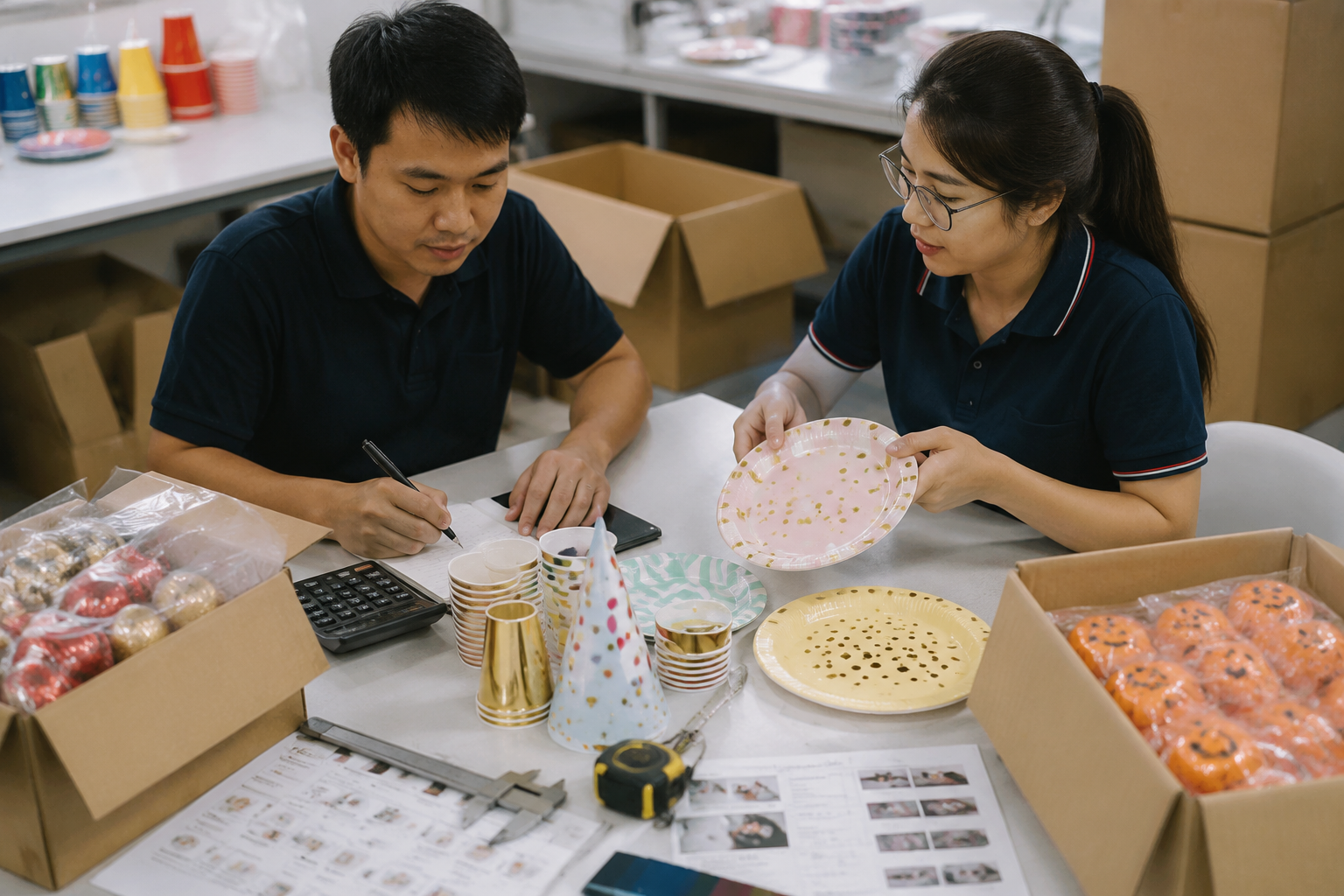
Buyer Comparison Table
| Factor | Option A | Option B | Buyer note |
|---|---|---|---|
| Forecast basis | Order from last year's total sales | Order from selling window, store count, display capacity, carton pack, and markdown risk | Last year's total can hide late arrivals, early sellouts, missing markdown records, or poor display placement. Ask stores for opening stock, sell-through before markdown, ending stock, and display space before setting this year's quantity. |
| MOQ structure | Accept one MOQ per design | Ask for MOQ by shared material, size, print plate, colorway, carton assortment, or total order value | For a small retailer, 3,000 pieces of one Halloween print may be too much risk. Ask for 500, 1,000, and 2,000 pieces per design, and ask whether designs can share base material, molds, handles, packaging, or cartons. |
| Specification depth | Request catalog pricing | Send SKU-level specifications before price negotiation | A quote is easier to compare when each SKU includes size, material thickness or gsm, print colors, finishing, retail pack count, barcode position, inner pack, carton quantity, carton size, document needs, and required warehouse date. |
| Sample approval | Approve digital artwork only | Approve a production-equivalent sample with retail pack and barcode | Artwork approval does not prove cup rim quality, balloon stretch, gift bag handle strength, glitter shedding, kit component count, or barcode scanning on glossy packaging. |
| QC checkpoint | Check final carton count only | Use material, in-line, finished goods, and carton checks where risk justifies it | Seasonal stock has little recovery time. Catch leaking cups, weak balloon necks, poor glue, wrong warnings, missing kit parts, and incorrect carton marks before the shipment cutoff. |
| Freight plan | Compare FOB unit price only | Compare landed cost using carton dimensions, gross weight, CBM, units per carton, and arrival deadline | Many wholesale seasonal party supplies are light but bulky. A lower unit price can lose value if cartons are oversized, inner packs do not match store allocation, or air freight is needed to save the launch date. |
| Compliance file | Request documents after production | List documents and label responsibilities in the RFQ and PO | Food-contact tableware, latex balloons, children's celebration items, recycling marks, importer details, language warnings, and country-of-origin marks should be checked before packaging artwork is approved. |
Start With the Launch Date
Seasonal party supplies forecast order planning succeeds or fails against the first in-store selling date, not the holiday date. Halloween cups, Christmas gift bags, graduation balloons, Valentine's banners, and Easter decorations need to be on shelf while shoppers are still building baskets, not when stores are preparing markdowns.
The buyer's first decision is the latest acceptable warehouse date. Work backward from store delivery, receiving time, freight, customs, final inspection, production, sample approval, artwork correction, and RFQ response time. If one step slips, the selling window absorbs the damage.
Small retailers should decide early whether the order is imported custom stock, supplier catalog stock, or a mixed program. Custom seasonal party supplies give control over artwork, pack count, and retail presentation, but they also add proofing, sampling, plate or setup time, inspection files, and packaging review.
- Plan from first selling date, not holiday date.
- Put RFQ, artwork, sample, deposit, production, inspection, shipment, warehouse arrival, and store delivery on one calendar.
- Classify each SKU before quoting: core repeat, seasonal refresh, or trend-led trial.
- Request carton dimensions, gross weight, units per carton, inner pack, and CBM during quotation.
- Define inspectable tolerances for size, color, print position, pack count, barcode placement, carton marks, and quantity variance.
Selling Window
Set four dates before choosing quantity: warehouse arrival, store delivery, first selling date, and markdown date. Christmas ranges may need stores ready by early or mid-November. Graduation goods may need to land before local school shopping peaks. Summer picnic themes may need stock before weather-driven demand starts.
For imported custom goods, a planning range of 90 to 150 days is often more realistic than a short buying cycle. Allow time for quotation, artwork correction, sample review, production, inspection, export packing, freight, customs, receiving, and store allocation.
Confirm what the party supplies supplier means by lead time. Some factories count from deposit, others from final artwork approval, and others from approved physical sample. That difference can decide whether the order launches on time or arrives into markdowns.
Choose the reorder strategy before approving MOQ. If production plus freight plus receiving takes longer than the remaining season, the opening order carries almost all demand risk. For evergreen birthday colors or generic congratulations ranges, smaller opening orders with planned reorders may work better.
- Set warehouse arrival 2 to 4 weeks before store launch where possible.
- Do not plan a seasonal reorder unless production, shipping, and receiving fit inside the remaining selling window.
- Use the markdown date to judge leftover risk before accepting a high MOQ.
- Add buffer for first-time artwork, new packaging, foil finishes, shaped items, and multi-component kits.
- Ask whether quoted lead time starts after deposit, artwork approval, or sample approval.
Seasonal Party Supplies MOQ Risk
Seasonal party supplies MOQ should be judged by leftover value, not only by unit price. Core repeat items, such as solid-color balloons, plain table covers, metallic banners, and standard gift bags, may be usable after the season. Dated graduation prints, year-specific designs, and narrow holiday graphics usually are not.
Seasonal refresh SKUs need tighter quantity control than core basics. A Christmas paper cup in a fresh print may be low risk if the shape, pack count, and price point are proven. A very specific phrase, unusual palette, or large decoration kit should be treated as a trial unless demand is already committed.
MOQ is usually driven by process, not the buyer's shelf plan. Balloons, paper cups, gift bags, banners, and kits can each have different minimums for latex material, foil film, PE or water-based coating, paper gsm, offset printing, flexo printing, screen printing, heat transfer, foil stamping, molds, handles, or component sourcing.
A tight coordinated range often beats a wide shallow range. Too many designs create more barcodes, cartons, proofing rounds, pick lines, and allocation work while giving each SKU too little shelf presence.
- Mark each SKU as core repeat, seasonal refresh, or trend-led.
- Ask whether MOQ applies per item, design, color, print plate, carton assortment, or total order.
- Request quote breaks such as 500, 1,000, 2,000, and 5,000 units where the product type allows.
- Ask whether designs can share base material, size, mold, handle, packaging, print setup, or carton.
- Use conservative quantities for year-specific artwork unless demand is committed.
Quantity Logic for Small Retailers
Build the order from store reality: store count, display capacity, expected display turns, selling weeks, carton pack, and safety stock. Sales history is useful, but only after adjusting for stockouts, late arrivals, markdowns, display space, and last year's assortment changes.
A simple Halloween cup example: 20 stores x 12 packs on display x 3 expected turns equals 720 packs. If the export carton holds 48 packs, the buyer rounds to 15 cartons before adding or removing safety stock. A proven design may justify 10% to 15% buffer; a narrow print with no reorder window may not.
Adjust the formula by product behavior. Gift bags are bulky and size-sensitive, so slow turns and freight cost matter. Balloons are compact and can work well as small hanging packs or color assortments. Decoration kits need component checks and may take more warehouse space than their unit price suggests.
Distributors should separate committed customer demand from speculative seasonal stock. Generic colors, birthday shades, gold, silver, black, white, red, and non-year-specific congratulations designs are safer for speculative stock than narrow dated artwork.
- Forecast by store count, shelf facings, display turns, selling weeks, carton pack, and reorder possibility.
- Round PO quantities to full export cartons and practical inner packs.
- Use lower safety stock for dated designs, narrow event graphics, and bulky low-margin goods.
- For distributors, buy narrow seasonal prints against committed orders where possible.
- Compare the saving from a larger MOQ with the expected markdown risk.
Specification Fields
The RFQ should let the supplier quote the exact shelf-ready SKU. Item name and quantity are not enough; missing specs create revised pricing, wrong samples, late artwork questions, and inspection disputes.
For balloons, state material type, size before inflation, intended inflated diameter, color, print color, print position, one-side or two-side print, pack count, warning text, barcode, retail bag type, and destination market. For paper cups, state capacity, rim diameter, bottom diameter, height, paper gsm, coating type, food-contact requirement, print method, color reference, pack format, pack count, and carton quantity.
For gift bags, include size, paper gsm, handle type, reinforcement card, lamination, foil stamping, glitter, embossing, bottom board, hang tag, barcode, and carton pack. For decoration kits, list every component, quantity per set, material, size, pack method, and replacement rule for missing parts.
Set tolerances before production. Buyers should define acceptable size variance, color reference, print position tolerance, pack count tolerance, carton quantity tolerance, and production quantity variance. Pantone references help, but ink will look different on kraft paper, coated paper, latex, foil film, PP, PE, and non-woven material.
Treat packaging as part of the SKU. A correct product can still be unsellable if the retail pack lacks a hang hole, barcode, warning label, country-of-origin mark, importer detail, language requirement, or correct shelf orientation.
- Use SKU-level fields for material, size, print, finish, retail pack, inner pack, carton pack, barcode, carton marks, and documents.
- State whether artwork is final, editable, pending, or supplier-assisted.
- Confirm barcode size, placement, orientation, and scan quality on the real packaging surface.
- State acceptable production quantity variance where applicable.
- Keep final artwork, approved sample photos, packaging layout, and PO specification in one procurement file.
Sample Approval
Approve what the customer and store will actually receive. The sample should show product material, size, print color, finishing, retail packaging, barcode placement, warning text, carton label style, and any consumer assembly method.
Choose the right sample type. A reference sample confirms an existing size or material. A digital proof confirms artwork layout. A pre-production sample should represent the final approved product before mass production. A kit may need a packing sample showing how components are counted, folded, bagged, and placed into the retail pack.
Ask whether the sample uses the same process as bulk production. A digitally printed proof may not match offset, flexographic, screen, or heat-transfer production. Foil stamping, glitter, shaped balloons, and special paper finishes can also differ between sample and mass production.
Write approval notes as production instructions. Comments such as move barcode to lower back panel, change inner pack from 50 to 25, adjust red to approved Pantone, strengthen handle attachment, correct warning language, or reduce glitter shedding are more useful than general comments about quality.
- Approve the retail-ready pack when goods will go directly to stores.
- Check barcode scanning on glossy, curved, colored, or transparent packaging.
- Record status as approved, approved with changes, or rejected.
- Use dated photos, file names, and exact correction notes for each sample round.
- Do not release production until artwork, warnings, pack count, and barcode issues are closed.
QC Checkpoints
Choose inspection checks based on defects that would block sale, create returns, cause safety concerns, disrupt allocation, or miss the selling window. Seasonal party goods leave little time for sorting and replacement after arrival.
Printed balloons need checks for pinholes, weak sealing, poor elasticity, odor, print smearing, wrong size, incorrect color, and wrong pack count. Practical checks include inflation sampling, print review, weight or thickness comparison, pack count verification, and warning label review.
Paper cups need checks for leaking seams, poor rim forming, unstable stacking, wrong capacity, odor, print rub-off, and missing food-contact support. Use water leakage testing, capacity checks, rim and bottom measurement, print rub testing, and carton count verification.
Gift bags, banners, tissue decorations, and kits need different attention. Check weak handles, poor glue, tearing at folds, bent corners, loose glitter, foil defects, color mismatch, missing accessories, and incorrect kit count. A kit sold as a complete party set should be inspected as a set.
Put timing into the PO or quality file. Incoming material checks can catch wrong gsm, film thickness, or color before production. In-line checks catch print, glue, or assembly problems while correction is still possible. Final inspection confirms finished goods against the approved sample, PO, artwork, and packing list.
- Use inflation checks for balloons, leakage checks for cups, handle strength checks for gift bags, and component counting for kits.
- Check carton marks for PO number, SKU, design code, quantity, carton number, gross weight, net weight, carton size, and destination.
- Define critical, major, and minor defects before inspection.
- Treat missing warnings, wrong barcode, leaking cups, and incorrect assortment as serious defects where relevant.
- Schedule inspection early enough for sorting, repair, replacement, or shipment adjustment.
Compliance and Labels
Check compliance before deposit because documents and labels can affect material choice, artwork layout, packaging space, and retail channel approval. Requirements depend on destination market, product type, age grading, food-contact status, and sales channel.
Food-contact tableware such as cups, plates, and straws may need declarations, material information, migration-related test reports, or supplier statements for the destination market. Latex balloons and children's celebration items may need warning labels and safety-related documentation.
Packaging may need recycling marks, importer details, country-of-origin marking, language-specific warnings, and channel-specific labels. Reserve space on the first artwork proof instead of trying to add these after packaging approval.
The RFQ should name the requested document, SKU, issuing party, standard or regulation reference if known, report date, and whether the document must match the exact product, exact material, or material family. For private-label orders, state who owns compliant artwork text, warnings, importer information, and market review.
- List required documents in the RFQ and PO before production starts.
- Confirm food-contact needs before selecting cup, plate, straw, or tableware material.
- Check balloon warnings, latex warnings, small-part warnings, and age guidance where applicable.
- Reserve packaging space for importer details, country-of-origin marks, recycling marks, and warnings from the first proof.
- Keep documents by SKU, artwork version, shipment lot, and supplier report reference where possible.
Cartons and Freight
Freight can change the buying decision because many party supplies are light but bulky. Gift bags, tissue decorations, hats, banners, table covers, and display packs can consume carton cube quickly. A low unit price is not useful if the item is expensive to ship, store, and allocate.
Request master carton dimensions, gross weight, net weight, units per carton, inner pack quantity, carton material, and palletization details with the quotation. CBM per SKU helps estimate LCL cost, container use, courier charges, warehouse space, and store labor.
Choose inner packs around store allocation, not only factory convenience. A carton of 500 loose units may be efficient for export but slow for receiving and picking. Inner packs of 12, 24, or 48 can reduce handling even if packaging cost rises slightly.
Let the deadline decide freight mode. Sea freight may protect margin on planned volume. Air freight can rescue a launch but may erase profit on bulky or low-priced goods. A split shipment can work when a small air quantity protects opening displays and the sea balance still has enough selling window.
- Request carton dimensions, gross weight, net weight, units per carton, inner pack, carton material, and CBM at quotation stage.
- Compare unit price with landed cost, warehouse space, and store allocation effort.
- Use inner packs that match store allocation quantities where possible.
- Specify carton marks and routing labels before production packing.
- For late stock, calculate whether air freight protects margin or only increases the loss before markdown.
RFQ Language Buyers Can Use
Send RFQs by SKU so suppliers quote the same product. A general request for best seasonal price often produces offers that cannot be compared because materials, pack counts, cartons, and documents differ.
Include the commercial decision fields: target quantity, seasonal party supplies MOQ flexibility, delivery deadline, shipment terms, destination port or warehouse country, quote validity, payment preference, sample cost, sample lead time, production lead time trigger, and whether the order is a trial, repeat, or annual program.
Include the product decision fields: item size, material, paper gsm or film thickness, print method, print colors, finishing, artwork status, retail pack, inner pack, carton pack, barcode, carton marks, document needs, sample requirement, and inspection standard.
Tell the supplier which specs are fixed and which may be adjusted. If 250 gsm gift bag paper is preferred but 230 gsm can be quoted as a cost-saving option, say so. If exact brand color is required, state that a near match is not accepted without written approval.
- Please quote by SKU with MOQ at 500, 1,000, and 2,000 pieces per design where possible, and state whether MOQ is per design, per color, per print setup, or total order.
- Please include carton dimensions, gross weight, net weight, units per carton, inner pack quantity, and CBM for each SKU with the quotation.
- Please confirm whether production lead time starts after deposit, final artwork approval, or approved pre-production sample.
- Please quote target specification, cost-saving option, and faster lead-time option if available, with material, finish, packaging, or MOQ changes clearly stated.
- Please list available compliance documents for each SKU and confirm whether packaging artwork must include importer details, country-of-origin marking, warnings, or food-contact symbols.
Buying Calendar
Use a calendar that protects the warehouse date, not one that only records the PO date. Imported custom seasonal party supplies often need 90 to 150 days when the range includes several product types, custom artwork, or retail packaging.
At 120 to 150 days before the warehouse date, review last season's opening stock, sell-through, markdown inventory, defect claims, customer requests, and display space. At 100 to 120 days, narrow the assortment and send RFQs with specifications and target quantities. At 80 to 100 days, compare quotes, MOQ options, carton data, sample costs, and document availability.
At 60 to 80 days, approve artwork and samples. At 35 to 60 days, monitor production with in-line photos or checks. At 20 to 35 days, complete final inspection, document review, packing confirmation, and freight booking according to shipment mode.
After the season, judge each SKU by evidence. Record opening stock, units sold before markdown, markdown units, ending stock, gross margin, defect rate, return reasons, store comments, carton damage, and late-arrival issues. A sellout may mean under-ordering, but it may also reflect better placement or less shelf competition.
The supplier can support quotation, sampling, production, packing, and carton planning. The buyer owns the forecast logic, SKU discipline, launch date, markdown risk, and final market requirements.
- Start custom seasonal planning 90 to 150 days before the required warehouse date where possible.
- Review sell-through and markdown data before adding new designs.
- Assign owners and due dates for RFQ, artwork, samples, deposit, production, inspection, shipment, receiving, and allocation.
- Record post-season performance by SKU so next year's forecast is based on evidence.
- Treat late arrival as a buying calendar issue, not only a freight issue.
Related Joyline Party Supply pages
- custom balloons with logo
- paper cups with logo
- bulk gift bags wholesale
- wholesale party decorations
- custom party supplies manufacturer
FAQ
How should small retailers start seasonal party supplies forecast order planning?
Start with the first in-store selling date and work backward through store delivery, warehouse arrival, freight, inspection, production, sample approval, artwork preparation, and RFQ deadline. Then calculate quantities by store count, display capacity, expected turns, selling weeks, carton pack, and whether a reorder can arrive before markdowns.
What MOQ range should small retailers expect for seasonal party supplies?
Seasonal party supplies MOQ depends on material, size, printing method, finishing, packaging, and factory setup. Custom printed balloons may require around 1,000 to 5,000 pieces per design. Custom printed paper cups may require several thousand pieces per size or design. Gift bags and decoration kits may range from hundreds to a few thousand pieces depending on paper gsm, handle type, finish, and component count. Confirm whether MOQ is per SKU, design, color, print setup, carton assortment, or total order.
What RFQ fields matter most for wholesale seasonal party supplies?
Include SKU, item size, material, gsm or thickness, print method, print colors, finishing, artwork status, retail pack, inner pack, carton quantity, barcode placement, carton dimensions, gross weight, CBM, document needs, inspection standard, sample requirement, delivery deadline, shipment terms, and destination market.
Is a physical sample necessary before ordering custom seasonal party supplies?
For first orders, private-label artwork, food-contact items, retail packaging, and multi-component kits, a physical or pre-production sample is strongly recommended. It should confirm material, size, print color, finishing, packaging, barcode placement, warning labels, pack count, and carton label style. Repeat SKUs with unchanged artwork may use production photos in some cases, but that increases reliance on the previous approved file.
What defects should buyers watch for in seasonal party goods?
Common defects include leaking paper cups, weak gift bag handles, poor glue on paper decorations, balloon pinholes, print smearing, wrong color, missing kit components, incorrect barcode, weak retail packaging, wrong pack count, and wrong carton marks. Inspection should use the approved sample, signed artwork, PO specification, packing list, and written tolerance fields.
What should I ask a party supplies supplier before placing a seasonal order?
Ask how MOQ is calculated, when production lead time starts, which materials and print methods will be used, whether carton dimensions and CBM are confirmed, which compliance documents are available, whether packaging artwork needs warnings or importer details, and whether the supplier can provide a production-equivalent sample before mass production.
Ready to quote this project?
Send specs, quantity, customization needs, destination, and deadline.
Request a quote