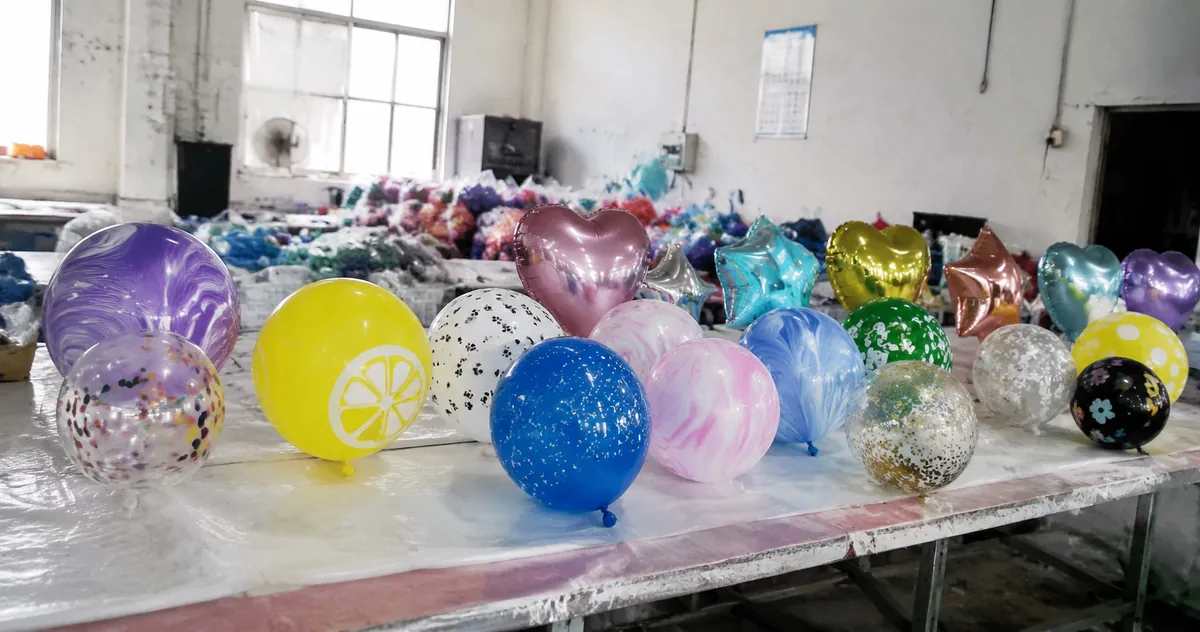
Material Choice Defines Your Product
The balloon material you choose determines print method, unit cost, shelf life, environmental claims, and which factory can produce it. Most Chinese manufacturers specialize in one material family — latex or foil — with only larger factories covering both. This guide compares the four main balloon materials produced in Zhejiang and Guangdong factories.
Latex: The Volume Workhorse
Natural latex rubber, harvested from Hevea brasiliensis trees in Southeast Asia, is the most common balloon material. Chinese factories import latex in liquid form and manufacture balloons through a dipping process: ceramic or metal molds are dipped into compounded latex, dried, vulcanized, and stripped.
Cost: Lowest unit cost of all balloon types. A standard 11-inch printed latex balloon costs roughly $0.03–0.08 FOB, depending on print colors and quantity.
Print method: Screen printing, 1–4 colors. Ink sits on the surface and stretches with the balloon.
Float time (helium): 8–12 hours for standard latex; up to 24 hours with Hi-Float treatment.
Biodegradability: Natural latex is biodegradable — it decomposes at roughly the same rate as an oak leaf. This is a marketable environmental claim if your buyers care about it.
Limitations: Latex allergies affect roughly 1–6% of the population. Not suitable for environments where latex allergy is a concern. Oxidizes and becomes brittle over 6–12 months of shelf storage in hot climates.
Foil (BOPP/Nylon Film): The Premium Look
Foil balloons use biaxially oriented polypropylene (BOPP) or nylon film with a vacuum-deposited metallic layer. They are manufactured by heat-sealing two shaped film sheets together, with a self-sealing valve for inflation.
Cost: Higher than latex. A standard 18-inch foil shape costs roughly $0.15–0.40 FOB, depending on shape complexity and print.
Print method: Heat transfer or pre-printed film lamination. The design is applied to the film before the balloon is cut and sealed.
Float time (helium): 3–7 days — the key selling point over latex.
Reusability: Can be deflated (using a straw in the valve) and re-inflated multiple times.
Limitations: Not biodegradable. Higher minimum order quantity due to die-cutting tooling. Shape complexity affects unit cost more than with latex.
Mylar: A Subset of Foil
Mylar is a brand name (DuPont) for polyester film, but in the balloon industry it's used generically for metallic-looking foil balloons. Most Chinese factories use BOPP, not true Mylar-brand polyester. The terms are interchangeable for sourcing purposes — specify the shape, size, and metallic finish rather than the chemistry.
PVC Bubble/Bobo: The Premium Novelty
Stretch PVC clear balloons, typically 18–24 inches. Manufactured from transparent PVC film, heat-sealed and inflated. These are a growing category for premium events, with LED inserts and layered printed designs inside the clear bubble.
Cost: Highest unit cost — $0.50–1.50 FOB depending on size and inclusions.
Print method: Designs are typically printed on an inner film or inserted as confetti/decor.
Float time: 1–3 days with helium; often used air-filled as decor.
Limitations: PVC environmental concerns are growing in EU markets. Heavier than latex/foil, so shipping costs more per unit.
How to Choose: Decision Matrix
| Factor | Latex | Foil/Mylar | PVC Bubble |
|---|---|---|---|
| Unit cost | $0.03–0.08 | $0.15–0.40 | $0.50–1.50 |
| MOQ | 3,000 pcs | 2,000–10,000 pcs | 1,000–3,000 pcs |
| Print colors | 1–4 screen | Full-color heat transfer | Inserts/decor |
| Float time | 8–12 hours | 3–7 days | 1–3 days |
| Biodegradable | Yes | No | No |
| Custom shapes | Limited (round) | Die-cut any shape | Round/oval |
| Best for | Volume, value, eco claims | Premium, events, long float | Luxury events, social media |
Factory Selection by Material
Latex balloon factories cluster in Zhejiang province (Yiwu, Wenzhou, Taizhou). Foil balloon production is split between Zhejiang and Guangdong (Shenzhen, Dongguan). If your program requires both latex and foil, look for a factory or trading partner that coordinates across both — few factories do both materials in-house.
When requesting quotes, always specify material type in the first inquiry. A latex factory cannot quote foil, and vice versa. Sending a mixed-material RFQ to a single-material factory wastes a week of back-and-forth.