Why Source Custom Balloons from China?
China manufactures an estimated 70–80% of the world's party balloons. Zhejiang province alone hosts hundreds of balloon factories, from small workshops to export-grade manufacturers with EN71 and ASTM F963 testing capabilities. For a wholesale buyer, the price advantage over domestic suppliers typically ranges from 40–60% on like-for-like specs, even after freight and duties.
But price is only half the story. Chinese balloon factories offer customization depth that most Western distributors cannot match: full-wrap 360° printing, Pantone color matching, custom die-cut foil shapes, confetti-filled balloons, LED balloons, and coordinated multi-SKU collections across balloons, tableware, and decorations.
This guide walks through the sourcing process from first inquiry to shipment, with practical benchmarks for MOQ, lead time, printing, and compliance.
Balloon Types: What Chinese Factories Actually Produce
Most Chinese balloon factories specialize in one or two categories. Understanding which factory makes what saves you weeks of misdirected inquiries.
Latex Balloons
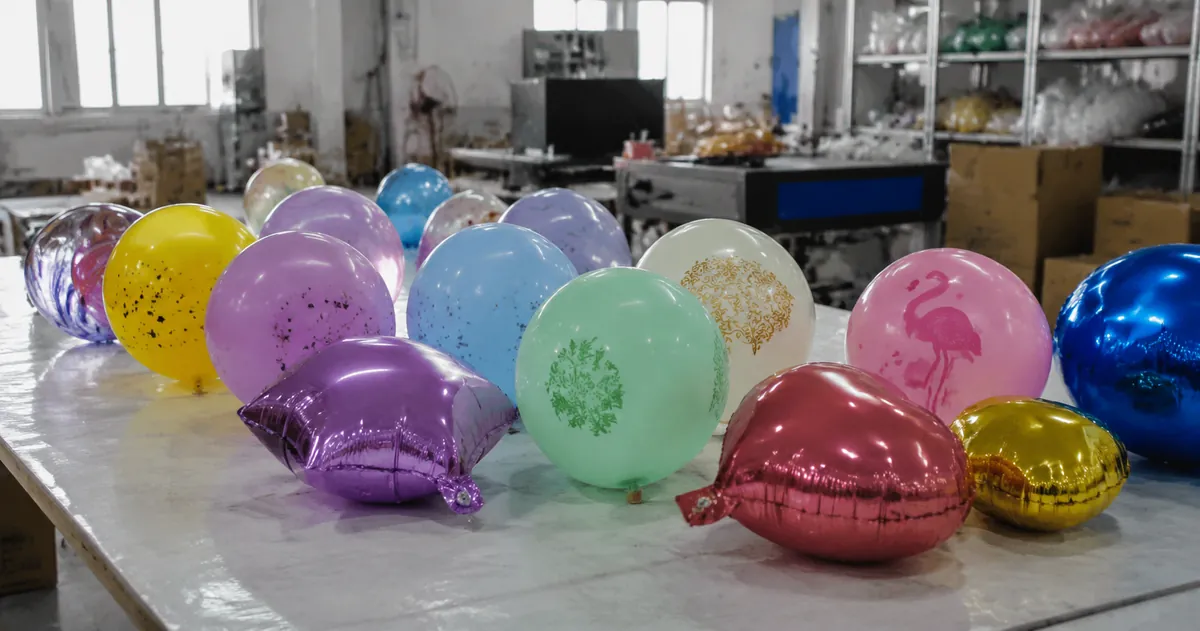
The workhorse category. Chinese latex balloons use 100% natural latex from rubber plantations in Southeast Asia. Standard sizes range from 5-inch to 36-inch. Helium-grade means the balloon floats for 8–12 hours — critical for retail and event buyers. Factories offer standard, metallic, pastel, agate/marble, and crystal clear finishes. Most screen-print 1–4 colors, and some offer 360° full-wrap printing on 11-inch and 12-inch balloons.
Foil & Mylar Balloons
Foil balloons use BOPP/nylon film with a metallic coating. Common formats are 18-inch shapes (star, heart, circle, animal), 16-inch and 32-inch number and letter foils, and custom die-cut shapes. Printing on foil is typically heat-transfer or pre-printed film lamination — not screen printing. MOQs for custom foil shapes are higher than latex because of the die-cutting tooling cost.
Specialty Types
- Confetti Balloons: Clear latex pre-filled with tissue or mylar confetti. Premium retail pack item with high perceived value.
- Bobo/Bubble Balloons: 18–24 inch stretch PVC clear balloons. Popular for layered prints and LED inserts. Higher unit cost, premium positioning.
- LED Balloons: Standard latex with a replaceable button-cell LED unit inserted. Night event item with strong seasonal demand.
- Garland Kits: Assorted-size balloon arch and garland kits in retail-ready pack counts. Growing category for DIY party market.
Printing Methods for Custom Balloons
Screen printing is the standard for latex balloons — a mesh screen transfers ink directly onto the inflated balloon surface, one color per pass. Most factories support 1–4 color screen print. Full-wrap and 360° printing requires the balloon to be printed on a rotating mandrel, which limits the printable size range (typically 11–12 inch).
For foil balloons, heat transfer printing applies a pre-printed design onto the foil surface. Digital printing on foil is emerging for short runs but is not yet standard in Chinese factories.
Key specs to include in your RFQ: artwork format (AI/EPS/PDF vector preferred), Pantone colors, print placement (one side, two sides, full-wrap), and ink type (standard or food-safe).
MOQ Benchmarks and Cost Levers
Indicative MOQs from Chinese balloon factories (always confirmed per spec):
- Latex balloons, screen-printed: From 3,000 pieces per design
- Foil number/letter balloons: From 2,000–5,000 pieces per design
- Custom die-cut foil shapes: From 10,000 pieces (tooling amortization)
- Confetti/LED/Bobo balloons: From 1,000–3,000 pieces
Cost levers that affect unit price: print color count (each additional color adds roughly $0.01–0.03/unit), balloon size (latex price roughly doubles from 5-inch to 36-inch), packaging format (polybag bulk is cheapest; retail box adds $0.05–0.15/unit), and order volume (MOQ vs. 50,000+ pieces can swing unit price 20–40%).
Sampling: The Non-Negotiable Step
Never skip sampling on custom balloons. Sample lead time is typically 7–10 days after artwork approval. The sample fee (usually $50–150 depending on complexity) is refundable against the bulk order. What to check on samples: color accuracy vs. Pantone reference, print registration (alignment of multi-color prints), balloon inflation quality (no thin spots, even shape), and packaging quality if retail-ready.
Compliance for US and EU Markets
Ask the factory to arrange third-party testing through an accredited lab (SGS, Intertek, TÜV, BV). Key standards:
- EN 71-1/2/3: Toy safety for EU market — covers mechanical, flammability, and chemical migration
- ASTM F963: Toy safety for US market
- REACH: EU chemical substances regulation
- CPSIA: US children's product safety (if balloons are marketed as children's items)
A reputable factory will provide existing test reports or arrange new testing at cost. Test reports are typically valid for 1–2 years per product line.
Shipping and Logistics
Standard terms are FOB Ningbo or Shanghai. Sea freight to US West Coast is roughly 18–25 days; to Europe 25–35 days. Air freight is viable for urgent smaller orders but typically 4–6× the sea freight cost. Express (DHL/UPS/FedEx) works for samples and small orders under 30 kg.
A 20-foot container holds roughly 800–1,200 cartons of packaged balloons, depending on balloon size and packaging format. Factor roughly $0.02–0.05/unit for sea freight and duties on standard latex balloon imports.
Checklist: What to Send in Your First RFQ
- Balloon type (latex, foil, specialty)
- Sizes and quantities per size
- Artwork files or description
- Number of print colors and Pantone references
- Packaging format (bulk, retail, gift box)
- Destination country (for compliance requirements)
- Target delivery date
- Any reference photos of desired look
A complete RFQ typically gets a detailed quote within 1–2 business days from a responsive factory.