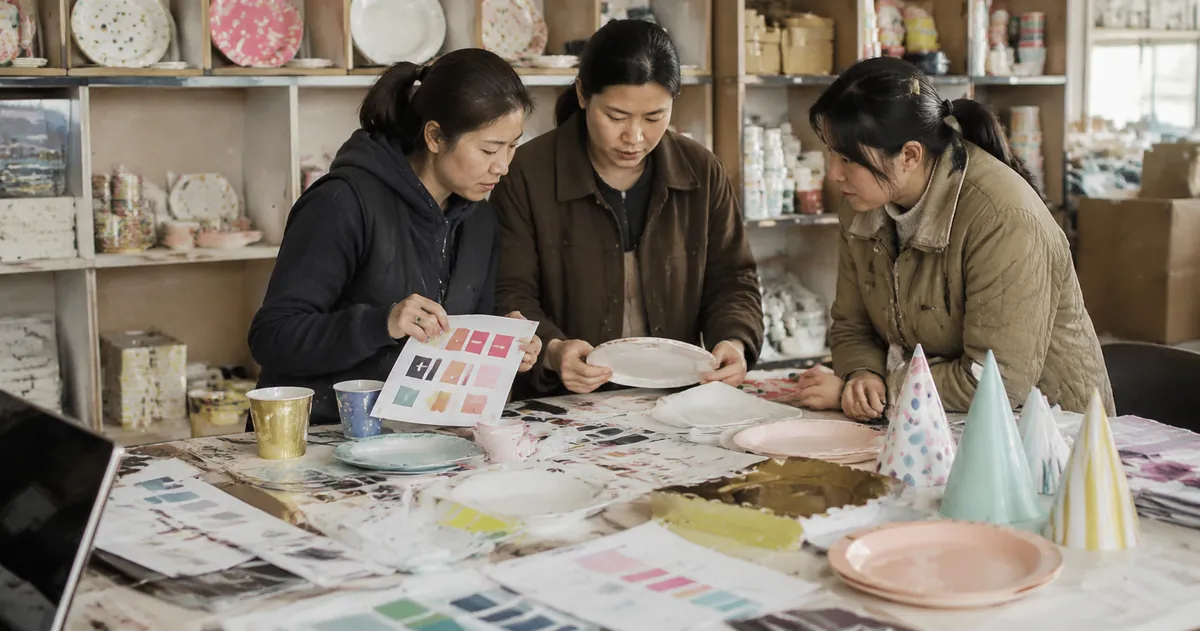
Buying Brief for OEM party supplies
A dependable OEM party supplies program starts by defining the sellable unit before comparing suppliers. Choose OEM when production follows a buyer-owned specification and ODM when the supplier contributes product development, while defining ownership and approval boundaries in both models.
Private-label development works best when artwork ownership, approvals, packaging data, testing responsibility, and change control are agreed before sampling. Name the selling channel, destination market, expected order quantity, and final pack contents so the factory can expose assumptions before sampling.
Core Specification
| Decision | What to define in the RFQ |
|---|---|
| Design input | List which party supplies are buyer-designed, supplier-designed, or adapted. |
| Ownership | State rights to artwork, molds, dielines, and samples. |
| Changes | Require written approval for material and construction substitutions. |
| Exclusivity | Document market, term, volume, and design scope where applicable. |
How to Approve Each Decision
Design input
List which party supplies are buyer-designed, supplier-designed, or adapted. Ask for a sample or measurement that proves the proposed design input is suitable for OEM party supplies.
Ownership
State rights to artwork, molds, dielines, and samples. Record the result beside the artwork and sample version used for OEM party supplies.
Changes
Require written approval for material and construction substitutions. Confirm who supplies, approves, and pays for any component affected by the changes choice.
Exclusivity
Document market, term, volume, and design scope where applicable. Suppliers should identify any tolerance, stock limitation, or cost change connected with this exclusivity decision.
Sample Plan
Ask the supplier to show design input, ownership, changes, exclusivity in the OEM party supplies sample set. Mark any permitted variance, because an unlabeled sample cannot settle a later disagreement about oem and odm labels are often used loosely in quotations.
Quality Risks and Controls
- Do not leave this as a general quality expectation. Define evidence that shows whether oem and odm labels are often used loosely in quotations.
- Use batch records, measurements, or functional tests to reduce the chance that supplier-developed artwork may not be exclusive by default.
- Inspect this point both before packing and on finished sellable units: Tooling payment does not automatically define ownership.
Classify the resulting checks as critical, major, or minor and agree the random sample plan before production. Where OEM party supplies includes several components, inspect the parts, the assembled result, and the finished retail pack.
Commercial and Timeline Questions
Tie the OEM party supplies schedule to artwork approval, sample sign-off, materials, bulk production, packing, and inspection. A change to design input, ownership, changes, exclusivity should trigger a written schedule update.
Request written confirmation for sample charges, tooling ownership, payment terms, carton quantity, shipment term, quality inspection, and the remedy for nonconforming goods. These terms should refer to the same approved specification used by production.
RFQ Details to Send
- Design input: List which party supplies are buyer-designed, supplier-designed, or adapted.
- Ownership: State rights to artwork, molds, dielines, and samples.
- Changes: Require written approval for material and construction substitutions.
- Exclusivity: Document market, term, volume, and design scope where applicable.
- Order profile: Quantity by variant, destination, required arrival date, Incoterm, and planned sales channel.
- Approval package: Editable artwork, color references, packaging copy, barcode data, reference images, and test or inspection needs.
Related Sourcing Pages
Continue with our custom printing and private-label options and custom party supplies. When your specification is ready, send the quantities, artwork, packaging needs, and destination market for a factory quotation.