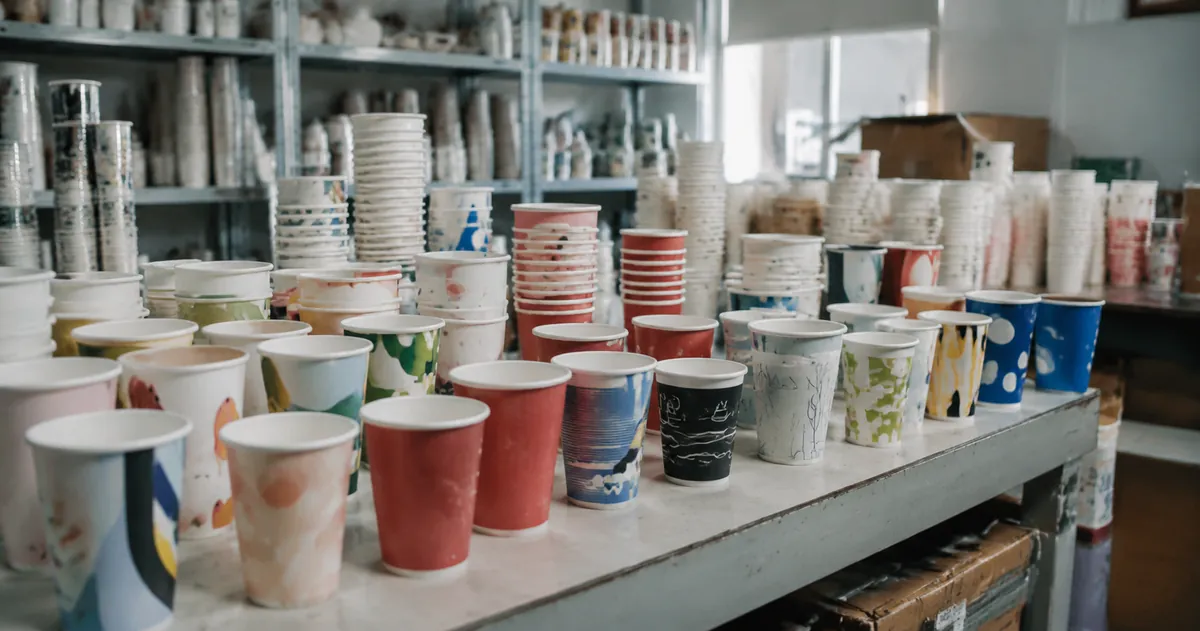
Paper Cups Are High-Volume Brand Carriers
A printed paper cup is a mobile billboard — every coffee shop customer, event attendee, and office worker carrying your client's branded cup is advertising for the cost of the cup. For wholesale buyers, this makes paper cups with logos one of the highest-ROI custom products in the party and foodservice supply chain.
This guide covers the technical side of sourcing custom printed paper cups from Chinese factories, with practical benchmarks for MOQ, printing, materials, and food safety compliance.
Cup Types and Construction
Single-Wall Cups
The standard. A single layer of PE-coated paper, formed into a cup with a bottom disc and curled rim. Sizes range from 4oz (espresso) to 22oz (large soft drink). Suitable for cold drinks and hot drinks with a separate sleeve. Lowest unit cost.
Double-Wall Cups
Two layers of paper with an air gap between them — the outer wall stays cool with hot contents, eliminating the need for a sleeve. 8oz and 12oz are the standard sizes for coffee service. Higher unit cost but better user experience and branding surface (both walls printable).
Ripple-Wall Cups
A textured outer layer (corrugated/waffle pattern) for insulation and grip. Premium coffee shop standard. Higher MOQ and cost than double-wall.
Printing Methods: Flexo vs. Offset
Flexographic Printing
The workhorse of cup printing. Uses flexible photopolymer plates wrapped around rotating cylinders, one plate per color. Best for: 1–6 spot colors, repeat patterns, logos with solid color blocks. Cost-effective for high volumes because plates last for millions of impressions. Limitation: not suitable for photographic images or fine gradients.
Offset Printing
Transfers ink from a plate to a rubber blanket to the cup surface. Best for: full-color CMYK designs, photographic images, fine details, and gradients. Higher setup cost than flexo but better print quality for complex artwork. Limitation: higher MOQ to amortize plate costs.
Decision rule: If your design is a logo + 1–3 solid colors, choose flexo. If it's a full-color photo or illustration, choose offset. If you're unsure, send the artwork to the factory and ask them to recommend — they will.
Materials and Food Safety
Paper cups for food contact use PE (polyethylene) coating on the inner surface to prevent liquid absorption. PE is FDA-approved for food contact and is the global standard. PLA (polylactic acid) coating is available as a compostable alternative but is less common, more expensive, and requires industrial composting facilities.
Key compliance points to verify with the factory:
- FDA 21 CFR 176.170: US food contact for paper and paperboard
- EU 1935/2004: EU framework regulation for food contact materials
- LFGB: German food contact standard (often requested by EU buyers)
Ask for migration test reports — these verify that no harmful substances migrate from the cup into the beverage under normal use conditions.
MOQ Benchmarks
- Single-wall printed cups: From 10,000 pieces per design (some factories accept 5,000 for simple designs)
- Double-wall printed cups: From 10,000–20,000 pieces
- Ripple-wall cups: From 20,000–50,000 pieces
Unit cost for a standard 12oz single-wall cup with 1-color logo print: roughly $0.02–0.05 FOB depending on quantity. Double-wall roughly doubles the unit cost. Full-color offset print adds roughly 20–40% over flexo.
Artwork Specifications
Send these specs for accurate cup printing:
- Vector artwork (AI, EPS, PDF) with fonts converted to outlines
- Pantone (PMS) color references for spot colors; CMYK values for process color
- Print area dimensions — cups are printed on the flat paper before forming, so the printable area is a rectangle with curved top and bottom margins to account for rim curl and bottom seam
- Bleed: 3mm beyond the print area boundary
- Design placement: single-side, double-side, or full-wrap (360°)
The factory provides a die-line template showing the exact printable area for each cup size. Always request this before finalizing artwork.
Coordinated Tableware Programs
Many wholesale buyers order cups as part of a coordinated program with matching plates, napkins, and straws. This is the highest-value approach because retailers pay a premium for matched sets and the factory can coordinate print across all items to ensure color consistency. If you are sourcing cups alone, ask whether adding plates and napkins to the same PO would reduce per-unit costs through consolidated production.