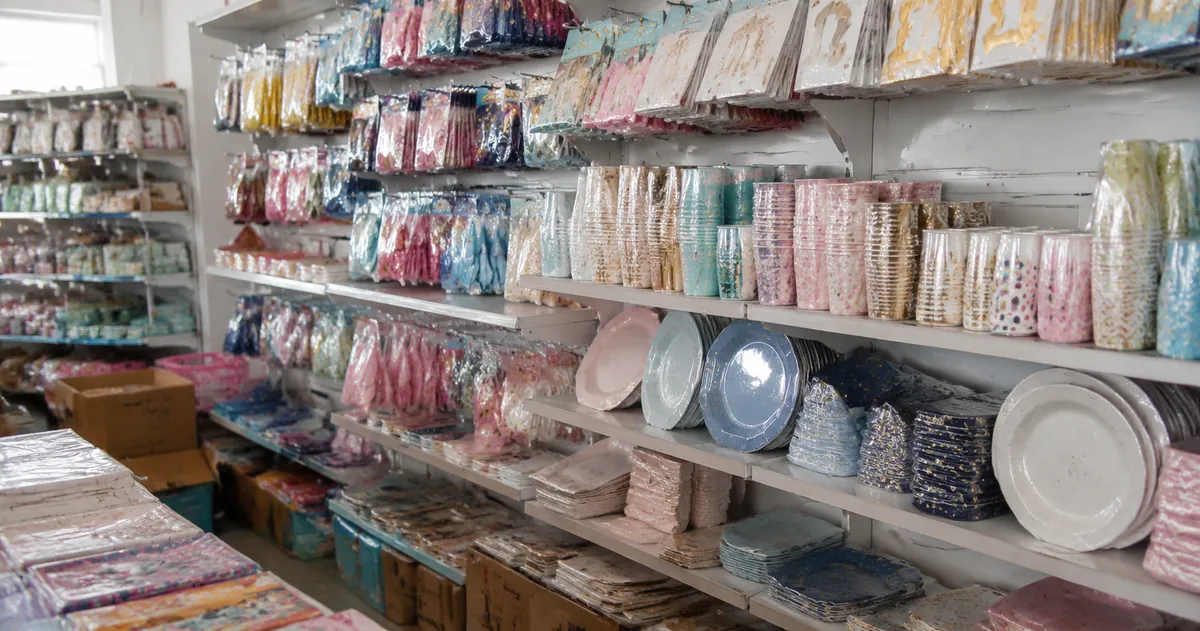
A Six-Category Product Family
A party supply wholesale program typically spans four to six product categories. The operational advantage of sourcing these from a coordinated Chinese factory partner — rather than five separate suppliers — is significant: consistent color matching across categories, consolidated shipping, one set of compliance documents, and one relationship to manage.
This guide walks through building a wholesale party supply program for import, covering product selection, supplier evaluation, quality benchmarks, and logistics.
Product Category Map
1. Balloons
The anchor category for most programs. Latex balloons in standard and metallic finishes are the volume driver; foil number and letter balloons are the margin driver; confetti, LED, and bobo balloons are the novelty differentiator. A well-structured balloon program has 3–5 latex colorways, 2–3 foil SKUs, and 1–2 novelty items.
2. Paper Tableware
Cups, plates, napkins, and straws in coordinated designs. This category has the highest SKU count per theme (4–8 items) and the highest MOQ per item (typically 10,000 pieces). The margin is lower than balloons but the repeat order rate is higher — retailers restock tableware more often than balloons.
3. Party Decorations
Bunting banners, backdrop boards, hanging decorations (pom-poms, honeycomb balls, tissue fans), and letter banners. Higher perceived value than tableware, lower MOQ (500–2,000 pieces), and strong seasonal spikes for Halloween, Christmas, New Year, and graduation.
4. Gift & Favor Bags
Kraft and printed paper bags, favor bags, and euro totes. This category bridges party and general retail — the same bag SKU sells for party and everyday gifting. Handles, print, and paper weight are the key spec dimensions.
5. Custom/Private Label
Any of the above categories with buyer-specific artwork, branding, and packaging. This is where the margin lives for most importers — a private-label balloon set retails for 3–5× the equivalent generic product.
6. Coordinated Collections
The full-program play: balloons, tableware, decorations, and gift bags in one matching theme. Retailers love these because they sell as a complete party solution. Factories love them because they consolidate production planning.
Supplier Evaluation Checklist
When evaluating a Chinese party supply manufacturer, verify these points before committing to samples:
- Product range overlap: Does the factory actually produce your target categories, or will they outsource? Direct production means better quality control and pricing.
- Print capabilities: Can they handle the print methods your designs require? Screen print for balloons, flexo/offset for paper, dye-sub for fabric — few factories do all three.
- Compliance track record: Have they shipped to your target market before? Ask for existing EN71/ASTM/REACH test reports.
- Sampling speed: 7–14 days is standard. Faster is possible but may indicate they're skipping steps.
- Communication quality: Do responses address every point in your RFQ, or do they give partial answers? Partial answers mean you'll spend more time chasing details.
The Import Timeline
Plan on this timeline for a first-time program:
- Week 1–2: RFQ and quotation — send specs, receive pricing
- Week 3–4: Artwork finalization and sample production
- Week 5–6: Sample approval and revisions
- Week 7–12: Bulk production (20–40 days depending on scope)
- Week 13–17: Sea freight and customs clearance (18–30 days depending on destination)
- Week 17–18: Warehouse receipt and distribution
Total: roughly 4–4.5 months from first RFQ to product in warehouse. Rush programs can compress this to 10–12 weeks by air-freighting samples and overlapping artwork approval with production planning, but this increases cost and risk.
Cost Structure Transparency
A typical party supply import program breaks down roughly as:
- 50–65%: Product FOB cost
- 10–15%: Sea freight and insurance
- 5–10%: Import duties and customs brokerage
- 10–15%: Domestic logistics and warehousing
- 10–15%: Your margin (wholesale); 40–60% (retail)
Product FOB is the most controllable cost. Every additional print color, packaging upgrade, or compliance test adds to it — be intentional about which upgrades your market will pay for.
Program Planning by Season
Party supplies are seasonal. Plan production 4–5 months ahead of the retail season:
- Christmas/Holiday: Order by July; ship August–September
- Halloween: Order by May; ship June–July
- Graduation (US): Order by January; ship February–March
- Summer/Outdoor: Order by February; ship March–April
- Everyday/Birthday: Year-round; plan quarterly replenishment
Late orders mean air freight, which can eat 20–40% of your margin. Early orders tie up cash in inventory but protect margin.