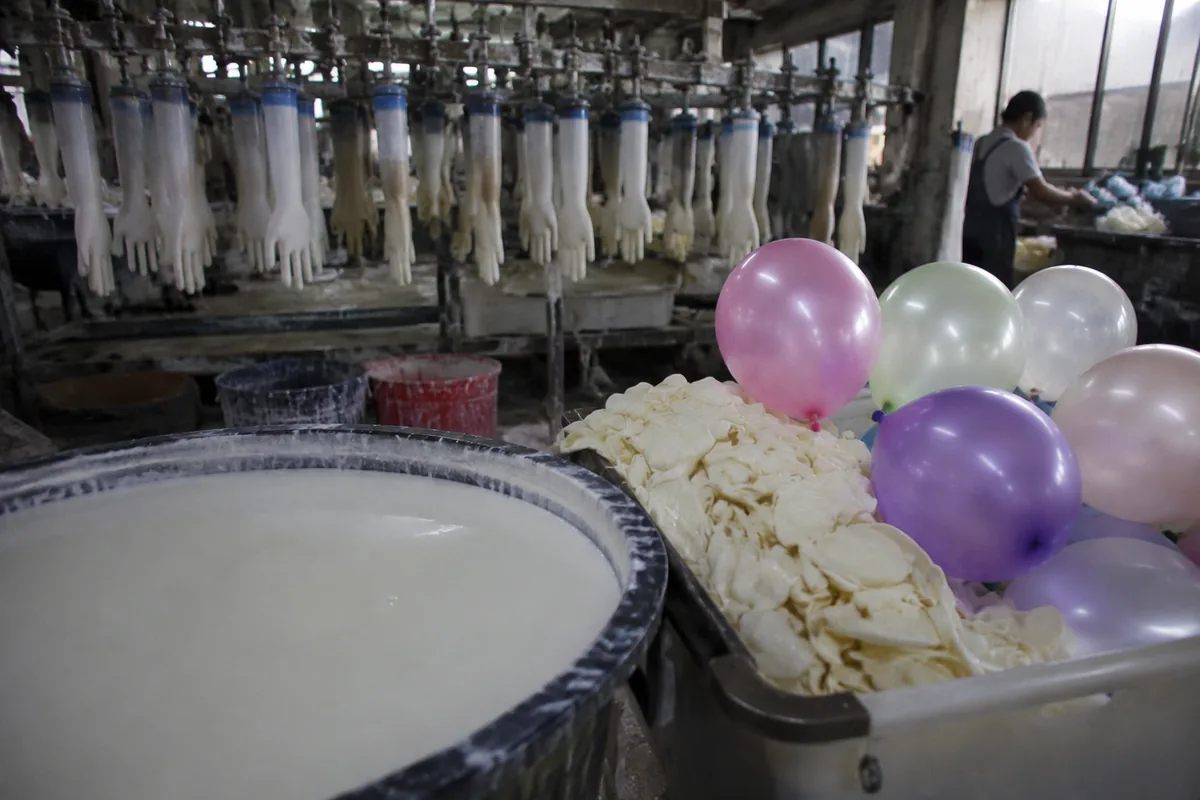
Natural latex rubber, harvested from Hevea brasiliensis trees in Southeast Asia, is the primary material for party balloons. Chinese factories import concentrated latex (60% rubber content) and compound it with vulcanizing agents, accelerators, antioxidants, and pigments before the dipping process.
Key Properties
| Composition | Natural cis-1,4-polyisoprene (rubber hydrocarbon) |
|---|
| Density | 0.92–0.96 g/cm³ |
|---|
| Elongation at break | 500–900% (excellent elasticity) |
|---|
| Tensile strength | 20–30 MPa |
|---|
| Glass transition temp | Approximately -70°C (remains flexible at low temperatures) |
|---|
| Biodegradability | Biodegrades under composting conditions at rate comparable to oak leaf |
|---|
| Shelf life | Approximately 12 months (cool, dry storage); oxidizes over time |
|---|
| Allergen note | Natural latex proteins may cause allergic reactions in 1–6% of population |
|---|
Grades & Variants
| Standard latex | General-purpose balloon production; standard colors and opacity |
|---|
| High-clarity latex | Lower pigment loading for crystal/clear balloons; used for confetti balloons |
|---|
| Helium-grade latex | Formulated for lower gas permeability; 8–12 hour float time |
|---|
| Metallic-effect latex | Pearlescent pigment additive for metallic finish balloons |
|---|
Compatible Processes
- Screen printing (1–4 colors)
- Dipping process
- Vulcanization
- Hi-Float treatment